

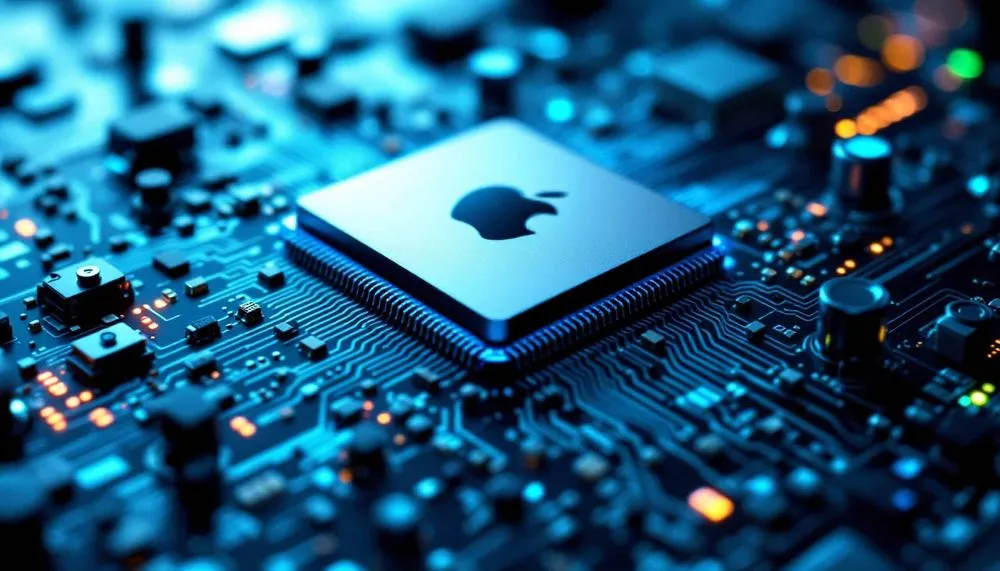
ETNews reports that Apple has begun mass production of its next-generation "M5" chip. The M5 adopts TSMC's 3nm "N3P" process, which offers improved performance and power efficiency, and significantly enhances AI capabilities. It is expected to be featured in the new iPad Pro, new MacBook Pro, and other devices.
Adopting TSMC's Latest 3nm "N3P" Process, Strengthening AI Performance
South Korea's ETNews reports, citing information from industry sources, that Apple began the packaging process for the M5 chip last month. Packaging is the final stage of chip manufacturing and serves as a key indicator that mass production has begun. Initial production is focused on the standard M5 chip model, with mass production of higher-performance variants such as the M5 Pro, Max, and Ultra planned to follow.
The M5 is likely to be the first chip manufactured using TSMC's latest 3nm process, "N3P." Compared to the previous-generation N3E, N3P is said to offer up to 10% improved power efficiency and a 5% performance boost. In particular, the improvement in power efficiency could contribute to longer battery life and more compact device designs.
Notably, the M5 significantly enhances AI capabilities. It is said to feature a more powerful Neural Engine, enabling advanced generative AI functions to run directly on the device.
The M5 chip is expected to first appear in the new iPad Pro, with a release window predicted for late 2025 through early 2026. It is then reported to be adopted in new 14-inch/16-inch MacBook Pro models.
Innovation in Chip Design: Adoption of SoIC-mH Packaging Technology
The M5 chip also brings significant changes to chip design. Of particular note is the adoption of TSMC's latest chip packaging process, called "SoIC-mH (System-in-Integrated-Chips-Molding-Horizontal)."
SoIC-mH vertically stacks semiconductor chips to improve thermal management, reduce current leakage, and enhance electrical performance. This should allow the M5 chip's performance to be maximized, especially in the iPad Pro, which is expected to maintain a thin design.
It has also been pointed out that models above the M5 Pro may adopt a multi-chiplet design that separates the CPU and GPU. This could be expected to improve manufacturing yield.
Furthermore, femtosecond laser technology will be applied for the first time to the cutting (grooving) of the M5 chip. This is said to minimize damage and contamination to the semiconductor, improving both quality and yield.
XenoSpectrum's Take
The news of Apple beginning mass production of the M5 chip shows that the company is focusing not only on performance improvements but also on strengthening AI capabilities and adopting innovative packaging technologies in its semiconductor development.
In particular, the adoption of SoIC-mH packaging technology could have a major impact on the design of future Apple products. Beyond contributing to thinner, higher-performance devices, it will likely also pave the way for more complex chip designs down the line.
The M5 chip is set to play a crucial role not only in elevating the performance of Apple devices to a new level, but also in accelerating the evolution of AI-centered user experiences. Future product rollouts will be worth watching closely.
Source