
サイエンス
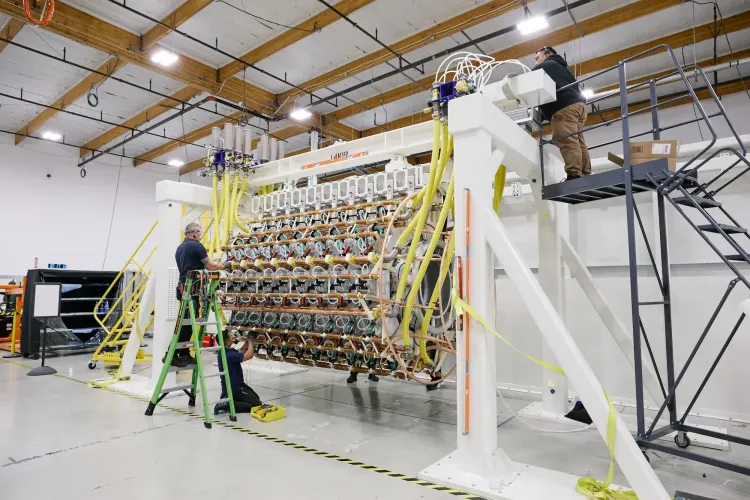
Pacific Fusion、80ナノ秒で440GWを放つ核融合パルサー試作機を検証
Pacific Fusionは核融合燃料を圧縮する電源モジュールの試作機を検証し、実証施設建設の節目となる約440GWのピーク出力を達成した。この成果は技術的な進捗を資金調達と連動させるマイルストーンとなり、次段階の実物大装置開発を加速させる。

カリフォルニア州を拠点とする核融合エネルギーのスタートアップ。パルス駆動型慣性閉じ込め核融合(ICF)を採用し、外部レーザーや磁場コイルを排除した低コストな核融合炉の開発を目指している。2030年までにネット・ファシリティ・ゲインの達成を目標としている。
Pacific Fusionは核融合燃料を圧縮する電源モジュールの試作機を検証し、実証施設建設の節目となる約440GWのピーク出力を達成した。この成果は技術的な進捗を資金調達と連動させるマイルストーンとなり、次段階の実物大装置開発を加速させる。

実現すれば人類の抱えるエネルギー問題を解決するとされる核融合発電において、最大の懸念事項は常に「コスト」であった。いかにして、反応を開始させるための莫大なエネルギーコストを、売電価格よりも低く抑えるか。この難題に対し、カ […]

カナダを拠点とする核融合スタートアップの雄、General Fusionが深刻な資金難に直面している。20年以上にわたり商業用核融合炉の実現を目指してきた同社は、最新実証炉「LM26」で重要な技術的マイルストーンを達成し […]
Summary Background Monoclonal antibody (mAb) and Fc-fusion protein (FcP) are highly effective therapeutic biologics. We aimed to analyse consumption and expenditure trends in 14 Asia-Pacific countries/regions (APAC) and three benchmark countries (the UK, Canada, and the US). Methods We analysed 440 mAb and FcP biological products using the IQVIA-MIDAS global sales database. For each year between 2010 and 2020 inclusive, we used standard units (SU) sold per 1000 population and manufacture level price (standardised in 2019 US dollars) to evaluate consumption (accessibility) and expenditure (affordability). Changes of consumption and expenditure were estimated using compound annual growth rate (CAGR). Correlations between consumption, country's economic and health performance indicators were measured using Spearman correlation coefficient. Findings Between 2010 and 2020, CAGRs of consumption in each region ranged from 7% to 34% and the CAGRs of expenditure ranged from 9% to 31%. The median consumption of biologics was extremely low in lower-middle-income economies (0·29 SU/1000 population) compared with upper-middle-income economies (1·20), high-income economies (40·94) and benchmark countries (109·55), although the median CAGRs of biologics consumption in lower-middle-income economies (31%) was greater than upper-middle-income (14%), high-income economies (13%) and benchmark countries (9%). Consumption was correlated with GDP per capita [Spearman's rank correlation coefficient (r) = 0·75, p < 0·001], health expenditure as a percentage of total (r = 0·83, p < 0·001) and medical doctors’ density (r = 0·85, p < 0·001). Interpretation There have been significant increases in mAb and FcP biologics consumption and expenditure, however accessibility of biological medicines remains unequal and is largely correlated with country's income level. Funding This research was funded by NHMRC Project Grant GNT1157506 and GNT1196900; Enhanced Start-up Fund for new academic staff and Internal Research Fund, Department of Medicine, LKS Faculty of Medicine, University of Hong Kong.
Total volatile base nitrogen (TVB-N) is a key indicator of shrimp freshness. Nevertheless, traditional detection methods are cumbersome, time-intensive, and destructive. Here, a rapid and non-destructive method based on near-infrared (NIR) and Raman spectroscopy for the assessment of TVB-N content in Litopenaeus vannamei was proposed. A TVB-N content prediction model was constructed based on three machine learning methods (Convolutional Neural Network, Extreme Learning Machine, and Backpropagation) combined with low-level and mid-level data fusion strategies. After Savitzky-Golay (SG) smoothing preprocessing, the NIR model with SPA feature extraction (coefficient of determination for prediction, R2p = 0.864) outperformed the Raman model with GA feature extraction (R2p = 0.784), with both being the optimal feature-level prediction models for their respective spectra. Furthermore, the combination of mid-level data fusion strategy and the Extreme Learning Machine model resulted in the best prediction performance, with R2p and root mean square error of prediction (RMSEP) values of 0.986 and 0.677 mg/100 g, respectively. Additionally, the feature-level fusion models optimized by the feature selection algorithm showed R2 values all exceeding 0.96. These results demonstrate the complementary advantages of NIR and Raman spectroscopy for non-destructive, real-time freshness monitoring of shrimp using portable instruments.
Tropical cyclones (TCs) are highly destructive weather phenomena that cause extensive human and economic losses in affected regions. Accurate prediction of tropical cyclone intensity (TCI) is crucial for disaster preparedness and mitigation. Traditional TCI forecasting methods fail to extract nonlinear features and suffer from high computation costs. In recent years, deep learning methods have been increasingly used to address this challenge. However, current approaches often underutilize meteorological variables and satellite cloud imagery, and fail to capture correlations between multimodal data. In this article, we propose TCIque, a sequence-to-sequence model specifically designed for TCI forecasting. TCIque is designed to integrate multimodal data and retrieve correlational features between them based on the Wide and Deep concept. The “Wide” component leverages domain knowledge to extract statistical features, while the “Deep” component captures nonlinear correlations and spatio-temporal dynamics based on self-attention mechanisms. This unique combination allows the model to fully utilize diverse data sources, such as meteorological variables, satellite imagery, and expert-driven features, ensuring robust feature fusion. Furthermore, a predictive encoder–decoder architecture associated with the self-attention mechanism is employed to address the challenge of long-term dependency decay. Experimental results demonstrate that the TCIque model outperforms existing methods, achieving more accurate performance in TCI prediction by 60.9%, 51.6%, 39.2%, and 1.8% compared to the best performance of baselines, which includes ConvLSTM, PredRNN, TC-Pred, SCSTque, SAF-Net, TCI-Net, Tint, and Pred_3d at 6h, 12h, 18h, and 24h forecast, respectively.