

サイエンス
AIが耐性菌を殺すウイルスを設計した。スタンフォード発ゲノム生成の最前線
スタンフォード大学がAIモデルEvo 2で設計したバクテリオファージのゲノムから、16個の機能性ウイルスを作出した。天然株を超える殺菌力と耐性克服能力を持ち、ゲノム設計の時代がタンパク質設計の先に開かれたことを示すScience誌掲載研究を解説する。

AlphaFoldは、Google DeepMindによって開発された人工知能プログラムです。アミノ酸配列からタンパク質の3次元構造を高精度に予測することができ、生物学における50年来の難問を解決したと評されています。創薬研究や疾患の理解を劇的に加速させるツールとして世界中で利用されています。
スタンフォード大学がAIモデルEvo 2で設計したバクテリオファージのゲノムから、16個の機能性ウイルスを作出した。天然株を超える殺菌力と耐性克服能力を持ち、ゲノム設計の時代がタンパク質設計の先に開かれたことを示すScience誌掲載研究を解説する。

Google DeepMindのHassabis氏がAlphabet最高科学責任者へ異動し、Dean氏(27年在籍)はDiscovery Loop設立のため2026年8月5日に同時退社。称号の格上げと出資による「緩やかな独立」という新しい人材保持モデルの実態を読み解く。

Google DeepMindがAlphaFoldの専任体制を解き、Gemini中心の科学AI基盤へ研究者を再配置したとFTが報道。John Jumperの移籍と同僚2人の移籍報道も重なり、競争は研究工程全体へ広がる。

2026年2月2日、AIスタートアップのAnthropicは、ライフサイエンス分野における歴史的な二つの重要なパートナーシップを発表した。提携先は、世界屈指のバイオ医学研究機関であるハワード・ヒューズ医学研究所 (HHM […]

OpenAIが生命科学分野への本格参入を開始した。同社は長寿研究のスタートアップRetro Biosciencesと協力し、タンパク質設計に特化した言語モデル「GPT-4b micro」を開発。初期テストでは、人間の研究 […]

過去2年間、人工知能(AI)の「可能性と脅威」について多くの議論がなされてきた。AIシステムが化学兵器や生物兵器の製造を支援する可能性があるとの指摘もある。 これらの懸念はどの程度現実的なのか。生物テロリズムと健康インテ […]

2014年、イギリスの哲学者Nick Bostromは、『Superintelligence: Paths, Dangers, Strategies』という不吉なタイトルの人工知能(AI)の未来に関する本を出版した。この […]
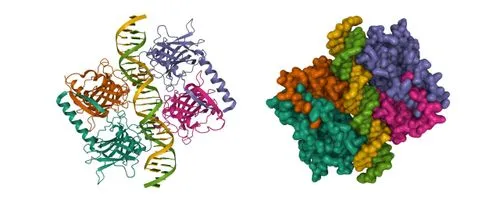
Google DeepMindによって開発された高度なアルゴリズムが、生物学における最大の未解決の謎の一つを解き明かしつつある。AlphaFoldは、その構成要素の「指示コード」からタンパク質の3D構造を予測することを目 […]
Proteins are essential to life, and understanding their structure can facilitate a mechanistic understanding of their function. Through an enormous experimental effort1–4, the structures of around 100,000 unique proteins have been determined5, but this represents a small fraction of the billions of known protein sequences6,7. Structural coverage is bottlenecked by the months to years of painstaking effort required to determine a single protein structure. Accurate computational approaches are needed to address this gap and to enable large-scale structural bioinformatics. Predicting the three-dimensional structure that a protein will adopt based solely on its amino acid sequence—the structure prediction component of the ‘protein folding problem’8—has been an important open research problem for more than 50 years9. Despite recent progress10–14, existing methods fall far short of atomic accuracy, especially when no homologous structure is available. Here we provide the first computational method that can regularly predict protein structures with atomic accuracy even in cases in which no similar structure is known. We validated an entirely redesigned version of our neural network-based model, AlphaFold, in the challenging 14th Critical Assessment of protein Structure Prediction (CASP14)15, demonstrating accuracy competitive with experimental structures in a majority of cases and greatly outperforming other methods. Underpinning the latest version of AlphaFold is a novel machine learning approach that incorporates physical and biological knowledge about protein structure, leveraging multi-sequence alignments, into the design of the deep learning algorithm. AlphaFold predicts protein structures with an accuracy competitive with experimental structures in the majority of cases using a novel deep learning architecture.
The introduction of AlphaFold 21 has spurred a revolution in modelling the structure of proteins and their interactions, enabling a huge range of applications in protein modelling and design2, 3, 4, 5–6. Here we describe our AlphaFold 3 model with a substantially updated diffusion-based architecture that is capable of predicting the joint structure of complexes including proteins, nucleic acids, small molecules, ions and modified residues. The new AlphaFold model demonstrates substantially improved accuracy over many previous specialized tools: far greater accuracy for protein–ligand interactions compared with state-of-the-art docking tools, much higher accuracy for protein–nucleic acid interactions compared with nucleic-acid-specific predictors and substantially higher antibody–antigen prediction accuracy compared with AlphaFold-Multimer v.2.37,8. Together, these results show that high-accuracy modelling across biomolecular space is possible within a single unified deep-learning framework. AlphaFold 3 has a substantially updated architecture that is capable of predicting the joint structure of complexes including proteins, nucleic acids, small molecules, ions and modified residues with greatly improved accuracy over many previous specialized tools.
While the vast majority of well-structured single protein chains can now be predicted to high accuracy due to the recent AlphaFold [1] model, the prediction of multi-chain protein complexes remains a challenge in many cases. In this work, we demonstrate that an AlphaFold model trained specifically for multimeric inputs of known stoichiometry, which we call AlphaFold-Multimer, significantly increases accuracy of predicted multimeric interfaces over input-adapted single-chain AlphaFold while maintaining high intra-chain accuracy. On a benchmark dataset of 17 heterodimer proteins without templates (introduced in [2]) we achieve at least medium accuracy (DockQ [3] ≥ 0.49) on 13 targets and high accuracy (DockQ ≥ 0.8) on 7 targets, compared to 9 targets of at least medium accuracy and 4 of high accuracy for the previous state of the art system (an AlphaFold-based system from [2]). We also predict structures for a large dataset of 4,446 recent protein complexes, from which we score all non-redundant interfaces with low template identity. For heteromeric interfaces we successfully predict the interface (DockQ ≥ 0.23) in 70% of cases, and produce high accuracy predictions (DockQ ≥ 0.8) in 26% of cases, an improvement of +27 and +14 percentage points over the flexible linker modification of AlphaFold [4] respectively. For homomeric inter-faces we successfully predict the interface in 72% of cases, and produce high accuracy predictions in 36% of cases, an improvement of +8 and +7 percentage points respectively.
Abstract The AlphaFold Protein Structure Database (AlphaFold DB, https://alphafold.ebi.ac.uk) is an openly accessible, extensive database of high-accuracy protein-structure predictions. Powered by AlphaFold v2.0 of DeepMind, it has enabled an unprecedented expansion of the structural coverage of the known protein-sequence space. AlphaFold DB provides programmatic access to and interactive visualization of predicted atomic coordinates, per-residue and pairwise model-confidence estimates and predicted aligned errors. The initial release of AlphaFold DB contains over 360,000 predicted structures across 21 model-organism proteomes, which will soon be expanded to cover most of the (over 100 million) representative sequences from the UniRef90 data set.
Abstract The AlphaFold Database Protein Structure Database (AlphaFold DB, https://alphafold.ebi.ac.uk) has significantly impacted structural biology by amassing over 214 million predicted protein structures, expanding from the initial 300k structures released in 2021. Enabled by the groundbreaking AlphaFold2 artificial intelligence (AI) system, the predictions archived in AlphaFold DB have been integrated into primary data resources such as PDB, UniProt, Ensembl, InterPro and MobiDB. Our manuscript details subsequent enhancements in data archiving, covering successive releases encompassing model organisms, global health proteomes, Swiss-Prot integration, and a host of curated protein datasets. We detail the data access mechanisms of AlphaFold DB, from direct file access via FTP to advanced queries using Google Cloud Public Datasets and the programmatic access endpoints of the database. We also discuss the improvements and services added since its initial release, including enhancements to the Predicted Aligned Error viewer, customisation options for the 3D viewer, and improvements in the search engine of AlphaFold DB.