


Press an EV's accelerator pedal firmly, and instant torque pushes you back into your seat in a way no combustion engine can replicate. This immediate response is the very thrill of EVs—but in that same instant, inside the battery cells, lithium ions shuttle between electrodes at a far faster pace than usual, and chemical stress accumulates.
How much does this "difference in pedal pressure" affect battery lifespan? Hao Cheng, Zhongwei Gu, and Wangqiang Gao of Shanghai Dianji University analyzed one year of real-world driving data from 15 EVs operating in Guangzhou, China, and showed that the most aggressive driving style causes roughly 2.5 times more capacity degradation than the gentlest eco-driving style. The paper was published on August 14, 2026, in the Nature-affiliated open-access journal Scientific Reports (DOI: 10.1038/s41598-026-66428-x).
The Wall of Confounding Factors That Correlation Analysis Couldn't Overcome
Lithium-ion batteries lose a bit of storage capacity with every charge-discharge cycle. Capacity that was 100% when new drops to 80% after a few years, shortening the range achievable on a single charge. The vehicle's resale value declines as well. According to IEA (International Energy Agency) estimates, the battery accounts for roughly one-quarter of an EV's retail price. Identifying the factors that slow degradation is thus a matter that directly affects owners' wallets.
Previous studies have pointed out that driving style affects degradation. The intuition that sudden acceleration and hard braking place a heavy load on the battery is correct. However, most prior research relied on correlational analysis. Battery degradation is influenced by a complex mix of factors unrelated to driving style itself, including ambient temperature, state of charge (SoC), and idling time. A driver who tends to drive hurriedly may also often be driving in hot conditions, or may often be driving with a low remaining charge. Correlation alone cannot distinguish whether degradation stems from driving style or from these confounding factors.
Overcoming this wall was the problem Cheng and colleagues set out to solve.
Isolating the Effect of Driving Style with a Thevenin Equivalent Circuit and a Gradient Reversal Layer
The framework the research team built is called physics-aligned causal inference. The method's skeleton consists of three stages.
In the first stage, a second-order Thevenin equivalent circuit describing the battery's electrical behavior is embedded within a generative model. A Thevenin equivalent circuit is a circuit model that approximates a battery as a combination of resistors and capacitors, reproducing changes in terminal voltage as current flows. "Second-order" means using two sets of parallel RC circuits with different time constants, allowing the model to represent both fast electrochemical polarization and slow concentration polarization. By embedding this physical model inside the generative model, representations that violate physical laws are excluded from what the model learns.
In the second stage, a gradient reversal layer is used to isolate the influence of confounding factors. This technique, originally developed for domain adaptation in machine learning, deliberately strips information about specific variables from a feature representation. In this study, temperature, state of charge, and idling time were set as confounding factors. The gradient reversal layer reverses the gradient of the loss that attempts to predict these confounding factors, encouraging the feature representation to learn without retaining information about them.
In the third stage, counterfactual inference quantifies the causal effect. This mechanism answers the hypothetical question: "If driving style alone changed under otherwise identical driving conditions, how would battery degradation change?"
As a check on model accuracy, the reconstruction error of terminal voltage achieved a MAPE (mean absolute percentage error) of 0.55%—a figure indicating that the battery's electrical state derived from real-world driving data could be reproduced with high precision.
A 2.5-Fold Gap in Capacity Loss After 1,000 Cycles
The analysis covers real-world driving data from 15 EVs operating in Guangzhou in 2022. Vehicle speed, current, state of charge, voltage, and temperature were recorded every 10 seconds under urban, suburban, and highway conditions, aggregated into 60-second intervals, and driving style was then classified into five levels. The gentlest category is eco-driving, while the most aggressive category involves repeated high-torque demands and large current draws at low speeds.
Notably, the average vehicle speeds of both groups were nearly identical. The difference showed up in the magnitude of current. The RMS current (root-mean-square current) of the aggressive-driving group was 66.02 A, compared to 20.56 A for the eco-driving group—a gap of roughly 3.2 times. Even at the same speed, how the accelerator is pressed dramatically changes the current, and thus the load placed on the battery.
In terms of instantaneous battery stress, the most aggressive driving style reached 18.4 times that of eco-driving. This, however, is a measure of momentary load, distinct from long-term degradation predictions.
For the long-term prediction, the characteristics of each driving style were fed into a battery degradation model to calculate capacity loss after 1,000 charge-discharge cycles.
| Metric | Eco-driving | Most aggressive driving | Ratio |
|---|---|---|---|
| Capacity loss after 1,000 cycles (model prediction) | 21.15% | 53.22% | ~2.5x |
| RMS current (root-mean-square) | 20.56 A | 66.02 A | ~3.2x |
| Instantaneous battery stress | baseline | 18.4x | 18.4x |
Verification through counterfactual inference was also carried out. Holding all other conditions constant and changing only the driving style from aggressive to eco-driving reduced short-term stress on the battery by 91.3%.
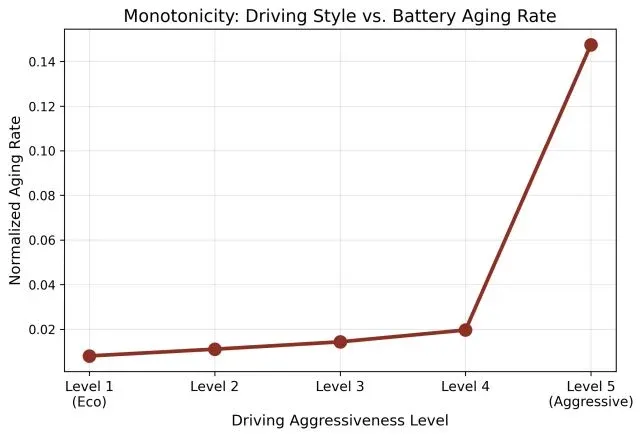
However, the capacity loss after 1,000 cycles is a model-derived prediction, not measured data from a battery that has actually completed 1,000 cycles of driving. The research team itself acknowledges this limitation. Even so, the fact that multiple analytical pathways—correlation analysis, counterfactual inference, and degradation model predictions—all point in the same direction reinforces the robustness of the result.
Relation to the Paradox That Current Fluctuation Extends Lifespan
In interpreting this result, it's worth touching on another finding that appears, at first glance, to contradict it. A study by Geslin et al. published in Nature Energy in 2024 (DOI: 10.1038/s41560-024-01675-8) showed, through a 24-month experiment using 92 commercial cells, that dynamic discharge profiles mimicking actual EV driving extend battery lifespan by up to 38% compared to discharge at a constant current. Given the same average current, a fluctuating current turns out to be gentler on the battery.
The study by Cheng and colleagues and the study by Geslin and colleagues do not contradict each other. What Geslin et al. compared was "whether the current is constant or fluctuating at the same average current," whereas what Cheng et al. compared was "driving styles that differ in the RMS value of current itself." The presence or absence of fluctuation and the magnitude of amplitude are separate axes. Taken together, the two studies suggest that what is desirable for a battery is driving in which the current fluctuates to some degree, but with small amplitude.
What Data from 15 Vehicles in One City Cannot Tell Us
This study has clear limitations. The sample consists of only 15 EVs in Guangzhou, offering limited diversity in vehicle models and battery chemistries. Guangzhou has a subtropical climate and is warm throughout the year. In colder regions, the very mechanism of battery degradation may differ. Another study published in the journal Batteries in 2026 (DOI: 10.3390/batteries12050163) reports that in low-temperature environments, the influence of driving style becomes far smaller, with capacity reduction rates capped at around 3% at most, whereas in warm environments the rate of capacity decline roughly doubles.
In addition, the degradation prediction after 1,000 cycles is a calculation based on a semi-empirical model, not a measured value. How closely the battery chemistry and temperature conditions assumed by the model match those of actual vehicles requires individual verification.
What the framework developed by Cheng and colleagues demonstrates is an estimate that a causal relationship between driving style and battery degradation exists with high confidence. The paper itself carefully maintains the position that this is an "estimate of causal association after controlling for confounding factors," not a "proof" of causation. The research team states in the paper that "these results indicate that optimizing driving style is an effective way to mitigate power battery aging and extend cycle life," but that claim remains within the bounds of model prediction.
What's needed next is replication across more vehicles and more diverse climate conditions, along with a direct comparison between model predictions and actual measured battery capacity. Just how universal the figure that a driver's accelerator technique alone can change battery lifespan by 2.5 times remains—that answer is not yet in.