

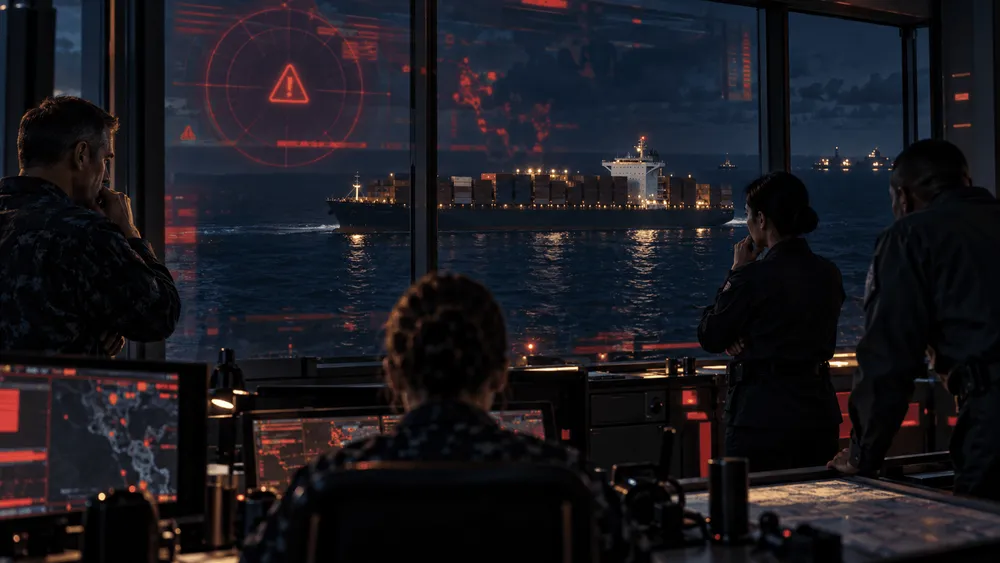
On September 18, 2026, CNN reported that US forces in the Middle East had been preparing to board a Chinese ship based on a flawed intelligence report produced with the help of AI. Armed personnel were reportedly ready to board, and military aircraft were already in the air. A last-minute check before the operation revealed that a chatbot used by an analyst had misidentified the ship's cargo. However, the account rests on anonymous sources in CNN's own reporting, and the US government has not confirmed it. The question is not only that the AI made a mistake, but why an unverified inference came to be trusted enough as intelligence to set a military operation in motion.
Preparations to board a Chinese ship, and what remains unconfirmed
CNN spoke to four sources familiar with the incident. Two said armed US personnel were preparing to board the Chinese ship. One of them and another source said military aircraft were already flying. The intelligence report that triggered the preparations claimed the ship was carrying components for a nuclear weapons program in the Middle East.
Just before the operation was to begin, officials examined the report more closely and found it was a document that an analyst at Special Operations Command had produced with AI assistance. The chatbot the analyst used had wrongly identified the ship's cargo. One source called the report "completely false" and told CNN, "We almost started a war." That is a source's assessment, not a settled government judgment.
Much remains unconfirmed. CNN could not identify the actual cargo, and it is unclear whether the chatbot was a commercial product or an internal government tool. The mission of the military aircraft, the level at which the boarding was approved, and the legal basis for the operation have not been made public. US Special Operations Command Pacific and the US Department of War did not respond to CNN's requests for comment. Neither the Chinese side nor the ship's operator has confirmed anything. For now, then, all that can be said is that CNN reports the US military came close to boarding the ship.
The AI misidentified the cargo and polished the report's appearance
AI appears twice in the process CNN described. The first was analysis. When the analyst queried the chatbot about shipping-related intelligence originating with US Special Operations Command Pacific, the tool reportedly combined open-source information with classified signals intelligence held by the government and linked the cargo to a nuclear weapons program. It is not known whether the error arose in the model's generation, in flawed input data, in a retrieval or integration failure, or in the analyst's interpretation.
The second use was documentation. The analyst used AI again to format the conclusion into a standard intelligence report trusted within the military, and then distributed it. That did not reduce the uncertainty of the content. If anything, a more readable text in a familiar format may have made the conclusion pass through the organization more easily.
A standard format does not guarantee that information is correct. But when recipients see a polished document, they tend to assume that source material has been checked, sources assessed, and alternative hypotheses considered. If CNN's account is accurate, the AI did more than reach a wrong conclusion: it also dressed that conclusion up to resemble existing intelligence products. That is a path by which an error gains authority.
"A human checked it" is not enough to stop it
In military AI, keeping a human in the decision loop is often cited as a safeguard. But unless we distinguish what the human actually looked at, the mere presence of a human is not enough. If the AI selects the source material, combines disparate information, summarizes conclusions, and then formats them into a standard template, and a human reads only the finished document, the reviewer cannot trace the boundary between fact and inference.
The Political Declaration on Responsible Military Use of AI, which the US published in 2023, anticipated this problem in fairly concrete terms. It called for training users and approvers to understand a system's capabilities and limitations, and for guarding against automation bias, the tendency to over-trust automated outputs. It also listed clearly defined uses, rigorous testing and assurance across the lifecycle, and safeguards to detect and avoid unintended consequences. Placing systems within a responsible human chain of command and control was one of its principles.
A summary compiled by the US Department of Defense's Task Force Lima in December 2024 listed the limits of generative AI: hallucinations, lack of explainability, security vulnerabilities, and immature testing and evaluation methods. It also noted that for uses with serious safety or security implications, systems should be deployed only where suitable and users must understand their capabilities and limits. In other words, the kind of danger now being reported was known before deployment.
Still, several government officials CNN spoke to explained that AI use across the military and intelligence agencies is fragmented, with tools, orders, and safety standards differing by department. They said there is no single unified set of standards for how to verify AI outputs. Even where principles exist, they do not function as safeguards in the field unless they are translated into individual units' work procedures, audit records, and pre-operation stop conditions.
Department-wide rollout and 30-day updates after the warning
About a year after the Task Force Lima summary laid out the risks, the Department of War greatly expanded the use of generative AI. On December 9, 2025, it announced GenAI.mil, with Google Cloud's Gemini for Government as its first model. It was offered in an IL5 environment able to handle controlled unclassified information, along with free training for all personnel. The official announcement explained that a mechanism supplementing answers with retrieved information would significantly reduce the risk of hallucinations.
The January 2026 AI strategy set out a policy of delivering leading models to roughly 3 million civilian and military personnel and opening pathways for AI use with intelligence data. It called for an update cycle allowing the latest models to be deployed within 30 days of public release, and for removing barriers to adoption, including testing and certification. It also set out experiments in decision support using an "Agent Network" linking multiple AI agents. Speed became an explicit goal.
However, there is no evidence directly linking this rollout to the incident CNN reported. It is unknown whether the chatbot used was GenAI.mil, or Gemini, Grok, Claude, or ChatGPT Mil. Nor can we judge whether GenAI.mil's web-reference feature could have prevented this misidentification. What can be confirmed is the timeline: after the US government publicly recognized the dangers, it chose a policy of rapidly expanding AI to more personnel, data, and missions.
This timeline does not prove that speed and safety must conflict. But if models are updated every 30 days and each department tests them in a different environment, then not only model performance but also source attribution, approval procedures, audit logs, and independent verification must be updated at the same pace. Otherwise, the oversights that grow with expanded usage could outweigh the errors that shrink with better performance.
Preventing a repeat depends on information provenance, not model names
The lesson from CNN's report is not to drop a particular chatbot. First, source material, facts extracted by AI, inferences generated by AI, and the analyst's judgment need to be recorded separately so that recipients can trace back. Even when open-source and classified information are combined, it must be possible to track which claims depend on which.
Second, documents should state explicitly when AI was used to put them into a standard format. The more polished the form, the more readily recipients assume the content has been verified. Disclosing AI use is not a mark that lowers a document's value; it is a cue showing which parts a human should check against source material.
Third, the closer a decision comes to the use of force, the more independent verification, returning to the source material, should be required rather than relying on internal review of the same intelligence report. The cargo's category, its link to nuclear-related uses, and the ship's identity and route need to be confirmed by a different analyst or through a separate intelligence channel. If they cannot be verified, the operation should be halted regardless of the AI's confidence level or how finished the document looks. These are not measures the US military has been confirmed to have adopted after the incident; they are requirements derived by applying the training, auditability, rigorous testing, and safeguards the US government itself has espoused to the failure path that was reported.
What the US military should show next is more than a model name. It is how much it will disclose about the existence of the incident, the misidentified cargo, the verification procedures before distribution, the cross-check that stopped the operation, and the corrective measures taken afterward. Only with that information can we judge whether the claim that a human was there at the end was a safeguard that actually worked.