

On August 3, Alibaba Group announced its next-generation flagship AI model, "Qwen3.8-Max," for global release. Despite boasting a massive total of 2.4 trillion parameters, it adopts a sparse Mixture-of-Experts (MoE) architecture that keeps the number of parameters active during inference to approximately 4%, or 95 billion. This achieves a viable trade-off between overwhelming scale and computational efficiency. The model features a context window of up to 1 million tokens, giving it the ability to process massive documents equivalent to roughly 750,000 words at once.
According to the company, Qwen3.8-Max possesses autonomous operating capabilities comparable to cutting-edge U.S. models such as Anthropic's "Claude Fable 5" and "Claude Opus 5." Unlike conventional chat-based AI that responds to and concludes with a single prompt, it is designed to complete complex tasks spanning several days without human intervention. The model is currently available through Alibaba Cloud's Model Studio API and the productivity platform "QwenWork." Next week, it is set to be released with open weights—an unusual move for a model of this class.
An Autonomous Loop That Self-Evolves Projects
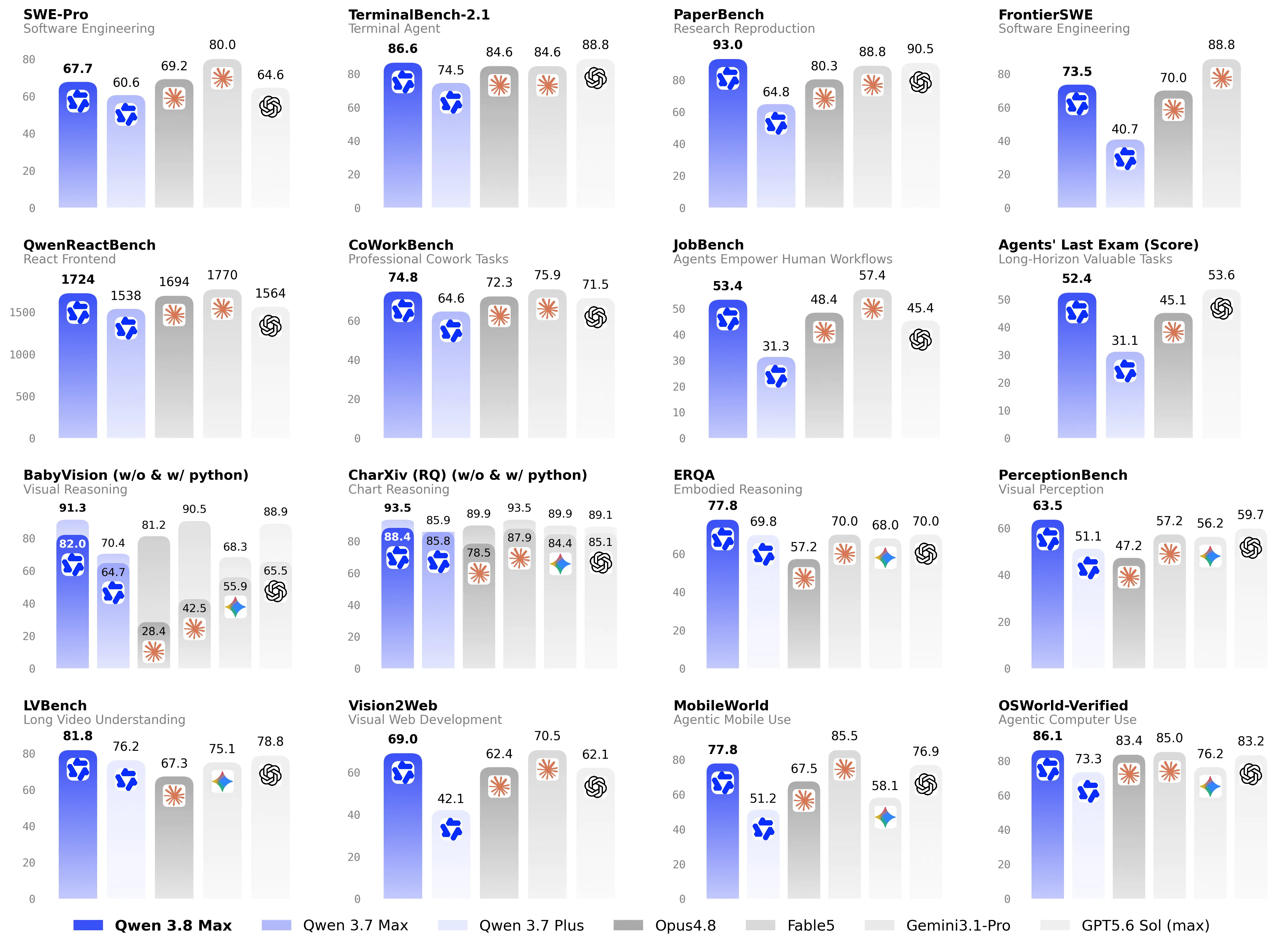
A notable feature of Qwen3.8-Max is its ability to run a loop in which it sets its own hypotheses, then self-evolves the system by repeating execution and verification.
The model's self-evolution capabilities are vividly demonstrated in a case where it completed an entire software development lifecycle on its own. In a build task for a project called "oh-my-cli," Qwen3.8-Max operated autonomously for 16 consecutive days. By self-defining community requests as issues and running cycles of code generation, testing, and self-repair, it processed 265 commits, 127 pull requests (PRs), and 151 issues—all without any involvement from human engineers.
In an experiment where the model was fed a recent paper proposing a method to improve AI learning efficiency (Unified Data Selection for LLM Reasoning), it built an entire pipeline starting from a state with zero implementation code. Over approximately five days (roughly 125 hours), the model wrote 7,600 lines of code and autonomously executed 33 GPU training runs to reproduce the paper's experiments. Furthermore, after reproducing the results, the model itself devised 18 improvement proposals across four rounds and repeatedly verified them. Ultimately, it independently derived a new method that surpassed the paper's original approach, raising the score on the challenging math benchmark "AIME24" by 2.71%.
Results from the WWW2025 Multimodal Dialogue Intent Recognition Contest, held on Alibaba Cloud's Tianchi platform, also serve as evidence of this autonomy. Within a 24-hour time limit, the model interpreted both text and interface screenshots, autonomously fine-tuning models such as BERT, MacBERT, RoBERTa, and the vision model Qwen2.5-VL-7B to build an ensemble system. Competing against 526 human teams, it recorded a win rate that defeated 458 teams—87% of the total field.
A Native Feedback Mechanism Connecting Vision and Logic
Underpinning this advanced level of autonomy at its core is a native feedback mechanism that deeply integrates visual processing into the process of task planning and verification. For Qwen3.8-Max, vision is not merely about parsing input data—it functions as an "eye" that lets the model evaluate the validity of its own actions and correct its course.
This mechanism proved most powerful in a hardware chip design task. When designing a cryptographic accelerator (GCD/RSA), the model's initial design consumed 8,298 gates. From there, by layering visual feedback from simulation and logic synthesis, it autonomously executed 500 iterations and 71 evaluations. By identifying defects and redundancies on its own and reconstructing the logic circuits, it ultimately reduced the gate count to 678. In terms of physical layout as well, it successfully shrank the design from an initial 106x106 micrometers down to 46x46 micrometers.
In the realm of software operations, the model similarly behaves as a hybrid agent that combines code-based backend processing with GUI operations. It can parse and extract information from lengthy PDFs exceeding 200 pages and video streams exceeding 100 hours. It has also demonstrated the ability to reconstruct an entire application from scratch—without any source code—based solely on visual feedback obtained from the screen of a running application.
Ripple Effects on Practical Work and Long-Term Decision-Making Ability
The impact of Qwen3.8-Max extends beyond development environments and research labs into complex real-world business settings. In a corporate legal compliance review, the model extracted 1,284 relevant clauses within one hour from hundreds of documents—a task that normally takes a team of paralegals a full week. In a restaurant startup task, it devised a 26-item menu while maintaining cost ratios, and in structural engineering, it reconstructed a seismic isolation model for a 30-story building in a browser.
Its long-term decision-making capability was clearly demonstrated in a 365-day e-commerce operations simulation called "E-Commerce Bench." This benchmark recreated a complex market environment involving 600 suppliers, 7,000 products, and even fraudulent vendors. Over the course of a year, the model autonomously handled procurement negotiations, pricing, and inventory management, generating a net profit exceeding 100,000 RMB. This return—4.16 times the initial capital—outperformed the results of its domestic Chinese competitor, GLM 5.2, by 38%. The model's ability to not only handle immediate tasks but also self-adjust the rhythm of negotiation and investment with an eye toward long-term cash flow holds the potential to significantly reshape the future of enterprise AI.
A Survival Strategy Under Constraints and the New Chapter Open Source Is Opening Up
This announcement of Qwen3.8-Max clearly reflects the geopolitical competitive dynamics at play in AI development. For the past two years, the U.S. government has restricted the export of advanced AI chips to Chinese companies, attempting to keep firms like Alibaba locked into a generation-behind level of technology.
Even under such constraints, Alibaba has demonstrated that it can build a top-tier model through algorithmic refinement and clever system architecture. The deliberate strategy of open-sourcing the weights of its flagship model represents a clear challenge to U.S. competitors including Anthropic and OpenAI. The market responded favorably to this move: on the day of the announcement, Alibaba's Hong Kong-listed shares rose 7%, closing at HK$125.20.
The specific form that next week's open-weight release will take is the biggest point of interest for the technical community. In what quantization formats and under what licensing terms will a model of this staggering scale—2.4 trillion parameters—be made available? And to what extent will the design, which activates only 95 billion parameters during inference, lower the requirements for running it locally? Once its practicality becomes clear, the battle for leadership in AI development within the global developer community will enter a new phase.