


On October 15, 2026, Amazon announced Bee Frontier and Bee Eclipse, AI devices that remember your conversations. Frontier is worn on the wrist or clipped to clothing, while Eclipse attaches to the back of a smartphone. Bee, which pulls summaries and to-dos out of conversations, now also connects to Alexa+ and Amazon.com. If users choose to enable it, items they mention in conversation can lead to shopping suggestions. Amazon says it deletes audio after processing and designs the system so that even its operators cannot read conversation content. However, once a user permits information to be passed to another service, it is handled outside the isolated environment, and the conditions for storage and deletion change.
Two Ways to Capture Conversations: On the Wrist or on the Back of Your Phone
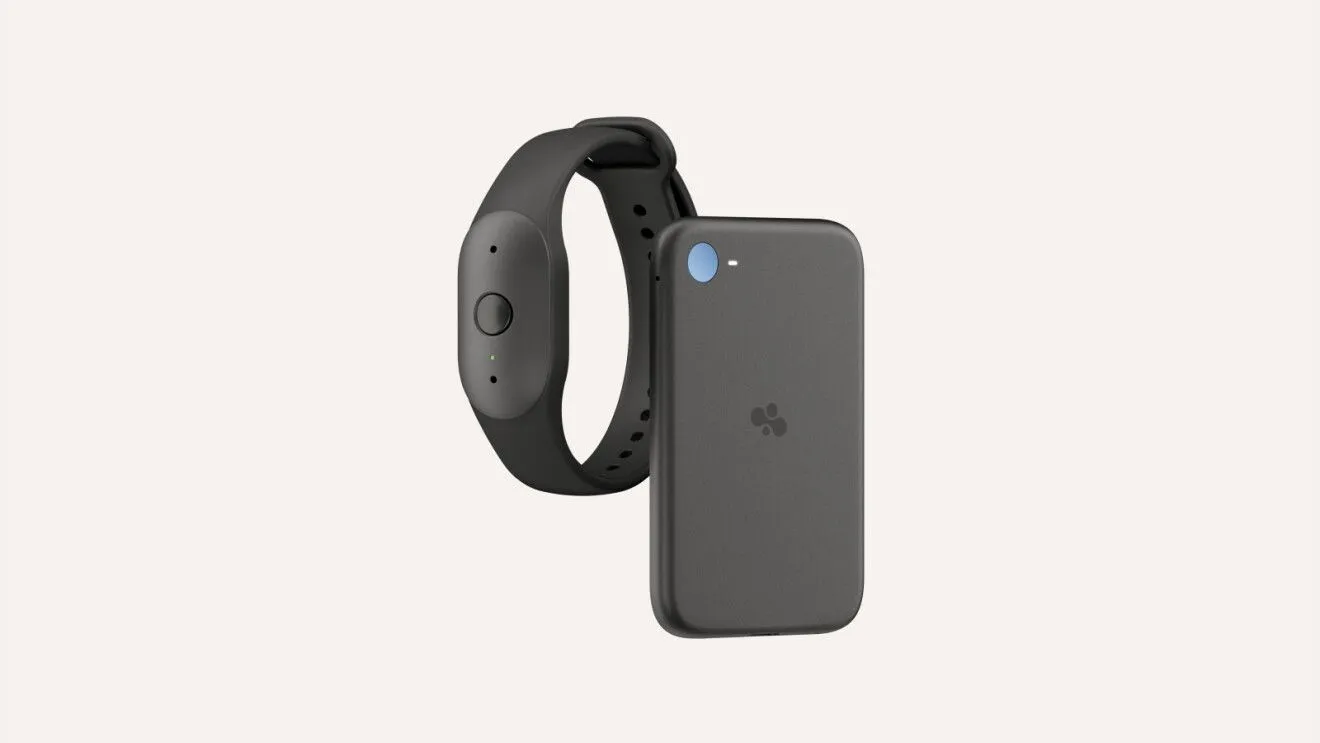
Frontier is a wearable that follows the earlier Bee Pioneer. It can be detached from its wrist band and clipped to clothing, and it captures conversations using two microphones and noise-reduction processing. Eclipse is about the size of a credit card and attaches magnetically to a smartphone. In addition to face-to-face conversations, it processes what both sides say on a call while it is active, according to Amazon.
| Item | Bee Frontier | Bee Eclipse |
|---|---|---|
| How it's worn | Wrist band or clip on clothing | Magnetic attachment to the back of a smartphone |
| Price | $74.99 | From $99.99 |
| Battery | Up to 7 days | More than 21 days |
| Availability | On sale at Amazon.com | Coming soon |
The battery figures are Amazon's stated values, not a comparison measured under identical conditions. Still, the design intent is clear: a device you can keep close without charging it often. Frontier is IP67 dust- and water-resistant, and Eclipse supports MagSafe. Both charge over USB-C.

Controls are simple, too. One press of the button starts or stops recording, and an indicator light is on while the device is active. Frontier also offers a setting that stops it automatically after a period of silence. This reduces the burden of opening a phone app for every conversation, while leaving it up to the user whether the microphone runs. The announcement did not give a release date for Japan.
Conversation Memory Becomes a Gateway to Shopping
"What was the name of that book?" "What did I promise in that meeting?" Bee aims to let you recall such memories from conversation summaries. With the new Alexa+ integration, you can check summaries and to-dos by voice instead of pulling out your phone. Echo's Voice ID is used to recognize who is speaking and to call up that person's Bee information.
The Amazon.com integration links memory to purchase suggestions. One example Amazon gives: after you mention needing dish soap in conversation, the feature helps keep you from forgetting to buy it. Once connected, recommendations related to items you discussed appear on the Amazon homepage and in the Bee app. What was announced here is product suggestions; it is not described as a feature that automatically places orders just because you said something.
Conversations can also feed into email and scheduling. Connect Gmail, Microsoft Outlook, and similar services, and Bee can draft a follow-up email after a meeting and create calendar invitations in services such as Google Calendar. It tries to cut down the effort of rereading records, extending all the way to the next action.
Using the integrations, however, requires the paid Bee Pro. Buying the device alone gives you conversation summaries, reviews, and 14 days of memory, but connections to Amazon.com and Alexa+, along with conversation templates and a desktop app, are part of Pro. Pricing is $11.99 per month or $99.99 per year, with a 30-day free trial for new users. Those who bought a Pioneer before October 15 can keep using its existing features for free.
This split suggests a structure in which a device that captures conversations serves as the entry point, and revenue comes from services that keep putting that memory to use. For Amazon, it widens the touchpoints for suggesting products from remarks made in daily life, even before a user searches for a product name. That raises the question of where conversations are processed and under what conditions information leaves the system.
Cloud Processing That Operators Aren't Meant to Read
Bee processes audio in real time and then deletes it. Transcripts and summaries, by contrast, are kept so that memories can be recalled later. According to an explanation Amazon published in September, these are encrypted with keys managed by the user's device and handled in an isolated environment called "Bee Private Compute."
This is not a system that does all processing on the device itself. According to the technical whitepaper, the user's device first verifies that the server it connects to is running approved software, and only then hands over a processing key limited to a specific purpose. On the cloud side, the data is processed in isolated virtual machines built on AWS's Nitro System and NitroTPM. In effect, the root secret held by the user's device is kept separate from the processing keys passed temporarily to the server.
This structure goes further than a mere internal rule that "employees do not look at the content." The aim is to ensure that even though the operator manages the servers, ordinary administrative operations cannot extract the contents of conversations. That said, the approved program that produces the summaries does read the content while processing it. Whether the protection holds depends not only on encryption but also on verification of the code that runs and on flaws in that code itself.
What the Public Audit Confirmed
Amazon has also published an audit report it commissioned from the security firm Trail of Bits. It records a code and configuration review conducted from May to June, along with follow-up checks of fixes. Recounting the 21 findings in the September 9 version of the report by severity and remediation status, all 7 high-severity issues are resolved; the 4 findings that were partially resolved or unresolved comprised 2 medium-severity, 1 low-severity, and 1 informational.
| Original severity | Resolved | Partially resolved | Unresolved |
|---|---|---|---|
| High | 7 | 0 | 0 |
| Medium | 5 | 2 | 0 |
| Low | 1 | 0 | 1 |
| Informational | 4 | 0 | 1 |
| Total | 17 | 2 | 2 |
The table tallies each finding in Appendix C of the report (printed pages 84–85) by severity and post-fix status. It shows both the progress made in fixing serious problems and the fact that not every item has been fully resolved.
The two partially resolved findings include a problem in which deletion of summaries left unencrypted for search can be delayed or fail, and a data-management problem on the side of connected services. For the latter, Amazon explains that services handling information from accounts the user has explicitly connected run outside the isolated virtual machines. The two unresolved findings also include a design decision on developer tokens issued only to the owner, and a risk acceptance on the grounds that a separate verification can prevent exploitation.
This is a September check of fixes to specific areas, not a hands-on test of the devices announced on October 15. It cannot be read as a figure showing the state of the product at launch or the occurrence of harm, but it does make concrete what should be examined, including the integrations.
What You Hand to Connected Services, and What You Can Take Back
Bee's technical whitepaper explains that when information is sent to an external service, a signed authorization tied to the recipient and scope is verified. The design confirms the user's permission and then passes information out of the isolated processing environment. Logging in to Bee with an Amazon account and sharing conversation information with Amazon.com are separate operations.
How information is handled after sharing is made clear in Section 1.4 of the Bee terms of use, updated September 23. Information a user chooses to send to a connected service leaves Private Compute and is processed under that service's terms of use and privacy notice. Even when it is sent to Amazon's own services, it moves under the conditions that apply to that service.
Disconnecting in the app stops further sharing. However, information already passed on may be retained by the connected service under its own policies, and Amazon cannot recall and erase it. Stopping sharing is not the same as deleting data that has already been shared. It is necessary to understand separately the protection of memories stored within Bee and the conditions under which those memories are used for things like shopping.
The consent of the people you talk to also remains a matter apart from data encryption. Amazon says it encourages users to ask the other party's permission each time they start recording a call, and the terms place on the user the responsibility for obtaining any necessary consent. The indicator light signals that the device is active, but it does not guarantee that the other person understood and consented.
What Bee expands is a way of using AI that picks up the tasks of daily life before you even start looking for a product, and connects them to the actions you need. In exchange for the convenience of fewer forgotten purchases, which information goes to which service? Whether users can understand and choose that scope, and stop it later, will be a condition for the product to take hold as something people trust with everyday conversations.