

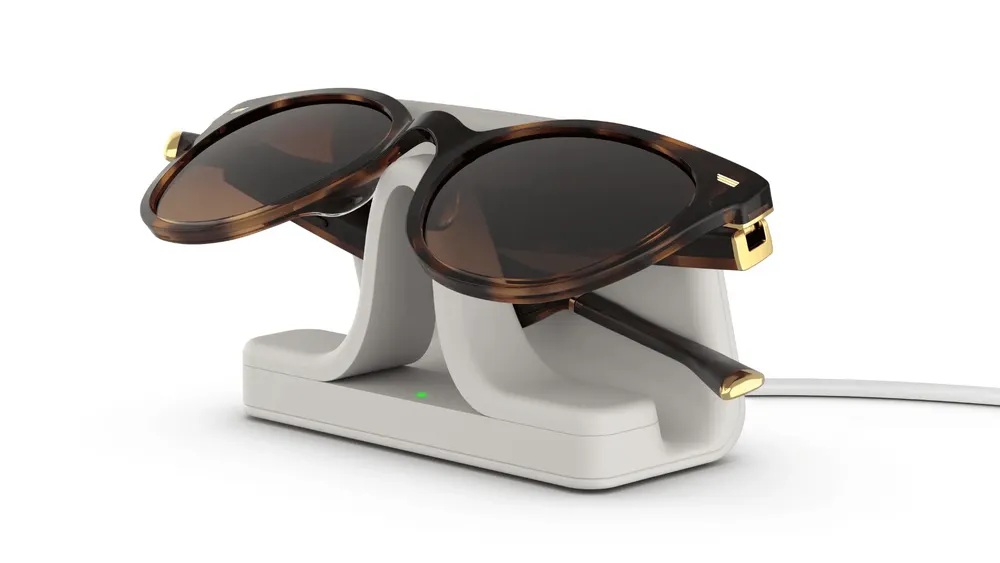
E-commerce giant Amazon appears to have set its sights on a new battlefield: "our faces." According to a report from The Information, the company is developing two types of smart glasses—one for consumers and one for enterprise use. The consumer model in particular, dubbed "Jayhawk," is said to be a direct challenge to the product lineup of Meta, which currently leads this space.
The E-Commerce Empire's Next Battlefield: "On Our Faces" — An Overview of the Report
According to The Information, a media outlet known for its in-depth technology industry reporting, citing two people familiar with the plans, Amazon is developing smart glasses that primarily come in two models.
- Jayhawk: A model targeting the consumer market. It reportedly aims for a sleek, non-bulky design.
- Amelia: A more utility-focused model designed for Amazon's vast fleet of delivery drivers.
This two-front strategy showcases the cleverness of Amazon's approach. With "Amelia," the company can accumulate technology and operational know-how while addressing a concrete need—improving the efficiency of its core logistics business. Meanwhile, "Jayhawk" targets the consumer market, which holds even greater potential. This strategy is reminiscent of Amazon's well-known playbook—as seen with Amazon Web Services (AWS)—of refining tools built for internal use and eventually elevating them into global platforms.
Consumer-Facing "Jayhawk" — An Evolution of Echo Frames, or an Entirely New Experience?
The consumer-oriented "Jayhawk" has the potential to reshape the competitive landscape of the smart glasses market. The reported specs are as follows.
- Display: A full-color display mounted on one lens (a monocular display).
- Input/Output: Built-in microphone and speakers.
- Camera: Equipped with a camera.
- Launch timing: Targeted for late 2026 to early 2027.
- Price: Unknown at this time.
These features reveal Amazon's clear intent to expand the voice-assistant experience it has cultivated with its existing smart glasses, Echo Frames, into the realm of visual information. Echo Frames had no display and were focused solely on voice interactions with Alexa and music playback. "Jayhawk," however, aims to fundamentally transform that experience by adding a "seeing" element.
For example, if you ask Alexa for directions, navigation could appear in the corner of your field of view. If you pick up a product at the supermarket, reviews and price comparisons for that item could instantly appear. These are exactly the kinds of areas where Amazon's e-commerce business and Alexa ecosystem excel, and they pair extremely well with a smart glasses device.
That said, it's worth noting that this may not currently qualify as "AR (augmented reality) glasses" in the strict sense. The reported specification of a "full-color display on one eye" suggests something closer to a "heads-up display (HUD)"—showing notifications and simple information in the field of view—rather than "true AR," which overlays 3D objects onto physical space. In other words, it likely falls into the category of what's generally called "smart glasses." This is an important distinction for general consumers, and it will be worth watching how Amazon chooses to market the product.
The Enterprise Trump Card, "Amelia" — A Revolution in the "Last Mile" of Amazon's Logistics Empire
Meanwhile, "Amelia," designed for delivery drivers, is a more concrete device directly tied to Amazon's business operations.
- Purpose: A work tool designed to improve package sorting and delivery efficiency.
- Function: Displays delivery instructions and navigation directly on the glasses' screen.
- Design: Expected to be larger and more rugged compared to "Jayhawk."
- Launch timing: Planned for Q2 2026, an earlier rollout than the consumer version.
- Production scale: An initial production run of 100,000 units is planned.
A figure of 100,000 units is not the scale of a mere pilot test. It reflects Amazon's genuine commitment to innovating its logistics network—particularly the "last mile," widely regarded as the most costly and complex part of delivery. If drivers can follow instructions displayed in their field of view without looking down at a smartphone or dedicated handheld device, this could lead to shorter task times, a dramatic reduction in misdeliveries, and shorter training periods for new drivers.
The "Amelia" project is an area where Amazon can leverage its strengths to the fullest. By refining the device within one of the world's largest logistics networks—a massive "testing ground" that no competitor can replicate—Amazon can eventually feed the insights and data gained back into the development of its consumer-facing "Jayhawk" model, creating a powerful virtuous cycle.
Head-to-Head with Arch-Rival Meta — The Battle for Smart Glasses Supremacy Heats Up
The biggest reason Amazon's move is sending shockwaves through the industry is that it signals a direct confrontation with Meta. Meta has already achieved a degree of success in pioneering the smart glasses market through its partnership with Ray-Ban. And as its next move, Meta is rumored to be on the verge of launching a full-fledged AR glasses product with a built-in display, codenamed "Hypernova" (also referred to as Celeste).
Comparing the two companies' strategies makes the differences in their approaches clear.
| Category | Amazon (Jayhawk) | Meta (Hypernova) |
|---|---|---|
| Core of the ecosystem | Alexa, e-commerce, AWS | Social graph, Messenger, Instagram |
| Expected primary use cases | Information lookup, shopping, navigation | Photo/video capture and sharing, live streaming, communication |
| Strengths | Practicality, commerce integration, validation via logistics network | Brand power (Ray-Ban), design appeal, social features |
| Business model | Device sales + driving consumption through the ecosystem | Device sales + advertising, driving users toward the metaverse |
While Meta centers its approach around "human connection" and "shared experiences," Amazon is aiming to provide more practical value—"improving convenience in daily life" and "streamlining consumption activities." This reflects the very nature of the empires each company has built, making for a genuinely fascinating point of contrast.
According to analyst Ming-Chi Kuo, Meta's "Hypernova" could be priced around $800. The price of Amazon's "Jayhawk" remains unknown, but if the company deploys the kind of aggressive pricing strategy it has shown with devices like Echo, it could rapidly intensify price competition across the market.
The Supply Chain and the Definition of "AR"
According to the report, both "Jayhawk" and "Amelia" will adopt core AR display technology supplied by the Chinese AR technology company "Meta-Bounds." This fact illustrates just how much cutting-edge device development relies on global supply chains. Rather than a single company internalizing every piece of technology, a horizontal division-of-labor model—sourcing optimal components from specialized companies around the world and combining them—is becoming the mainstream approach in this field as well.
Also, as noted earlier, care is needed when using the term "AR glasses." Many of the products currently on the market, and much of the reported specifications, describe smart glasses that "add" information to the real world, which differs from AR glasses that fully "merge" the real world with digital information. Amazon's "Jayhawk" is likely to start with the former and follow a roadmap that gradually evolves toward the latter. Understanding this technological progression will be essential to reading where the market is headed.
Why Big Tech Companies Are Targeting Our "Faces" — The Battle for Dominance in the Post-Smartphone Era
Why are massive tech companies—Amazon, Meta, and also Apple (Vision Pro) and Google (AR prototypes)—pouring such enormous investment into glasses-type devices? The answer is simple: they are all vying for control of the "post-smartphone era."
Smartphones revolutionized our lives, but the experience has always been constrained by the "small rectangular screen in our hands." Glasses-type devices have the potential to free us from that constraint.
- Always-on connectivity: Information is always in your field of view, and it can be operated hands-free.
- Contextual understanding: Cameras and sensors understand "what the user is currently looking at" and provide the most relevant information.
- Fusion with the real world: Digital information is displayed naturally, as if it were part of the physical world.
Whoever masters this new platform will lead the tech industry for the next decade. Each company envisions a different world, but they all share the same battlefield: "our faces."
The Impact of Amazon's Entry on the Market and What Lies Ahead
The report of Amazon's full-scale entry into the smart glasses market makes clear that this market is no longer just for niche gadget enthusiasts—it's transforming into a major battleground where giant tech companies are betting their futures.
The dual-pronged strategy of consumer-facing "Jayhawk" and enterprise-focused "Amelia" is an extremely rational and powerful approach that leverages Amazon's strengths to the fullest. In particular, the ability to use its own massive logistics network as a testing ground for the device gives Amazon an overwhelming advantage that no other company can match.
Of course, the road ahead won't be smooth. There are plenty of hurdles to clear: privacy concerns that inevitably come with camera-equipped devices, securing battery life sufficient for all-day wear, and—perhaps most importantly—creating a killer application that gives people a compelling reason to buy.
Still, there's no question that Amazon's entry will intensify market competition and accelerate technological innovation. This new frontier—pioneered by Meta and now being challenged by Amazon—has the potential to fundamentally transform how we live and work. In 2026, will the codename "Jayhawk" truly take flight in the market, living up to its name? The entire tech industry will be watching closely.
Sources
- The Information: Amazon is Developing AR Glasses in Challenge to Meta