

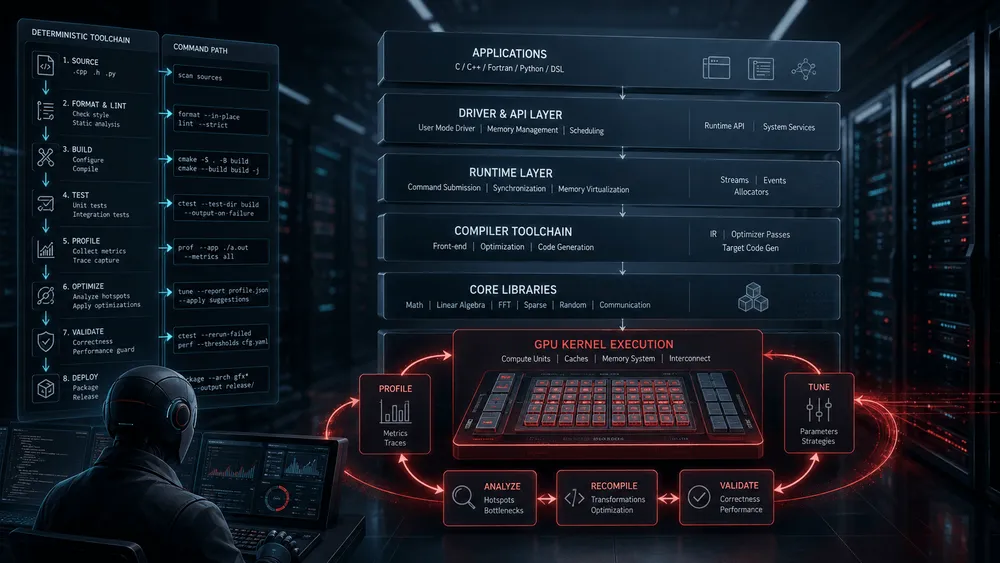
AMD is trying to shift GPU software performance tuning from manual expert work to iterative agent work. "ROCm.AI," announced on July 23, 2026, is not a new SDK that replaces ROCm's runtime or numerical computation libraries. Rather, it's a development experience that layers agent-oriented knowledge, reproducible commands, system monitoring, and autonomous optimization on top of the existing ROCm Core SDK.
The goal is clear: bring together, in a single workflow, the environment setup needed before AI models can run on AMD GPUs and the performance tuning needed after they're running. Looking at the published code, this vision has already begun to take shape. However, while the product page depicts everything from Instinct to Radeon and Ryzen AI, the validation scope of Hyperloom, which handles automatic optimization, is limited to three Instinct products. To gauge the value of ROCm.AI, one needs to separate the broad product vision from the initial implementation.
Layering the developer experience on top, without replacing ROCm itself
On the ROCm foundation side, ROCm Core SDK 7.14.0 was released on July 15. This version moved the build and release infrastructure to TheRock, narrowing the core down to fundamental components such as the runtime and compiler. Features for AI, data science, and HPC have been split out as use-case-specific SDKs, changing the structure so that only the necessary components need to be installed.
ROCm.AI brings development work together on top of this modularized foundation. The configuration AMD has published consists of four elements with differing roles and maturity levels.
| Element | Role | Status at time of publication |
|---|---|---|
| ROCm Core SDK | Runtime, compiler, numerical computation and communication libraries | 7.14.0 released July 15 |
| AMD Skills | Passes AMD-verified procedures to coding agents | Entire catalog is a Tech Preview |
| ROCm CLI/Console | Deployment, environment checks, model serving, updates, diagnostics, monitoring | Tech Preview, nightly builds only |
| ROCm Hyperloom | Measures inference workloads, changes settings or code, and re-verifies | Public Quickstart is 1.0.0a1 |
This division of labor separates the agent, which receives natural-language instructions, from the CLI, whose fixed commands can also be run from scripts. Rather than having the agent continuously assemble shell commands directly, the design has Skills translate intent into AMD's recommended procedures, with the CLI executing them. This makes work easier to reproduce in CI/CD pipelines and multi-developer environments.
CLI and Skills aim to shorten the "first step"
ROCm CLI is being developed as a single binary for Linux and Windows, and it doesn't presuppose an existing ROCm or Python environment. rocm install sdk installs TheRock's ROCm wheels and the corresponding PyTorch into a managed environment, keeping them separate from any existing ROCm environment. rocm examine inspects the GPU and runtime environment, and rocm serve launches an OpenAI-compatible model server. The inference engine switches between Lemonade for Radeon/Ryzen and vLLM for Instinct.
AMD Skills are procedures for invoking that CLI and existing tools from Claude, Cursor, Codex, and similar tools. The current catalog includes a skill for serving vLLM on Instinct, TraceLens for analyzing PyTorch profiler traces, and procedures for embedding local AI into applications, among others. The idea is to shift the burden of searching documentation and chaining commands onto executable knowledge maintained by AMD.
However, some of the features featured prominently in the announcement are still in the planning stage. rocm-doctor, which diagnoses misconfigurations in ROCm, PyTorch, and llama.cpp, and hyperloom-kernel-optimizer, which invokes kernel optimization, are marked as planned or coming soon in the official catalog. ROCm CLI itself is a Tech Preview with no stability guarantees, and the only published builds are nightly. While some components are usable now, the unified ROCm.AI product experience is not yet complete.
Hyperloom turns performance tuning into a loop of measurement and verification
Hyperloom restructures the work of speeding up a running inference workload into an autonomous loop. First, it measures baseline performance, and TraceLens analyzes traces collected by Magpie. Based on the bottlenecks found, it adjusts serving configuration or host-side code, Arbor expands the optimization search space, and GEAK tunes the heaviest GPU kernels. It then reruns the benchmark, verifies performance and correctness, and reports the proposed changes.
This differs from code completion. Hyperloom runs "measure, change, measure again" over an extended period, comparing results after every change. It's a mechanism that distributes to profilers and multiple agents the process that humans previously handled by reading bottlenecks and rewriting configuration values or kernels themselves. That said, correctness verification is limited to the prepared tests and workload scope, and does not constitute a guarantee for arbitrary code.
The current version's applicable scope is narrow. The compatibility table for Hyperloom 1.0.0a1 lists Instinct MI300X, MI325X, and MI355X as the supported GPUs, with Ubuntu 22.04 or 24.04 as the OS and ROCm 7.2.x. SGLang 0.5.12 or higher, or vLLM 0.21.0 or higher, is also required. The latest ROCm Core SDK is 7.14.0, and its combination with Hyperloom has not been verified in the published compatibility table. Radeon, Ryzen AI, and the latest Instinct MI455X, which appear on the product page, are also absent from the current Hyperloom verification table.
An upstream LLM is also required during operation. The Quickstart assumes access to Anthropic, and the authentication documentation shows how to connect separately to the Anthropic and OpenAI APIs, as well as how to use one's own LiteLLM-compatible gateway. Therefore, the fact that Console's telemetry stays on-premises is not synonymous with the optimization process being entirely closed off offline. Enterprises need to verify what code or traces the external model can access under a given configuration, and manage this alongside the terms of service.
The contest is about reproducible operations, not just model performance
What ROCm.AI is trying to fill in is not so much the GPU's raw computational performance, but the distance to getting the hardware into a usable state. ROCm 7.14.0 added support for PyTorch 2.12.0, JAX 0.10.0, vLLM 0.23.0, SGLang 0.5.13, and TensorFlow 2.21. However, there remains a gap between being listed in a compatibility table and actually being able to select the appropriate version for each individual GPU, serve a model, and tune it to the expected performance level.
Skills and CLI turn that work into standardized procedures verified by AMD. Hyperloom extends the same philosophy to post-deployment performance tuning. If this takes hold, developers will be able to start verification on AMD GPUs before having to learn every ROCm component. For MLOps teams as well, configuration and diagnostics that had depended on individual staff experience can be shifted into version-controllable skills and commands.
That said, AMD itself notes that the rate of performance improvement varies by workload and model. The GPU, software environment, and starting point also affect the results. At this stage, no general multiplier figure can be established. What will drive adoption decisions is whether a stable CLI release, the planned Skills, and Hyperloom's support for new GPUs and new ROCm versions come together in the same verified configuration—and whether they can demonstrate reproducible improvements on real-world project code.