


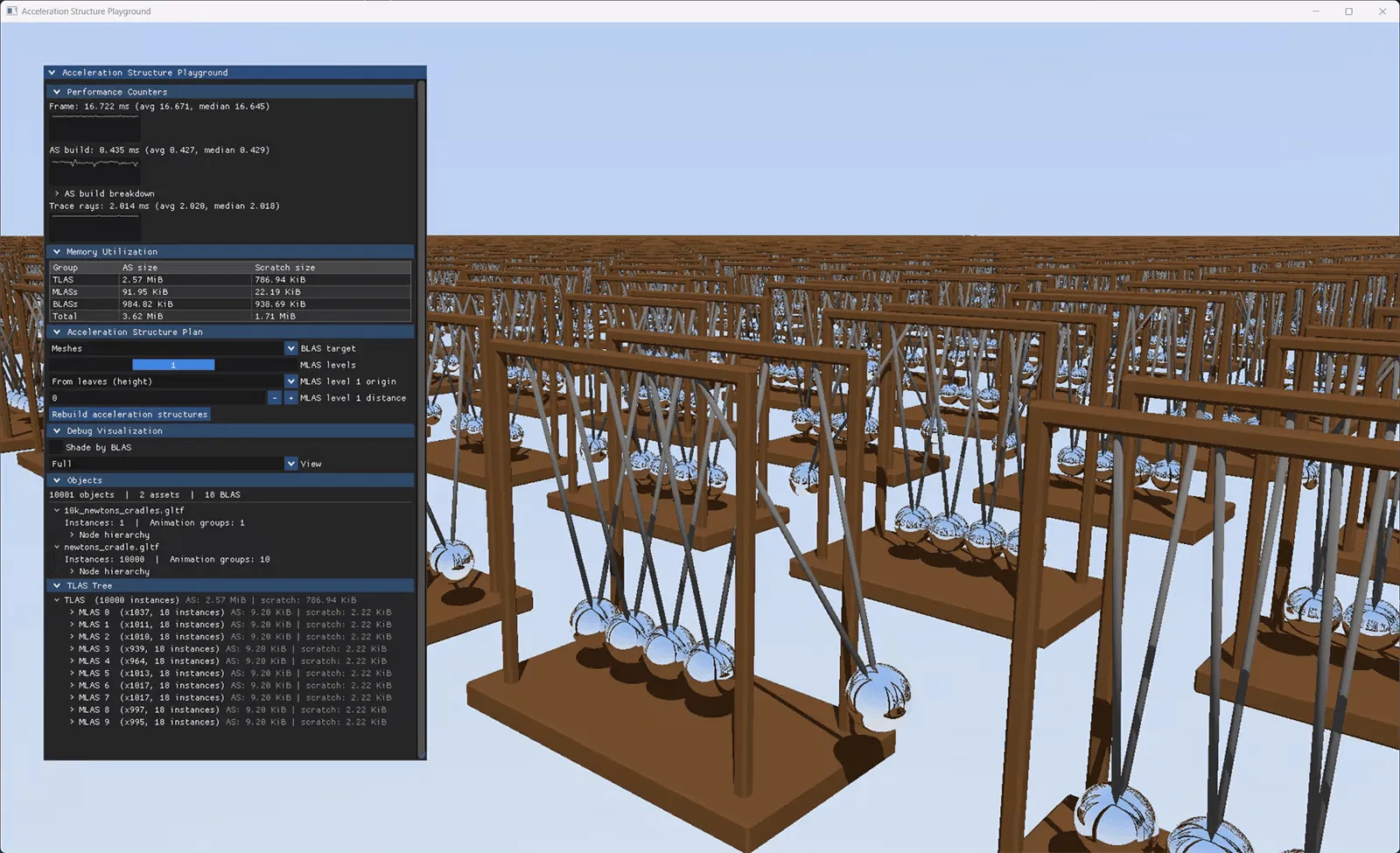
On November 24, 2026, AMD released RT-MLAS, a provisional Vulkan extension that adds an intermediate layer to the "acceleration structures" used to speed up ray-object intersection tests in ray tracing. Previously, the shapes of individual parts could be reused. The new approach also lets multiple parts share their placement and motion. In a demo rendering 10,000 Newton's cradles on a Radeon RX 9070, AMD measured acceleration structure memory usage of 3.62 MiB and a median rebuild time of 0.43 ms. In scenes with many objects repeating the same motion, adding a layer can substantially reduce the data the GPU has to hold and rebuild.
Memory use cut by about 92%, rebuilds up to about 3.7x faster
In AMD's test, 10,000 Newton's cradles, each made of several spheres swinging in sync, were assigned to one of 10 animation phases. A phase here means a time offset, so the same motion plays back at different timings.
The lower-level acceleration structure that stores individual shapes is called a BLAS (Bottom-Level Acceleration Structure). There are two conventional approaches: placing a BLAS for each part directly in the top-level structure, or combining each whole cradle into a single BLAS per animation phase. The latter requires rebuilding the BLAS every frame to follow the animation.
AMD's published measurements are as follows.
| Acceleration structure configuration | Memory usage | Median rebuild time |
|---|---|---|
| Per-part BLASes placed directly in the top level | 47.17MiB | 0.97ms |
| One whole-cradle BLAS per animation phase | 11.55MiB | 1.60ms |
| RT-MLAS | 3.62MiB | 0.43ms |
Test environment: Radeon RX 9070, Ryzen 7 5800X, 32GB RAM, Windows 11 Pro 10.0.26200, Adrenalin 26.20.25.01 driver with extension support.
Compared with managing a BLAS per part, RT-MLAS cut acceleration structure memory usage by about 92.3% and median rebuild time by about 55.7%. That is equivalent to rebuilding about 2.26 times faster. Compared with combining each whole cradle into a single BLAS, memory usage fell by about 68.7% and rebuild time by about 73.1%, making rebuilds about 3.72 times faster.
Reduction rates were calculated by dividing the difference from the conventional approach by the conventional value, and speed ratios by dividing the conventional rebuild time by the RT-MLAS rebuild time. The roughly 92% memory reduction and the roughly 3.7x rebuild speedup are based on comparisons with different conventional approaches. The measurements cover acceleration structure memory and rebuild time only; evaluating overall rendering performance also requires considering the time rays spend traversing the acceleration structure.
Sharing the motion of 10,000 cradles across 10 acceleration structures
Consider rendering a town with many identical houses. Even with conventional methods, the BLASes for walls, windows, and other parts can be shared, but placement information for each part is needed for every house. This is because the TLAS (Top-Level Acceleration Structure), which manages the whole town, directly references the parts that make up each house.
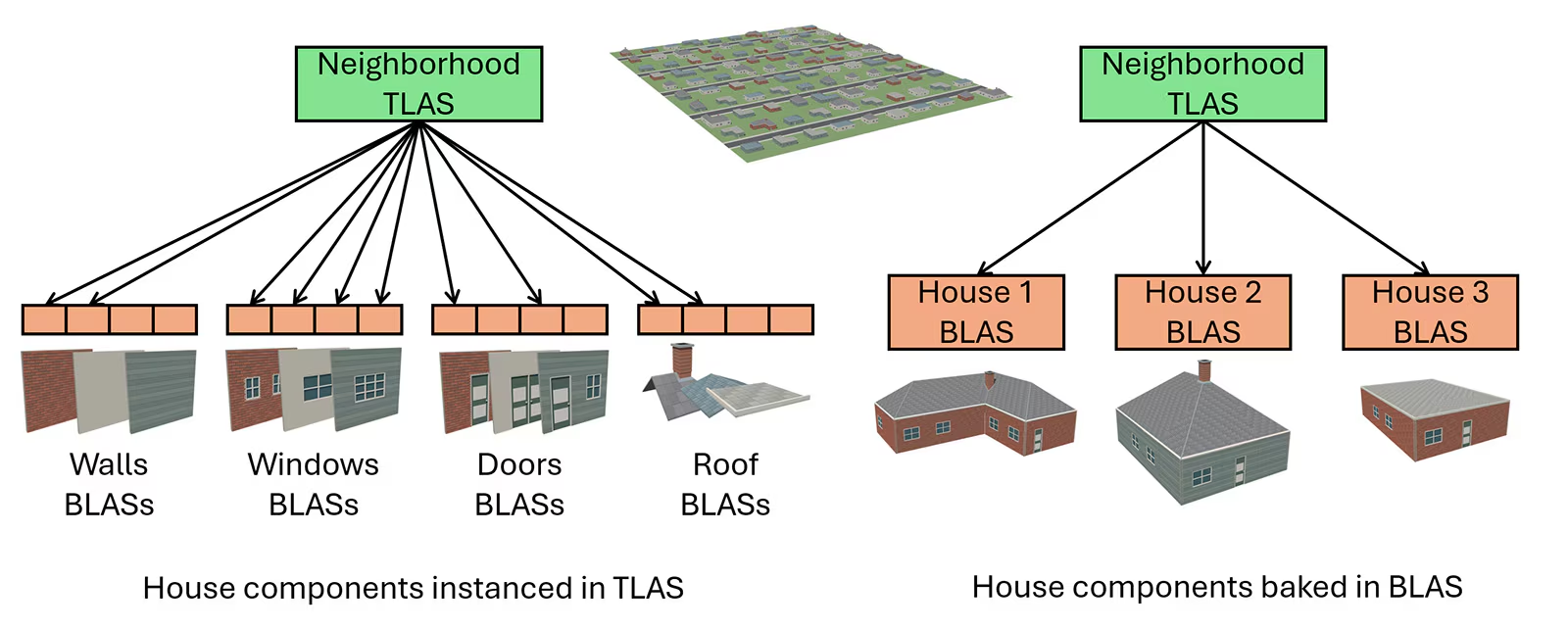
The intermediate acceleration structure AMD added, called MDLAS, bundles the parts of one house and their placement information. By referencing this MDLAS from the TLAS, houses with the same structure can be placed in different locations. According to the Vulkan extension's registry specification, up to two MDLAS levels can be inserted between the conventional TLAS and BLAS. Because an MDLAS can contain not only BLASes but also other MDLASes, objects made of multiple parts, and even larger structures, can be reused as hierarchical units.
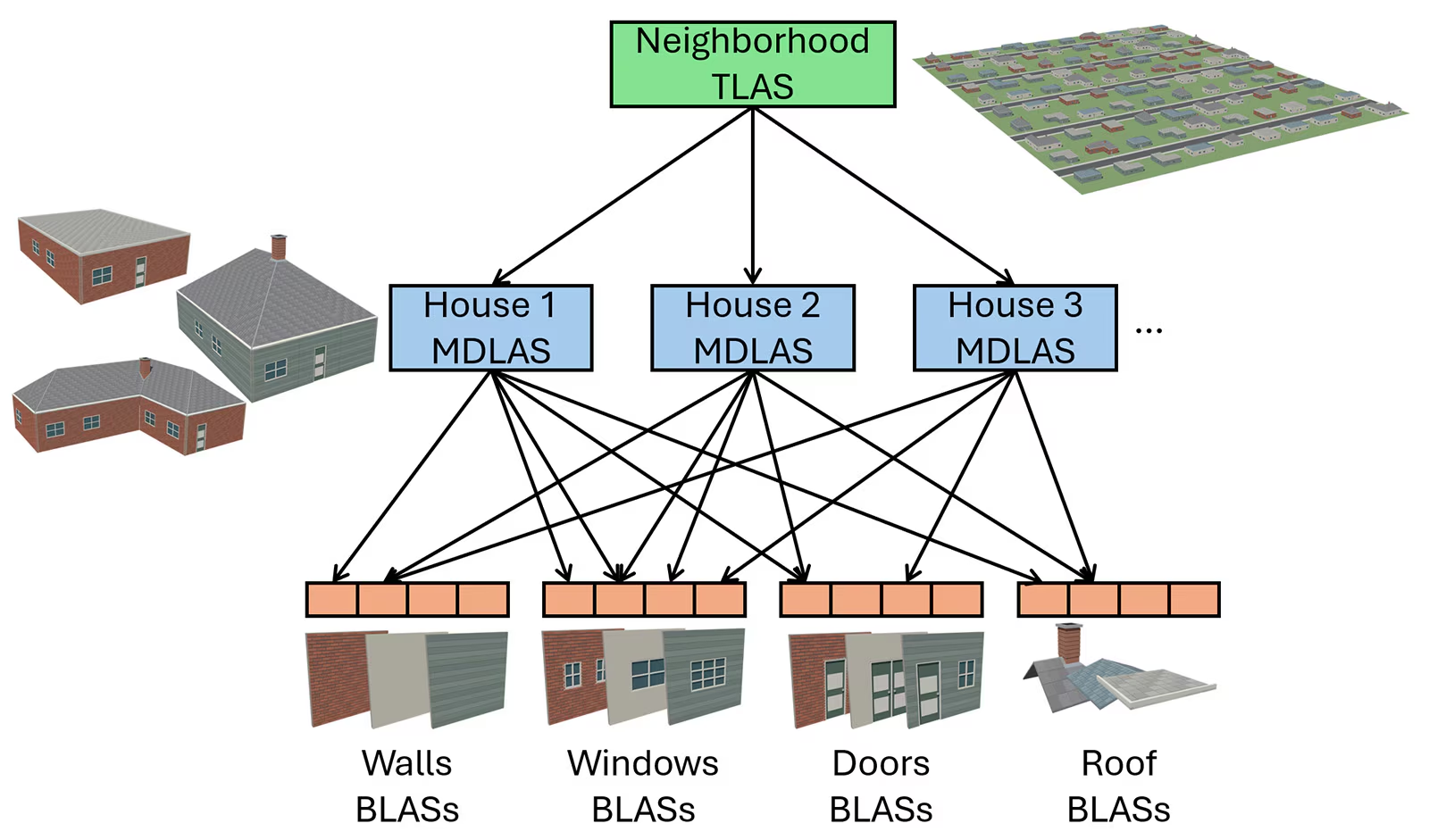
In the Newton's cradle test, position and orientation transforms are applied to each part's BLAS, and an MDLAS is created for each animation phase. Cradles swinging in the same phase share the same MDLAS. A sample AMD published on GitHub includes an implementation that randomly assigns 10 phases to 10,000 cradles. As a result, the memory savings depend not only on the total number of objects but also on how many objects share the same motion and how many parts each object contains.
Adding layers also increases the processing load when rays traverse the acceleration structure. AMD acknowledges this extra cost, but says the benefit of reducing build load grows with scene complexity. Intermediate layers also offer the advantage of finer control over which parts get rebuilt, in addition to allowing motion to be shared.
In large vegetation scenes, per-section updates remove a bottleneck
AMD's GPC2026 presentation slides describe a setup that splits a plant-heavy scene into per-section MDLASes, with each section holding dynamic plants and static terrain. Splitting into sections means only the areas that changed need to be rebuilt.
The basis for the plant motion is the tetrahedral cage technique AMD explained in September. It keeps dense geometry data and the BVH (Bounding Volume Hierarchy), a hierarchy that narrows down candidates for ray intersection tests, static, and deforms a small number of tetrahedra enclosing the shape. By converting ray coordinates into coordinates corresponding to the undeformed shape, it avoids the burden of rebuilding the acceleration structure for fine geometry every time. RT-MLAS groups these small BLASes and lets the update method be chosen per section.
In the demo shown in the talk, when the LOD (Level of Detail), which switches shape detail by distance and other factors, changes within a section, that section's acceleration structure is rebuilt. If nothing changes, the existing structure is kept and only the bounding volumes are updated. However, a rule was adopted to always rebuild when more than 30% of the plants in a section are at LOD0, the most detailed level.
The bounding-volume-only update keeps the BVH tree structure and changes the spatial extent each node covers. When object placement changes significantly, node bounding volumes can overlap, increasing the number of candidates examined in ray intersection tests. In such cases, rebuilding the BVH gives better traversal efficiency. Switching update methods per section balances build cost against traversal efficiency.
According to AMD, in the conventional setup the per-frame TLAS build triggered by LOD changes was the bottleneck, but after applying MLAS the bottleneck shifted to ray traversal, and average frame rate improved on the Radeon RX 9070 XT. Specific FPS figures and improvement rates were not disclosed. The 30% LOD0 threshold was also set to suit this demo scene.
P-TLAS (Partitioned TLAS), which can rebuild acceleration structures per section, also has advantages in traversal efficiency. According to AMD, P-TLAS merges its internal hierarchy into a single tree, so it often wins on traversal efficiency when each section has its own structure and no coordinate transforms are needed. MDLAS, on the other hand, allocates memory per section, lets developers choose between rebuilding and bounding-volume updates, and can reuse nested coordinate transforms and dynamic hierarchies. The presentation slides also show a future configuration combining MDLAS and P-TLAS.
Developers must handle instance information at each level
The Vulkan extension proposal adds instructions for retrieving instance information, which represents placed objects and parts, at each level. The existing InstanceId and InstanceCustomIndexKHR return the lowest-level instance information that directly references a BLAS. For example, when a ray hits a house wall, determining which house the wall belongs to requires consulting instance information at upper levels.
Instances in the TLAS are level 0, and OpGetInstanceIdAtLevelAMDX retrieves the instance index at a specified level. Application-assigned identifiers are retrieved with OpGetInstanceCustomIndexAtLevelAMDX. The ObjectToWorldKHR transform is the composition of the transforms at every level, while the mask that specifies ray visibility and the offset used to select the shader to invoke use the values of the lowest-level instance. Developers need to design which level's information to use for object identification and rendering.
The extension's formal name is VK_AMDX_multi_level_acceleration_structure. On the application side, developers enable the supported feature and add a flag permitting multiple levels when traversing acceleration structures. This flag is required not only for dedicated ray tracing pipelines but also for ray queries, which perform intersection tests directly from shaders.
At the time of announcement, supported GPUs are the Radeon RX 9000 series and Radeon AI PRO R9700/R9600 series. AMD has released extension-enabled driver 26.20.25.01 and a sample application, "Acceleration Structure Playground," which can be built using Windows and the Vulkan SDK. The driver's compatibility list also includes the Radeon RX 7000 series, but that indicates the driver's overall support range. The extension is a provisional AMD specification and has not yet been ratified. Support for DirectX 12 is also planned for the future.
When adopting it in actual games or graphics applications, developers will need to consider how many objects can share the same motion and how large the sections requiring rebuilds are, and evaluate build and traversal time together. If the savings in build load outweigh the increase in traversal load, it may be possible to keep ray tracing costs down even in large game worlds with many dynamic objects.