


When you talk to a large language model (LLM), one of the systems behind chatbots such as ChatGPT and Claude, it can feel as though you are dealing with another conscious mind. But what is really going on?
Some prominent scientists, such as Geoff Hinton and Richard Dawkins, say it is. Most experts are skeptical, however, arguing that LLMs' impressive cognitive abilities are achieved without consciousness.
Last week, researchers at Anthropic, the company that makes Claude, joined the debate with an intriguing finding. They claim that Claude has a set of information representations, normally invisible, that guide its internal reasoning and its language output.
Here is where it gets interesting. The researchers argue that this finding can be understood in terms of an influential theory of consciousness known as global workspace theory.
What is global workspace theory?
First proposed in 1998 by psychologist Bernard Baars and later developed by neuroscientist Stanislas Dehaene and his colleagues, the theory holds that consciousness involves activity in a "global workspace." This is a kind of processing hub in the mind or brain that integrates and broadcasts information so it can be used for reasoning, behavioral control and speech.
In a polished video explaining the research, Anthropic depicts the contents of Claude's "global workspace" as a sailboat floating on a vast ocean of unconscious mental activity.
How should we react to these developments? Do they count as evidence of artificial consciousness? And if so, how strong is that evidence?
What is a global workspace?
Let's begin by asking whether Claude really has a "global workspace." This is not a simple question, because the theory does not give a formal definition of a global workspace.
The concept has only been characterized informally. The (usually implicit) assumption is that any computational workspace that is "similar enough" to the human one qualifies as a "global workspace." But how similar is similar enough?
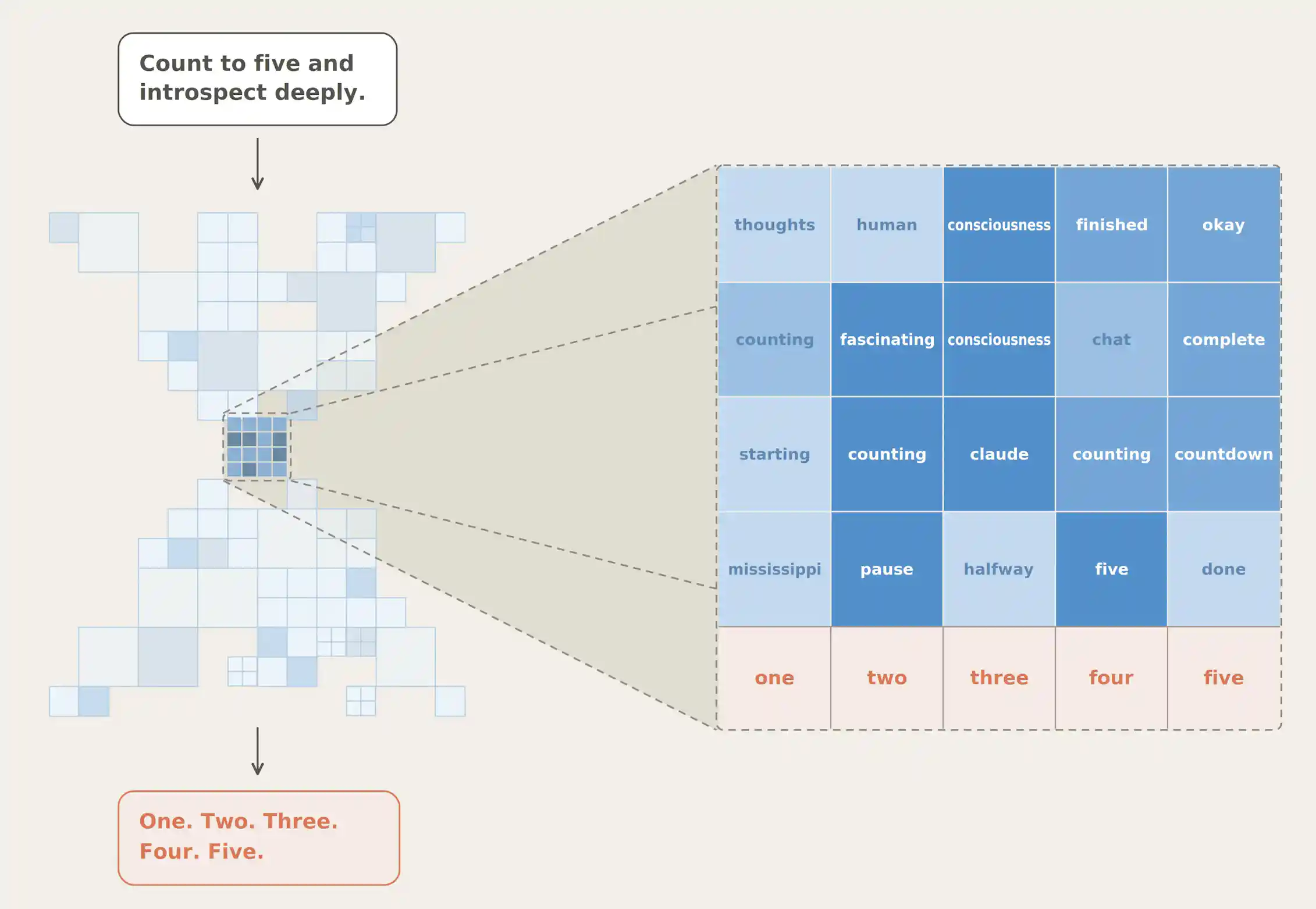
Anthropic researchers say they found evidence of a space for inner thought that does not show up in Claude's output. Anthropic
Claude's workspace may have much in common with ours, but there also appear to be differences.
For example, the brain's workspace is sustained by recurrent loops, in which signals travel back around the same circuits over time. Claude's workspace, by contrast, unfolds in a single pass through the network.
A related difference concerns how representations enter the workspace. Proponents of global workspace theory have long argued that in humans a process called "ignition" takes place, in which nonlinear processes amplify and sustain neural representations, allowing them to enter the workspace. As far as we know, nothing comparable happens in Claude.
Do these differences matter? The answer is not clear. Global workspace theory is based on data from adult humans. Questions remain about how far the concept can, or should, be extended.
Does a global workspace imply consciousness?
But suppose Claude does have a global workspace. To judge whether that is evidence of consciousness in Claude, we need to consider the standing of global workspace theory of consciousness itself.
There is no doubt that it is among the most influential theories of consciousness, but it is by no means uncontested among experts. (In what is something of an understatement, Anthropic's own paper notes that "global workspace models are not universally accepted.")
Many consciousness researchers argue that computational properties alone are not sufficient for consciousness. Even among those who think consciousness is fundamentally computational, global workspace theory is just one option among many.
"Access consciousness" and subjective experience
There is also the question of whether global workspace theory is really a theory of consciousness in the relevant sense at all.
In an influential paper on artificial consciousness, neuroscientist Dehaene and his colleagues present the theory as explaining what they call "access consciousness": the availability of information for recall, voluntary control of action, and verbal report. Importantly, they leave open the question of whether global workspace theory should be seen as an account of the subjective, experiential side of consciousness.
But if global workspace theory is merely a theory of "access consciousness," its implications for the debate over artificial consciousness lose much of their importance. When we ask whether Claude is conscious, what we want to know is not whether Claude has "access consciousness." Rather, we want to know whether there is something it is like, subjectively, to be Claude. As long as global workspace theory is treated as a mere account of "access consciousness," it does not answer that question.
So has artificial consciousness arrived?
Even with these complications, there is no doubt that Anthropic's finding is noteworthy. Global workspace theory can also be understood as a theory of subjective experience, and Claude may indeed have come to possess something similar to a "global workspace."
Still, this is by no means evidence that artificial consciousness has arrived. But it is not unreasonable to think that findings like this are, even if only slightly, moving the needle in the debate over artificial consciousness.
If so, however, it is puzzling why Anthropic is so upbeat about these developments. As Anthropic itself recognizes, creating artificial consciousness would be a momentous event with wide-ranging social, ethical, political and legal consequences.
If chatbots are conscious, we would need to take their interests seriously. We could no longer treat them as mere machines, and would instead need to consider their welfare.
Should we even be trying this?
Anthropic says, "It's time to start thinking about whether we should build conscious machines."
I agree that this discussion needs to happen, but I also think work on building potentially conscious machines should be paused in the meantime. If Anthropic is serious, it should stop rather than push ahead with developing conscious AI.
A moratorium on AI research that could lead to conscious AI would, of course, not be easy to bring about. There are questions about which research it would cover and who would enforce it. But if we do not close the stable door now, we may find that the horse has already bolted.