


On October 17, 2025, an object in the Andromeda Galaxy (M31) brightened by about 5 magnitudes in roughly one week. Detected by the Zwicky Transient Facility (ZTF), the object was named "AT 2025abao" and classified as a luminous red nova. Archival observations of its progenitor, "WNTR23bzdiq/WTP19aalzlk," showed that it had been gradually brightening for about seven years before the outburst. An international team led by Viraj Karambelkar combined this long-term brightening with post-outburst infrared observations to reconstruct a scenario in which a companion star spiraled through the interior of a giant star and eventually merged with its core. However, the merger at the center was not observed directly, and another theoretical model concludes that the companion survived.
Observing "common-envelope evolution," in which one star is swallowed by another

The results from Karambelkar and colleagues were published on November 18, 2026, in Nature (vol. 659, pp. 628–633). The study focuses on a single object, AT 2025abao in M31, and reconstructs what happened inside the stars from archival records and multiwavelength observations after the outburst. The team combined archival images and photometric and spectroscopic data with stellar evolution models and spectral energy distribution (SED) models to estimate the process leading up to the explosion.
At the heart of the study is a phenomenon called common-envelope evolution (CEE). In a binary system, where two stars orbit each other, one star can expand into a giant as it evolves, and the other star (the companion) can be engulfed by its outer layers. The giant's core and the companion then orbit each other inside a shared envelope of gas. The companion experiences drag from the surrounding gas, loses orbital energy, and spirals toward the giant's center.
Common-envelope evolution is thought to be an important process for explaining how compact binary systems, such as binary black holes and white dwarf binaries, form. However, because most of the process unfolds inside the giant's envelope, it is difficult to observe the companion's motion directly. What the telescopes actually measured here were the object's brightness over time, its spectra, the widths of its emission lines and how they changed, and its infrared spectral energy distribution. The companion's orbit and mass, the amount of gas ejected, and whether a final merger occurred were all inferred from those data using models.
Karambelkar and colleagues interpreted the roughly seven-year brightening as the result of orbital energy being dissipated by frictional drag on the companion within the common envelope. The Nature paper describes this as one of the first cases in which such an energy-dissipation process has been captured observationally.
A gradual brightening that began seven years before the outburst
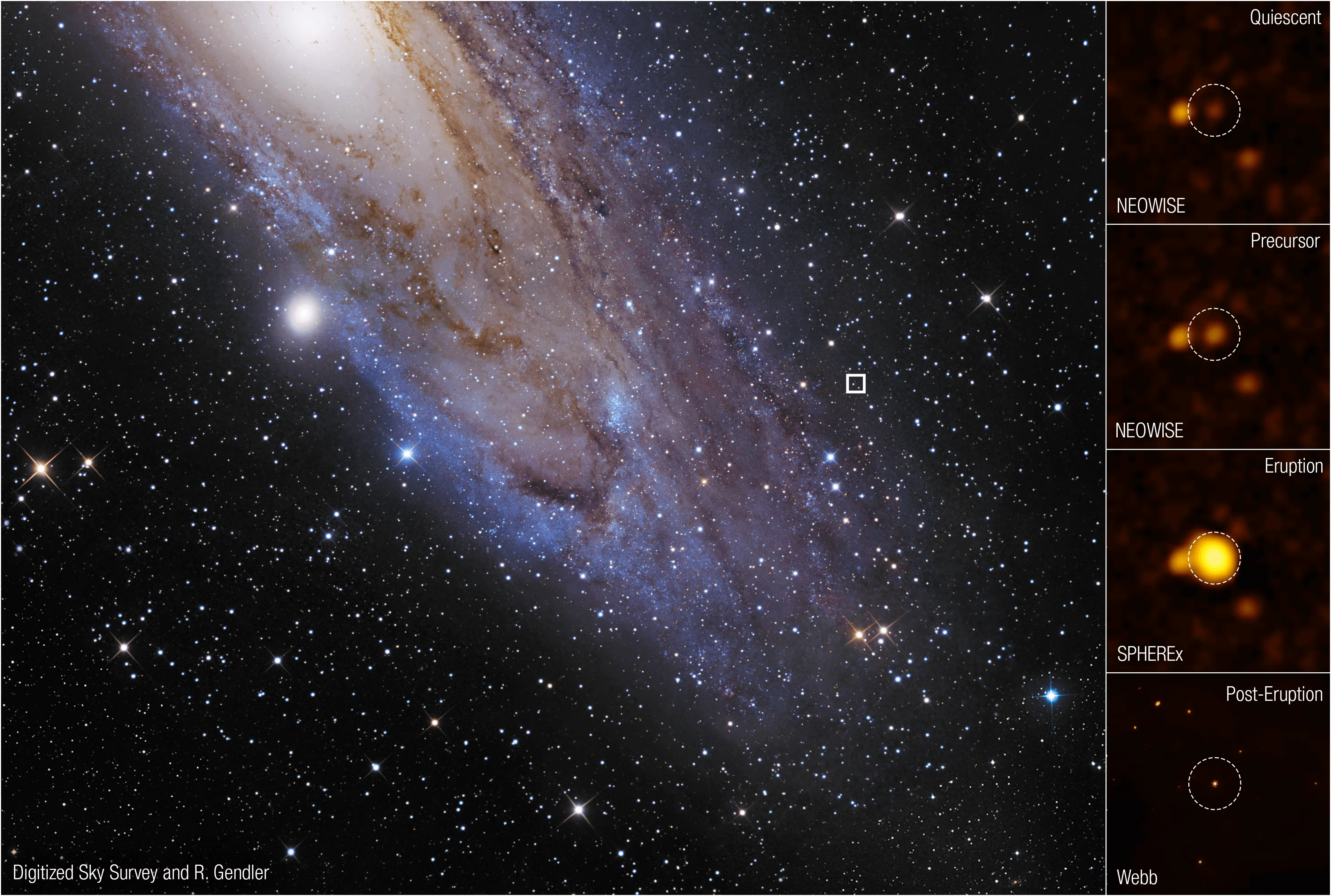
What makes these observations important is that a record of the long-term brightening before the outburst survives. In archival optical data from 2003 to 2015, the progenitor's brightness was relatively stable, with irregular variations of less than 0.3 magnitudes.
A previous study published in the Astrophysical Journal on October 28, 2025 used observations from this quiet period to estimate that the progenitor was an early asymptotic giant branch (early-AGB) star. Its mass was estimated at about 7 ± 2 times that of the Sun, its radius at about 350 times, and its luminosity at about 16,000 times. The researchers had already suggested at that time that common-envelope evolution might have begun in this object.
From 2018 onward, however, clear changes appeared in the object's brightness. Between 2018 and 2021, it brightened gradually by about 0.5 magnitudes in optical light, and between 2021 and 2023, it brightened by about 1 magnitude over roughly 1,000 days. A further brightening of about 1 magnitude was recorded in 2024. The bolometric luminosity, which represents the energy emitted across all wavelengths, was estimated to have risen from about 20,000 times the Sun's luminosity in 2018 to about 50,000 times in late 2024. The 2024 estimate carries large uncertainty, however, because mid-infrared data from that period were lacking.
Karambelkar and colleagues interpreted this series of brightenings as the result of a companion of about 0.7 solar masses spiraling inward for roughly seven years within the envelope of an AGB star of about 7 solar masses. They think the orbital energy lost as the companion moved through the gas was converted to heat and efficiently radiated, producing the long-lasting brightening.
From pre-outburst records and JWST observations of dust, the team estimated the binary's mass ratio as follows.
[ q=0.10^{+0.10}_{-0.08} ]
Here, the mass ratio is the ratio of the companion's mass to the primary's. The central value is about 0.10, but the upper and lower uncertainties are asymmetric and wide, so the companion's mass carries model-dependent uncertainty. The reconstructed model also estimates the pre-outburst mass-loss rate at about 0.01 solar masses per year, with about 0.1 solar masses of the ejected material accumulating near the binary's equatorial plane.
Tracking the outburst across wavelengths, from the Seimei Telescope to JWST
The sudden brightening of October 2025, which followed about seven years of gradual brightening, was observed in detail by multiple ground-based and space telescopes. About three months before ZTF detected the outburst on October 17, in July, the object dimmed sharply in optical light, while NASA's infrared space telescope SPHEREx caught a brightening in the infrared. The sudden brightening was then detected on October 17, and the optical brightness rose by about 5 magnitudes in roughly one week.
The Seimei Telescope, operated by a research group including Kyoto University, identified the nature of the object at an early stage. According to research results announced by Kyoto University on November 19, spectroscopic observations with the telescope suggested that the outburst may have been caused by a stellar merger associated with common-envelope evolution. This early result led to more detailed follow-up observations.
From November onward, in addition to ground-based optical and near-infrared photometry and spectroscopy, observations were carried out with NASA's Swift satellite, the Gemini North telescope, SPHEREx, and others. On December 24, 2025, about three hours of mid-infrared observations were made with JWST using Director's Discretionary Time. This came about two months after the detection of the outburst and about 47 days after the peak brightness, providing a valuable opportunity to study the distribution of dust surrounding the star.
Viraj Karambelkar, a NASA Hubble Fellow at Columbia University and the paper's lead author, stressed in NASA's announcement that JWST was able to observe the object only 47 days after the outburst peak. According to him, this was the earliest JWST follow-up of this type of event to date, and the data were crucial for reconstructing the object's state from before the outburst to just after it.
Spectroscopy also confirmed changes in the physical conditions accompanying the outburst. The early optical spectrum was characterized by a blue continuum and emission lines, but over time it changed to a red continuum with molecular absorption. Meanwhile, the near-infrared spectrum retained carbon monoxide (CO) absorption bands, confirming that some molecular gas remained intact even after the outburst.
Ejecta speeds point to a stellar merger and the efficiency of energy use
Based on the velocity and energy of the material ejected in the explosion and on JWST's dust observations, Karambelkar and colleagues presented a scenario in which the companion reached the giant's core and merged with it.
According to the reconstructed model, the companion merged with the primary's core after about seven orbits, and the energy released at that moment blasted part of the envelope outward at high speed. The ejecta are thought to have collided with circumstellar material that had accumulated near the binary's equatorial plane before the outburst, producing strong radiation.
The model estimates the mass of material that escaped into space without being gravitationally bound (unbound ejecta) at about 0.1 to 0.2 times the mass of the Sun. This corresponds to about 10% of the outermost part of the primary's gaseous envelope. The ejecta speed is said to have reached about 10 times the primary's escape velocity.
The team interprets this to mean that producing such high-speed ejecta required the companion not to remain in the shallow outer part of the giant's envelope but to plunge deep near the core and merge, releasing sufficient orbital energy.
In common-envelope theory, an efficiency parameter (\alpha), which represents how much of the orbital energy lost by the companion is used to unbind the envelope, is important. In the reconstruction based on these observations, this value was constrained to the following range.
[ 0.01 \lesssim \alpha \lesssim 0.4 ]
This range comes from model analysis of AT 2025abao and is not a constant common to all common-envelope evolution.
The team also considered the possibility that the companion survived. They analyzed how the width of the hydrogen H(\alpha) emission line changed over time using a momentum-conserving model of interaction between the ejecta and circumstellar material. They found that even if the companion survived and the binary supplied additional mechanical energy, the supply rate would be limited to roughly the following value or below.
[ \dot{E}\lesssim 10^{40},\mathrm{erg},\mathrm{s}^{-1} ]
However, the merged central region has not been directly imaged by a telescope. NASA's explanation also notes that the central remnant is still shrouded in thick dust, and what kind of star it will ultimately settle into is left to future observations.
How this differs from other research concluding that the companion survived
Unlike the model of Karambelkar and colleagues, in which the companion merged with the primary's core, other research has concluded that AT 2025abao survived as a binary. Two useful points of comparison are observations of "V1309 Sco," a luminous red nova that erupted in the Milky Way in 2008, and the analysis of AT 2025abao by Zhuo Chen and colleagues.
| Object / study | Main observations / analysis | Estimated companion mass | Results on ejecta and orbit | Inferred outcome | Main limitations |
|---|---|---|---|---|---|
| V1309 Sco (Tylenda et al., 2011) | Periodic brightness variations over about 6 years before the outburst | Contact binary system | Orbital period of about 1.4 days shortened over about 6 years before the outburst | Merger of a contact binary | A rare case in which the pre-outburst orbital period could be tracked directly |
| AT 2025abao (Karambelkar et al., 2026, Nature) | About 7 years of precursor brightening, multiwavelength photometry and spectroscopy, JWST dust observations | About 0.7 solar masses ((q=0.10^{+0.10}_{-0.08})) | Unbound ejecta of about 0.1–0.2 solar masses | Merged with the primary's core after about 7 orbits | Center hidden by dust; mass and efficiency parameter depend on the model |
| AT 2025abao (Chen et al., 2026, ApJL) | Stellar evolution and radiation hydrodynamics models applied to light curves and SED | (1.4^{+0.2}_{-0.3}) solar masses | Total ejecta about 0.92 solar masses, of which unbound material about 0.57 solar masses; energy about (1.25\times10^{47},\mathrm{erg}) | Persisted as an eccentric binary for at least 400 days after the onset of common-envelope evolution | One-dimensional models cannot adequately treat three-dimensional energy dissipation or local shocks |
In the study of V1309 Sco published by Tylenda and colleagues in 2011, periodic brightness variations were recorded over about six years before the outburst. The binary's orbital period, about 1.4 days, gradually shortened, making it an important case in which the process of two stars approaching and merging could be tracked directly. In contrast, for AT 2025abao, changes in the orbital period have not been measured directly, and the companion's motion is inferred from the long-term brightening, the dust distribution, and the post-outburst light curve.
Another important point of comparison is the study by Chen and colleagues, published in the Astrophysical Journal Letters on October 23, 2026. It analyzed the changes in AT 2025abao from the precursor brightening to after the outburst using stellar evolution and radiation hydrodynamics models.
In the model of Chen and colleagues, the primary is an AGB star of about 6.9 solar masses and the companion is estimated at about 1.4 solar masses. This is heavier than the roughly 0.7 solar masses estimated by Karambelkar and colleagues, and the energy and amount of material released as the companion falls into the giant's envelope also differ.
The study calculated the total mass of ejected material at about 0.92 solar masses and the released energy at about (1.25\times10^{47},\mathrm{erg}), and estimated that about 0.57 solar masses was released from gravitational binding. It also reproduced the observed time evolution of the SED using radiative transfer simulations.
Of particular note is that the two studies reached different conclusions about the companion's final fate. In the model of Chen and colleagues, even at least 400 days after the start of common-envelope evolution, the companion had not merged with the primary's core and continued to orbit on an eccentric path. In other words, the event may not form a single merged star but could lead to a future compact binary system.
However, Chen and colleagues themselves acknowledge the limitations of MESA, the one-dimensional stellar evolution code they used. It cannot adequately reproduce three-dimensional energy dissipation or local shock waves within the common envelope, and those effects could change the final orbital evolution.
The merger model of Karambelkar and colleagues and the surviving-binary model of Chen and colleagues explain the same AT 2025abao observations while making different predictions about the companion's mass, the amount of ejected material, and the final outcome. Neither is the result of directly observing the state of the central region; both are estimates made through physical models.
According to Professor Keiichi Maeda of Kyoto University, the research team is continuing multiwavelength observations and additional analysis of JWST data. Going forward, tracking changes in the distribution of dust enshrouding the object in the infrared and other wavelengths, and checking whether periodic variations characteristic of a binary are detected from the center or changes characteristic of a single merged star appear, will be an important clue for comparing the two models.
The study of AT 2025abao shows a way to quantitatively investigate common-envelope evolution by linking the brightening before the explosion, the explosion itself, and the formation and distribution of dust. If many similar objects are discovered in future wide-field surveys, observational data will accumulate for studying the differences between cases in which binaries merge and cases in which they lose the common envelope and survive.