


On July 9, 2026, Anthropic released "Reflect," a new feature for reviewing how you use Claude, as a beta. It summarizes usage themes and work patterns from past conversations, creating an opportunity to think about which tasks to leave to AI and which ones you want to keep doing yourself. While it includes settings that encourage breaks, it also recommends other Claude features such as Projects. Both a mechanism for preventing overuse of AI and a mechanism for embedding Claude into daily work now sit on the same dashboard.
Reflect Shows 1, 3, 6, and 12 Months of History
Reflect is generated from the settings screen on Claude's web and desktop versions. It is available to Free, Pro, and Max users who have Memory enabled. Claude's Memory expanded to free users as of March 2026, so this new feature is not an analysis tool limited to paying subscribers. Reflection of conversations conducted in Cowork will be added in the future.
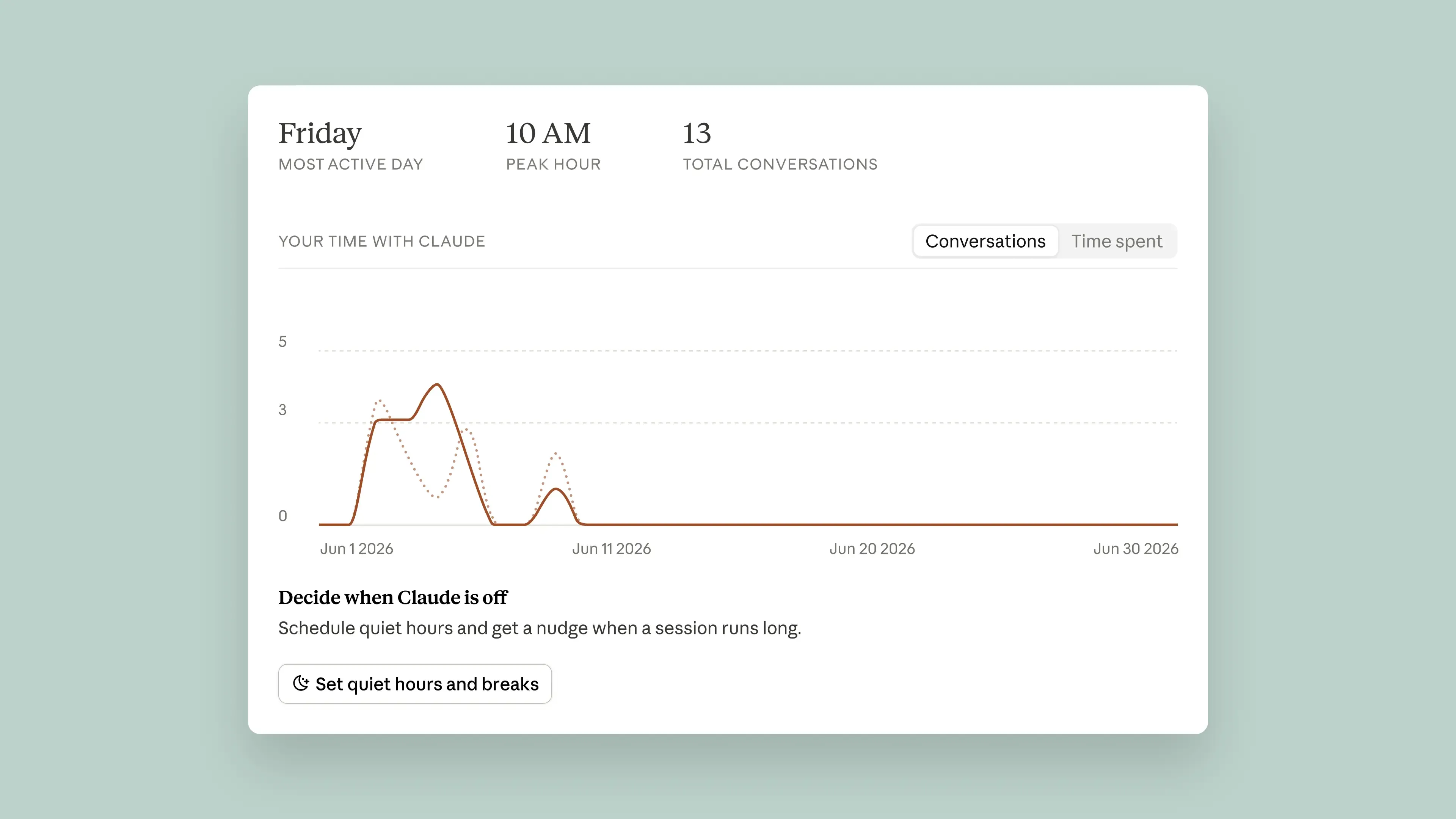
Users can choose the period they want to review from the past 1, 3, 6, or 12 months. The report shows the main topics discussed with Claude, the time periods when the user is most active, and what kinds of tasks were carried out. Display of time spent on usage is also planned but had not yet been implemented as of the announcement.
This is not simply a feature for looking at numbers. Reflect periodically displays questions such as "What is it that you want to keep doing yourself, even though Claude could do it faster?" There are also settings to designate quiet hours when you'd rather not be disturbed, or to trigger a break notification after using the service for a certain length of time. However, both are dismissible reminders rather than features that forcibly restrict usage time.
From Reflection to Suggestions for Future Use
What distinguishes Reflect is that, after showing usage history, it goes a step further to address "how should you use it next." As its evaluation criteria, it uses the "4D AI Fluency Framework," which is also used in a course Anthropic co-offers with university professors. The 4Ds are: Delegation, deciding what scope to hand off to AI; Description, putting objectives into words; Discernment, judging the output; and Diligence, taking responsibility for the results.
The report summarizes your collaboration with Claude according to each of these elements. For example, it might note that you tend to rewrite email drafts in your own voice, or that you decide on a policy before delegating the work. Based on this, for users who repeatedly explain the same background information, it suggests Projects, which can consolidate ongoing context. In this way, the output of the analysis directly becomes a gateway to other Claude features.
As background for Reflect, Anthropic cited a large-scale conversational interview conducted in December 2025. A total of 80,508 people from 159 countries, speaking 70 languages, participated, answering questions about hopes and concerns regarding when AI should be used and which tasks are better left to humans. Participants were voluntarily gathered from among Claude users, so this is not a survey representative of the general population. Even so, alongside hopes for improved productivity, participants also expressed desires for improved quality of life and personal transformation, as well as concerns about autonomy, cognitive function, and dependency. With Reflect, users can consider these questions in light of their own usage history.
Encouraging Pauses While Also Deepening Attachment to Claude
Break notifications and quiet-hour settings are features that let users themselves decide the appropriate distance to keep from an always-responsive chat AI. In developing this, Anthropic collaborated with MIT Media Lab's Advancing Humans with AI, Boston Children's Hospital's Digital Wellness Lab, and the Family Online Safety Institute. Given that the feature deals with sensitive conversations, digital wellbeing experts were brought into the design process.
At the same time, this reflection function visualizes just how broadly Claude has become embedded into daily life. TechCrunch analyzed that by displaying usage records in graphs and suggesting features like Projects, the effect is to make users more conscious of Claude as the foundation for their work. The more history and ongoing context accumulates within a single service, the greater the burden of switching to a competitor. While this is not a stated goal from Anthropic, there is reason to believe that such product design contributes to user retention.
What we see here is less a contradiction than a reflection of two demands facing consumer AI. Products can't grow unless people use them daily. But simply increasing the frequency of use raises concerns about over-reliance on AI for decision-making. Rather than stopping usage, Reflect lets users themselves decide, within Claude, how much to rest and how much to delegate. It is a design in which the service itself provides the space to support that choice.
The Boundaries of Privacy Lie Within the Dashboard
In personal usage analysis, what is excluded from analysis matters just as much as what is included. According to Anthropic, Reflect does not reference secret chats, nor does it incorporate the original files from connected tools. For example, if you had Claude summarize your inbox, the original emails are excluded, but a summary that remains in the conversation may appear in the reflection. Conversations connected to health-integration tools are excluded from the analysis altogether.
Sensitive conversations are not necessarily erased entirely; they may appear in a more abstracted form. Anthropic states that information and insights within Reflect are not used for any other purpose. That said, it's hard to judge just how much abstraction is needed for users to feel reassured without actually seeing the reports themselves. During the beta period, questions will also arise about the granularity of controls—whether users can exclude specific unwanted items individually, or delete and regenerate analysis results.
The next things to watch for with Reflect are whether the planned display of usage time ends up being just a simple total, or whether it connects meaningfully to users' own goals. If Cowork's work history is eventually added as well, the scope of activity that Reflect analyzes will expand even further. Will it grow into a design where users can adjust for themselves the line between helpful advice and excessive intervention? That is what the beta period should reveal.