


A research team at the ARC Centre of Excellence for Transformative Meta-Optical Systems (TMOS), an Australian meta-optics research hub, has demonstrated rewritable reflective display technology that can hold an image for months without a power supply.
Conventional displays, such as those in smartphones and televisions, consume power even when they simply keep showing the same image. By contrast, a thin film made from antimony selenide (Sb₂Se₃), a type of phase-change material, can maintain an optical state without power once it has been written. In this study, the team used a millimeter-scale thin film and succeeded in both rewriting images and retaining them over the long term.
A multilayer thin film that produces color through atomic rearrangement and optical interference
The joint TMOS research team, which includes RMIT University and the Australian National University (ANU), published its findings on the fundamental technology of a reflective display using Sb₂Se₃ thin films in the journal Advanced Photonics Research.
The device used in the experiments has a multilayer structure: a sputtered Sb₂Se₃ layer and an indium tin oxide (ITO) layer stacked on a highly reflective silicon substrate coated with platinum (Pt) and titanium (Ti). The 5 nm-thick ITO layer on top serves as a protective film that prevents selenium from evaporating and antimony from oxidizing during heat treatment and laser irradiation.
The ability to retain an image without power comes from the non-volatile phase-change properties of Sb₂Se₃. Phase-change materials (PCMs) can have their atomic arrangement changed repeatedly by stimuli such as heat or light. Sb₂Se₃ can take an amorphous state, in which atoms are arranged irregularly; a crystalline state, in which they are arranged regularly; and intermediate states in which the two coexist. Because each state persists after the external stimulus is removed, displaying a still image does not require a continuous power supply.
When the atomic arrangement changes, optical constants of the material such as refractive index and absorption coefficient change as well. The team exploited this property by incorporating Sb₂Se₃ into a multilayer structure in which optical interference occurs. The degree of crystallization and the film thickness alter the interference conditions, making it possible to control the wavelength and intensity of reflected light and thus express different colors and shades. The researchers also mention potential applications beyond rewritable multi-level displays, including high-density optical information storage.
Writing images with nanosecond laser pulses and erasing them with 200 °C heating
Rather than controlling pixels directly with electrical signals as in typical electronic displays, this device rewrites images through laser irradiation and heating. In the phase-change experiments, a 15 nm Sb₂Se₃ thin film sandwiched between 5 nm ITO layers was first heated (annealed) at 200 °C for 2 minutes to bring it to a uniform crystalline state.
The writing and erasing process
Images are written and erased as follows.
- Writing (nanosecond laser pulses): Laser irradiation locally melts the thin film, and rapid cooling locks the atoms into the amorphous state before they can return to an ordered crystalline structure. In the experiments, laser fluences (irradiation energy per unit area) of 1.80 to 4.36 J/cm² formed partially amorphized intermediate states, and 4.51 J/cm² produced a transition to a fully amorphous state. The team verified changes in optical properties and structure using reflectance measurements, Raman spectroscopy, and ellipsometry.
- Erasing (heating at 200 °C): Using a hot-plate-type Linkam stage, the film was heated in air at 200 °C for 1 minute, recrystallizing the entire film and returning it to the uniform pre-writing state.
In the demonstration, images including a map of Australia, the TMOS logo, and a koala were drawn. For the map of Australia, seven laser-written states were combined with a background in the unirradiated crystalline state to express colors ranging from blue to purple. The koala image was drawn at 60 × 60 pixels in a 1.2 × 1.2 mm area, with grayscale tones reproduced by adjusting the power of a laser with a 16 μm spot diameter.
Seven rewrites and three months of unpowered retention confirmed
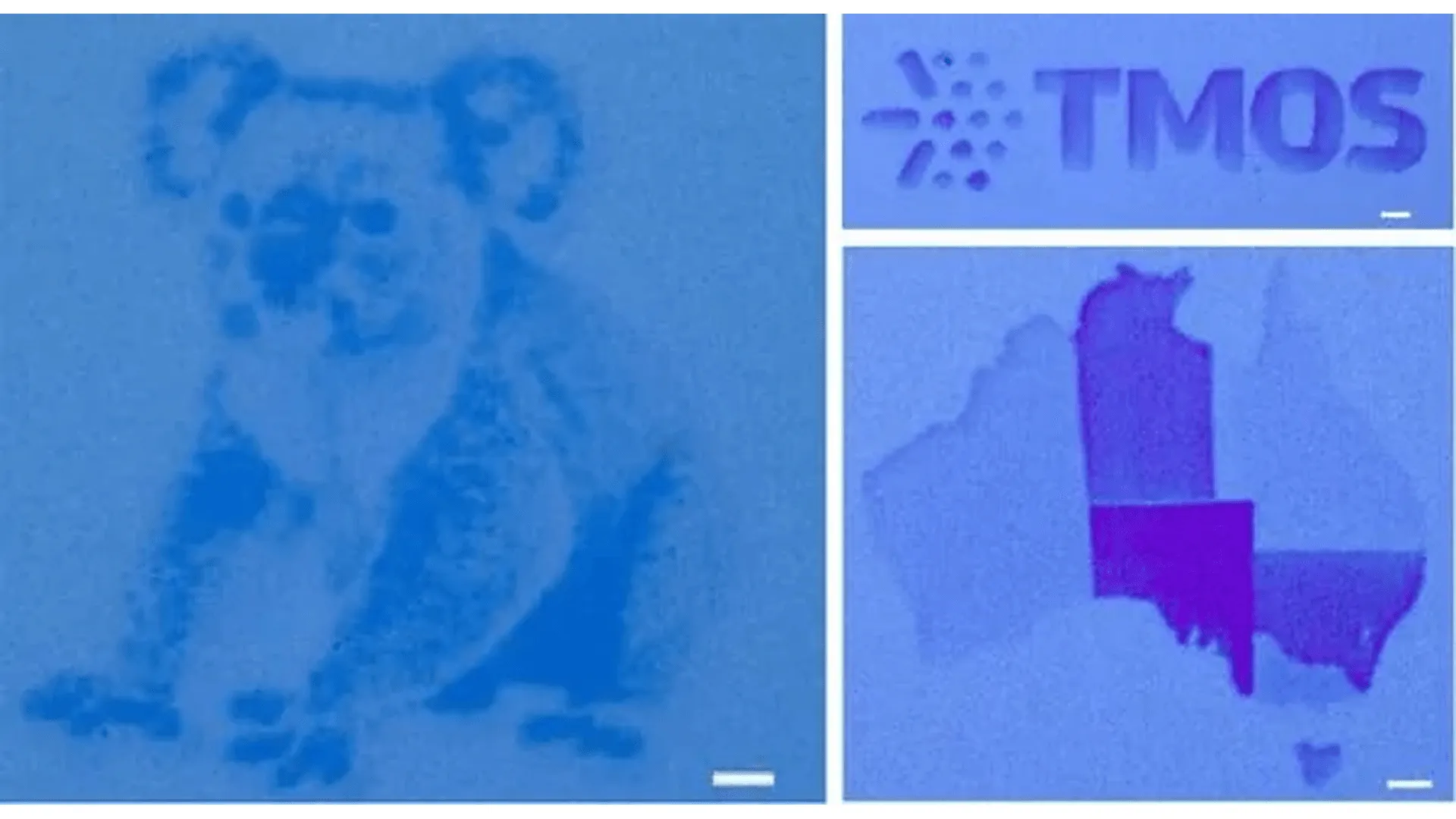
From March to November 2025, the research team ran seven rewrite tests, repeatedly amorphizing and recrystallizing the film. Raman spectroscopy repeatedly confirmed the spectra corresponding to each phase. In the first cycle, the laser power was insufficient and a full phase change was not achieved; excluding that measurement point, the variation in resonance wavelength for each of the two phases stayed under 7 nm. After the map of Australia was erased by 200 °C heating, observation of the surface under a 5× optical microscope showed no trace of the original image.
In the long-term retention test, a device on which the koala image had been written was stored in air at room temperature for three months, and the image was confirmed to have been maintained. Micrographs taken before and after storage show differences in tint, which the paper explains as due to the use of different microscopes and white balance settings. In TMOS's announcement, lead researcher Dr. Phuong Yen Le said, "I actually still have that image, and it looks the same a year later." The retention period formally reported in the paper is three months, but according to her observation the image has been maintained after one year.
Note that this retention test was conducted at room temperature, and durability against high temperature and humidity, exposure to strong light, mechanical wear, and similar factors has not been verified. The total energy required for writing and erasing, the rewrite speed for a full screen, and the power consumption as an electrically driven display have also not been reported, and no independent replication by third parties has been confirmed.
How this differs from earlier research on phase-change materials
Research on reflective displays and multi-level displays using phase-change materials has been under way for some time.
- 2014 study (GST): Hosseini, Wright, Bhaskaran, and colleagues published in Nature a method that uses an ultrathin germanium-antimony-tellurium compound (Ge₂Sb₂Te₅, GST) to change color through electrical stimulation and retain the state. Reflective and semi-transparent devices were formed on rigid substrates and flexible films, and experiments were also conducted in which 300 × 300 nm pixels were switched individually using a scanning probe.
- 2016 study (AIST): A study using a silver-indium-antimony-tellurium compound (Ag₃In₄Sb₇₆Te₁₇, AIST) reported voltage-driven multi-level grayscale display and also compared it with GST.
| Study / material | Writing method | Color / tone control | Main demonstrated results |
|---|---|---|---|
| This study (Sb₂Se₃) | Nanosecond laser pulses (erasing by 200 °C heating) | Multi-level display via laser fluence and film thickness (blue to purple, grayscale) | 1.2 × 1.2 mm (60 × 60 pixels), 7 rewrites, 3 months of room-temperature retention |
| 2014 study (GST) | Electrical stimulation (scanning probe, etc.) | Color switching and retention through phase change in ultrathin films | Individual switching of 300 × 300 nm pixels, demonstrated on rigid substrates and flexible films |
| 2016 study (AIST) | Voltage-driven | Multi-level grayscale display | Comparison with GST, demonstration of multi-level display |
Electrical rewriting and multi-level display had already been demonstrated in earlier studies. What distinguishes this study is that, in a multilayer film using Sb₂Se₃, it demonstrated multi-level writing with nanosecond lasers, repeated rewriting, and image retention for three months without power.
Challenges for practical use: electrical driving and a wider color gamut
To develop a practical display, the current approach of writing with a laser and erasing by heating the entire film will need to be replaced with a mechanism that can be controlled electrically pixel by pixel. Dr. Le is currently investigating the material's electrical properties with a view to electrical driving. The team also points out that the range of colors the current multilayer structure can express is limited, and that reproducing a wider range of colors may require rethinking the device structure.