


Apple's AI strategy may only truly kick into gear in 2027.
Apple, which has long remained silent and maintained a cautious stance, is finally poised to launch a full-scale offensive into the generative AI hardware space, according to reports from Bloomberg, The Information, and others.
In this article, we'll cover two pieces of news—The Information's report on an "AirTag-style wearable AI pin" and Bloomberg's scoop on "Siri's complete transformation into a chatbot (codename: Campos)"—and explore the ambitious picture that emerges of Apple aiming for the throne of "next-generation ruler."
The Mysterious Hardware: The Full Picture of the AirTag-Style "AI Pin"
According to The Information's report, Apple is currently developing an entirely new category of wearable device in complete secrecy. It's neither a watch nor glasses. It's a "Pin"-shaped device.
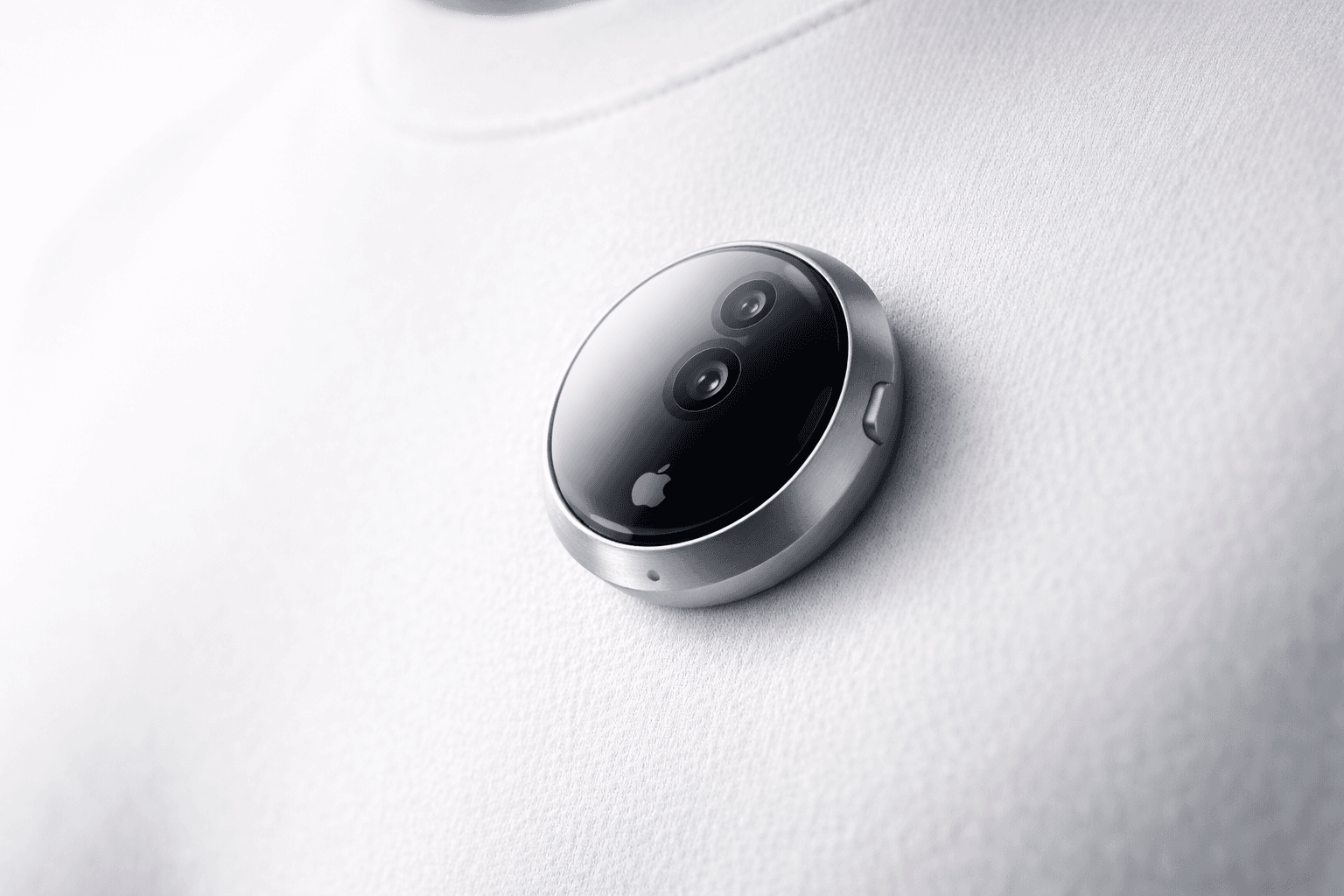
Design and Specs: The Pinnacle of Minimalism
The device under development is said to have a shape reminiscent of an existing hit product in Apple's ecosystem: the AirTag.
- Shape and materials: A thin, flat, circular disc shape. Built with an aluminum and glass shell, it's expected to combine the premium feel and durability characteristic of Apple products. The size is roughly equivalent to an AirTag, though it will likely be slightly thicker due to internal components.
- Visual input (Vision): The standout feature is two cameras mounted on the front. One is said to be a standard lens and the other a wide-angle lens, allowing the device to perceive not just the user's "field of view" but the entire surrounding environment broadly. This functions not as a mere photo-taking tool but as an "AI eye" for environmental awareness and context understanding.
- Audio input and output: Equipped with a three-microphone array that filters out ambient noise while accurately capturing the user's voice and surrounding sounds. It also has a built-in speaker, enabling voice feedback.
- Control interface: Here we see Apple's characteristic attention to UX. A physical button is placed on the side. Amid growing privacy concerns over always-on recording, providing a physical trigger is intended to give users peace of mind and reliable control.
- Power system: The back features a magnetic induction charging interface similar to the Apple Watch. This maintains compatibility with the existing charging ecosystem.
Launch Timing and Production Scale
According to The Information, the device's launch is projected for "as early as 2027." Apple is also reportedly taking a confident stance from the outset, with rumors of production plans on the scale of 20 million units. This suggests it's not an experimental niche product but a strategic offering aimed at the mass market from the start.
Project "Campos": The Death and Rebirth of Siri
Alongside the hardware innovation, a software transformation—swapping out the "brain"—is underway simultaneously. According to Bloomberg's Mark Gurman, Apple is undertaking a fundamental rebuild of Siri under the codename "Campos."
From Voice Assistant to AI Chatbot
Until now, Siri has been merely a "voice assistant" that performs pre-programmed tasks. However, the new Siri will evolve into an "AI chatbot" akin to ChatGPT or Claude.
- Interface overhaul: The conventional Siri interface will be discarded, and iOS 27 (along with iPadOS and macOS) will adopt a new UI that seamlessly supports not just voice but text input as well. This allows users to interact via text on a train and via voice at home, adapting to the situation.
- Dramatically enhanced capabilities: It will cover nearly all the functions offered by current generative AI—web search, image generation, coding assistance, and long-form summarization and analysis. Even more importantly, it can recognize on-screen content (the contents of open windows or apps) and offer operations or suggestions based on that.
- Integration with Google Gemini: What's notable here is the depth of the partnership with Google, as pointed out by Wccftech. Apple is reportedly adopting Google's Gemini model (some reports cite a custom model with 1.2 trillion parameters) as the backend for this Siri chatbot, leveraging Google's TPUs and cloud infrastructure. This represents an extremely pragmatic and realistic "hybrid strategy"—running Apple's own AI development (Apple Intelligence) in parallel while tapping the strongest external models for tasks that demand top performance.
Why a "Pin" Now?: Industry Shifts and Threats
At this point, some readers might wonder, "Why is Apple making an AI pin now, given the track record of failures?" Indeed, Humane's "AI Pin" (Japanese) and Rabbit's "R1" were harshly judged by the market due to short battery life, overheating issues, and above all, their failure to "offer value beyond what a smartphone could already do."
However, there are clear threats and calculated odds behind Apple's move at this particular moment.
The Shadow of OpenAI and Jony Ive
The biggest threat is the AI hardware reportedly being developed jointly by OpenAI's Sam Altman and Jony Ive, the former soul of Apple design (Japanese). This too is rumored to arrive around 2027. If they present "something to replace the iPhone" first, Apple risks losing its status as the innovator. Apple's development of the AI Pin is a powerful "blocking move" and defensive line against this development.
Learning from "Failures" and Apple's Advantages
The causes of Humane's and Rabbit's failures lay in immature hardware and a lack of ecosystem. Apple, by contrast, holds overwhelming advantages in the following areas:
- Apple Silicon's power-efficiency technology: Its proprietary chip design capabilities make it highly likely to solve heat and battery issues.
- Integration with the iPhone: Rather than insisting on standalone operation, distributing processing with the iPhone as a mothership allows Apple to achieve both lighter weight and high functionality.
- Trust in privacy: For a device that's constantly worn with cameras and microphones, the "privacy protection" brand image Apple has built over many years is a massive asset that competitors cannot easily replicate.
Apple's Vision for "Ambient Computing"
This author sees this move not as the mere launch of a new product, but as a signal that Apple is beginning to fully commit to a shift toward "ambient computing" (computers that blend into the environment).
From "In Hand" to "In Space"
Vision Pro offered an immersive experience as a "spatial computer," but it was far too bulky for daily wear. This new AI Pin, on the other hand, minimizes its presence while constantly sharing the user's sight and hearing.
A user might say "Hey Siri, look at this" while asking a question about a document in hand or the scenery in front of them. Or the device might analyze conversation content in the background and whisper needed information straight to their AirPods. Here, even the action of pulling a device out of one's pocket becomes unnecessary.
Risks and Rewards from an Uneasy Alliance with Google
Adopting Google Gemini as Siri's brain (Japanese) will be a magic bullet that instantly elevates Siri's performance to world-class levels in the short term. However, in the long run, this also carries the risk of depending on a competitor for core AI technology.
As Bloomberg's report indicates, Apple is positioning this chatbot Siri as a core feature of "iOS 27." In other words, from late 2026 into 2027, Apple is attempting to redefine its own OS experience atop Google's infrastructure. This reflects both the aspect of defeat—that in-house AI development couldn't keep pace—and Apple's determination to swallow its pride for the sake of user experience.
2027: What Comes After the Smartphone Begins
The 2027 timeline carries decisive significance for Apple.
Twenty years since the iPhone's debut. The market has matured, and hardware evolution is nearing saturation. As OpenAI and Google attempt to rewrite the concept of hardware led by software (AI), Apple is trying to ride that wave with two pillars: the "AirTag-style AI Pin" and the "reborn Siri."
Will Apple, with its overwhelming capital, technological power, and ecosystem strength, turn into reality the world that Humane dreamed of but couldn't achieve? Or will the wall of the smartphone prove too thick after all?
We'll likely witness the answer at WWDC 2027, or perhaps at a special event in September. One thing is certain: Apple no longer intends to remain a company that sells only iPhones.
Sources
- The Information: Apple Developing AI Wearable Pin
- Bloomberg: Apple to Revamp Siri as a Built-In iPhone, Mac Chatbot to Fend Off OpenAI