


On September 9, 2026, Apple announced the AirPods 5, the fifth generation of its open-ear wireless earbuds. Compared to the noise-cancelling model of the previous-generation AirPods 4, the base model—priced at 23,800 yen (tax included)—now comes standard with active noise cancellation (ANC) that reduces external noise by up to 50 percent. The higher-end model, which includes a wireless charging case and costs 27,800 yen (tax included), adds a swipe-based volume control on the stem—a first for open-ear AirPods—along with a battery that delivers up to 5 hours of standalone playback with ANC enabled. How did Apple manage to achieve near-sealed-earbud levels of quiet and control in an open-ear design, and how does this fit into the everyday interface for Apple Intelligence? Let's examine the structure and the trade-offs.
Standardizing ANC Across All Models, Effectively Cutting the Entry Cost by 6,000 Yen
The biggest change in this product refresh lies in the restructuring of the lineup's tiering itself. With the previous-generation AirPods 4, the lineup was split into two tiers: a standard model without ANC (21,800 yen) and an ANC-equipped model (29,800 yen). Users who wanted active noise cancellation had to accept an 8,000-yen price premium to choose the higher-end model.
In contrast, the AirPods 5 builds ANC into the 23,800-yen entry model from the start. While the base unit price rose by 2,000 yen compared to the previous generation's non-ANC model (21,800 yen), the effective cost of entry for ANC in an open-ear design has been reduced by 6,000 yen from the previous generation's 29,800 yen.
The higher-end model with a wireless charging case, meanwhile, is priced at 27,800 yen. This represents a 2,000-yen price cut compared to the previous generation's ANC model (29,800 yen), while also adding the stem-based swipe volume control and enhanced battery performance discussed below.
| Item | AirPods 4 (Standard) | AirPods 4 (ANC) | AirPods 5 (Base) | AirPods 5 (Higher-End) |
|---|---|---|---|---|
| Launch price (tax included) | 21,800 yen | 29,800 yen | 23,800 yen | 27,800 yen |
| Fit type | Open-ear | Open-ear | Open-ear | Open-ear |
| ANC | Not included | Included | Included (up to 50% improved) | Included (up to 50% improved) |
| Volume control | Device-side control | Device-side control | Device-side control | Stem swipe control |
| Standalone playback (ANC on) | - | Up to 4 hours | Up to 4 hours | Up to 5 hours |
| With case (ANC on) | - | Up to 20 hours | Up to 20 hours | Up to 22 hours |
| Case charging method | USB-C | USB-C, Apple Watch, Qi | USB-C | USB-C, Apple Watch, Qi |
| AI/Translation features | Basic Siri | Basic Siri | Siri AI, Live Translation | Siri AI, Live Translation |
As this comparison shows, Apple has eliminated the old boundary line that treated "entry-level open-ear models" as inherently lacking noise cancellation. Pre-orders begin on September 9, 2026, with availability starting September 18, 2026, in Japan, the United States, and many other countries and regions.
How Apple Achieved a 50% Reduction in Noise
Because open-ear earbuds don't seal the ear canal with silicone tips, outside air passes freely around the ear. This means there's essentially no passive noise isolation to speak of. Achieving effective active noise cancellation—using external and internal microphones to pick up ambient noise and emit inverted sound waves to cancel it out—is acoustically far more challenging in an open design than in sealed (in-canal) earbuds.
To address this, the AirPods 5 adopts a newly designed "multi-port acoustic architecture," drawing inspiration from the design philosophy behind the higher-end AirPods Pro 3. Apple redesigned the internal acoustic vents and airflow paths within the earbuds, precisely controlling the balance between airflow and sound pressure. This is paired with a next-generation adaptive equalization system and an evolved computational audio algorithm, which together compensate for low-frequency sound leakage while accurately directing inverted sound waves toward the ear canal opening.
According to measurements Apple conducted in July 2026, tests compliant with the IEC 60268-24 standard showed up to 50 percent greater external noise reduction compared to the ANC-equipped AirPods 4. These tests were conducted using an iPhone 17, pre-release AirPods firmware, and iOS 27.
With improved attenuation of steady-state noise such as low-frequency road noise and fan hum, the listening environment remains stable outdoors and while on the move—even with an open-ear design.
Alongside noise reduction, Apple also improved the precision of the ambient sound mode that lets outside sound in. External microphones process ambient sound with low latency, delivering the wearer's own voice and others' calls to the ear with a more natural sound quality.
Both models also support "Adaptive Audio," which dynamically balances ANC and ambient sound pickup based on the surrounding noise level, and "Conversation Awareness," which automatically lowers media playback volume the moment the wearer starts speaking. This design lets wearers keep the light, unobstructed feel of an open-ear fit while still suppressing noise when needed and transitioning smoothly into face-to-face conversation without removing the earbuds.
Swipe Volume Control and 5-Hour Battery Life Close the Practical Gap

In terms of hardware usability, the advance brought by the higher-end model (27,800 yen) centers on the pressure-sensitive sensor in the stem. It's the first open-ear AirPods to support volume adjustment via an up-and-down swipe gesture.
Previously, open-ear AirPods let users press the stem to play/pause music, skip tracks, or switch ANC modes, but adjusting volume required pulling out an iPhone, tapping an Apple Watch screen, or asking Siri by voice. With the higher-end AirPods 5, users can simply slide a finger up or down on the flat surface of the stem to adjust volume directly. This significantly improves usability in situations where touching a screen is difficult, such as on a crowded train or while jogging.
Extended battery performance also creates a meaningful practical difference. Thanks to a redesigned internal battery, the higher-end model achieves up to 5 hours of continuous standalone playback with ANC enabled—a one-hour improvement over the previous-generation ANC-equipped AirPods 4, which topped out at 4 hours with ANC on.
When used together with the included wireless charging case, playback time with ANC enabled reaches up to 22 hours, a two-hour extension over the previous generation's 20 hours.
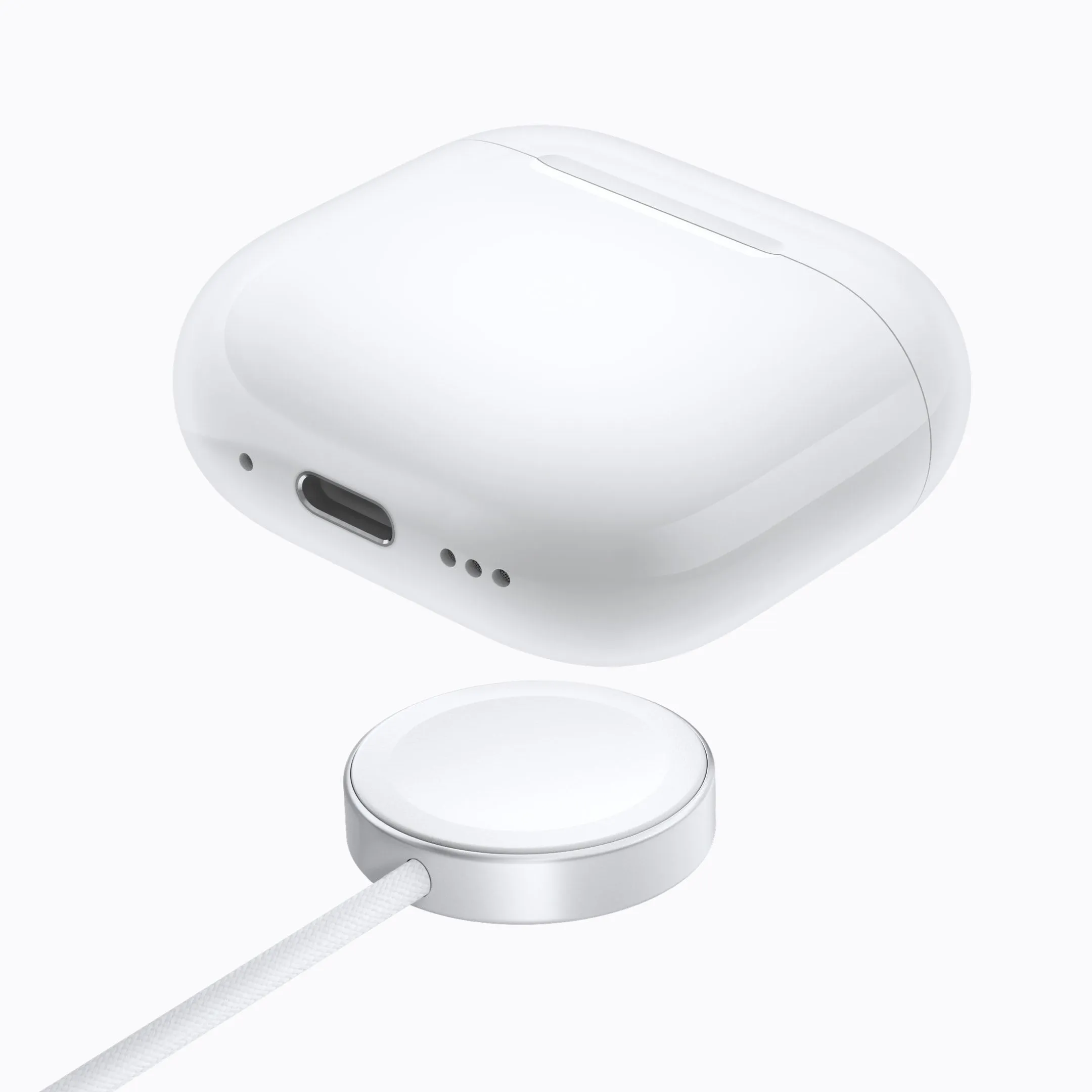
The higher-end model's charging case supports wired charging via USB-C as well as Apple Watch chargers and Qi-standard wireless chargers, letting users take advantage of desk charging pads or general-purpose wireless charging setups while out and about. The base model's (23,800 yen) charging case supports only wired USB-C charging and does not support wireless charging.
On durability, both models feature improved dust resistance and sweat/water resistance, adding peace of mind for outdoor workouts or use in inclement weather.
On the environmental front, the product uses 40 percent recycled materials overall. The wireless charging case incorporates 70 percent recycled plastic, and the battery uses 100 percent recycled cobalt. Across the manufacturing supply chain, 35 percent renewable energy—such as wind and solar—is used, and the outer packaging is made entirely from fiber-based materials.
Siri AI Integration and Live Translation Enable Hands-Free Operation
The launch of the AirPods 5 comes alongside an update to the audio hardware, but it also positions the earbuds as a wearable device for accessing "Siri AI" and "Apple Intelligence"—new features arriving with iOS 27 on September 15, 2026.
Dave Pakula, Apple's vice president of Hardware Engineering, said, "Combined with Siri AI, AirPods let you access powerful features completely hands-free, opening up a whole new range of use cases."
Siri AI, which begins beta availability with iOS 27, goes beyond conventional fixed-command processing to understand personal context spanning messages, emails, photos, and more. For example, asking "Play the song my friend recommended in a message" prompts it to reference past conversations and start playback, while asking "Open the dinner reservation confirmation in my email" pulls up the relevant reservation information.
Head gestures come in handy in situations where you don't want conversations like these to be overheard. When Siri asks for confirmation, nodding is recognized as "yes" and shaking your head is recognized as "no," allowing you to confirm actions discreetly without speaking—even in an office or on public transit.
"Live Translation," powered by Apple Intelligence, is also highly practical. After downloading the necessary language packs in advance through the iPhone's Translate app, the feature can be activated by long-pressing both AirPods stems simultaneously, saying "Hey Siri, start Live Translation," or pressing the iPhone's Action Button. The foreign language spoken by the person you're talking to is translated in real time into Japanese or another language and played directly into your ear. The combination of ANC's background noise reduction and computational audio processing power makes the translated speech easier to hear even in noisy stores or exhibition halls.
The Physical Boundary With the Sealed-Fit Pro, and Server-Side AI Limitations
Despite the advances in acoustic design and intelligent features, the AirPods 5 comes with several caveats and constraints from a purchasing and real-world usage standpoint.
First, there's the physical limitation inherent to the open-ear design itself. Apple's claim of "up to 50 percent improved external noise reduction" is a comparison against the previous-generation "ANC-equipped AirPods 4" as the baseline. Compared to the AirPods Pro 2 or AirPods Pro 3, which fully seal the ear canal with silicone tips, a physical gap remains in the ability to block high-frequency metallic sounds and sudden impact noises that leak in through the ear's open gaps. Users seeking long hours of sleep on an airplane, or a work environment where surrounding voices are completely silenced, need to be aware of this structural difference from the sealed-fit Pro series.
Second, there's the split in functionality between the two models. Stem-based swipe volume control, up to 5 hours of battery life with ANC enabled, and the Apple Watch charger/Qi-compatible wireless charging case are all exclusive to the 27,800-yen higher-end model. The 23,800-yen base model omits the swipe volume control, and its charging case only supports wired USB-C connections. Weighing the price gap between the base and higher-end models against how often you'd use volume swiping and how much you value charging convenience will be the deciding factor.
Third, there's the rollout schedule and operating requirements for the software and AI features. At the launch of iOS 27 on September 15, 2026, Siri AI will only be available as an English-language beta; support for Japanese, French, Korean, Portuguese, and Spanish will have to wait for an update in October 2026. Additionally, using the most powerful on-device model requires the latest hardware, such as an iPhone 17 Pro, iPhone 18 Pro, iPhone Air, or an iPad or Mac equipped with at least 12GB of unified memory. There's also a restriction preventing users under 13 from using Siri AI.
Additionally, processing that relies on Siri AI or advanced cloud models comes with daily usage limits, and Apple has indicated plans to expand access through paid plans in the future. Exactly how much usage will be available within the free tier remains to be seen as the service rolls out.
The AirPods 5 combine the pressure-free wearing comfort of an open-ear design with active noise cancellation that has finally reached a practical, everyday level. Together, these two achievements substantially rewrite the standard for what open-ear earbuds can offer. Siri AI's Japanese-language support arriving in October, along with how well the noise reduction performs in real-world living environments, will be the benchmarks by which this new standard is judged.