


On July 18, Apple revised prices for iPhone, Apple Watch, and AirPods on its Japan online store. The iPhone 17 rose from ¥129,800 to ¥142,800, and the iPhone 17 Pro Max's starting price clearly exceeded ¥200,000. Removing Japan's 10% consumption tax from the yen prices and comparing them with US SIM-free prices, the converted rate for the four main models—excluding the base model—lines up at ¥161.1 to ¥163.6 per dollar. Apple has not announced the reason for this round of changes, but the price list reveals fairly concretely how much of the yen's depreciation since autumn 2025 has been reflected in domestic prices.
iPhone 17 Pro Max Up ¥20,000 as Apple Revises All Five Current Models
The largest price increase was for the iPhone 17 Pro Max, which rose ¥20,000 from ¥194,800 to ¥214,800. The highest percentage increase was for the iPhone Air, at 11.3%. The base model iPhone 17 also rose by ¥13,000, or 10.0%.
| Model | Before Revision | From July 18 | Increase | Rate |
|---|---|---|---|---|
| iPhone 17e | ¥99,800 | ¥107,800 | ¥8,000 | 8.0% |
| iPhone 17 | ¥129,800 | ¥142,800 | ¥13,000 | 10.0% |
| iPhone Air | ¥159,800 | ¥177,800 | ¥18,000 | 11.3% |
| iPhone 17 Pro | ¥179,800 | ¥194,800 | ¥15,000 | 8.3% |
| iPhone 17 Pro Max | ¥194,800 | ¥214,800 | ¥20,000 | 10.3% |
Every model in the current iPhone 17 family rose in price, and even the iPhone 17e, which only launched in March 2026, went up ¥8,000. Since the entry-level model, previously ¥99,800, has now crossed the ¥100,000 threshold, this affects even buyers choosing the cheapest device in the lineup.
The prices shown on the Apple Store are the full amount for SIM-free devices. Buyers can receive an ¥8,800 discount by signing a carrier contract, or a ¥20,000 discount when switching online to NTT Docomo or SoftBank, but buyers who don't meet these conditions bear the full revised price. Even as sales programs lower the apparent amount paid, the baseline price of the device itself has risen a notch.
Four Main Models Converge Around ¥161–164 per Dollar
The scale of the price revision becomes even clearer when compared with US prices. Japan's tax-included prices were divided by 1.10 and then divided by the corresponding US SIM-free prices. The figures used were $599 for the iPhone 17e, $999 for the Air, $1,099 for the 17 Pro, and $1,199 for the 17 Pro Max.
| Model | Converted Rate Before | Converted Rate After |
|---|---|---|
| iPhone 17e | ¥151.5/$ | ¥163.6/$ |
| iPhone Air | ¥145.4/$ | ¥161.8/$ |
| iPhone 17 Pro | ¥148.7/$ | ¥161.1/$ |
| iPhone 17 Pro Max | ¥147.7/$ | ¥162.9/$ |
Before the revision, the converted rates varied by model, ranging from ¥145.4 to ¥151.5. After the revision, they now fall within a narrow range of ¥161.1 to ¥163.6, which nearly matches the Tokyo foreign exchange market on July 17. According to the Bank of Japan, the dollar-yen rate at 5:00 PM that day was ¥162.28–162.29.
The standard iPhone 17 was excluded from this comparison. The $799 US price includes a $30 carrier connection discount, and a SIM-free purchase without choosing a carrier upfront would be $829. Ignoring this difference in conditions would overestimate the converted rate for the Japan price. Prices in each country also incorporate rounding, distribution terms, and margin settings, so the ¥161–164 figure is not an internal exchange rate disclosed by Apple.
Even so, the timeline is clear. On September 9, 2025, when Apple announced the main iPhone 17 models, the dollar-yen rate at 5:00 PM was ¥147.22–147.24. The yen's depreciation through July 17, 2026 amounts to approximately 10.2%, close to the iPhone 17's 10.0% price increase. However, the iPhone 17e, announced March 2, when the rate was ¥156.98–157.00, saw only an 8.0% price increase—meaning a uniform formula based solely on the launch-date exchange rate cannot fully explain the changes. It's reasonable to conclude that this price list reflects product-by-product adjustments while bringing the converted rates for the main models close to the current exchange rate.
Watch and AirPods Did Not Move at the Same Rate
Apple Watch and AirPods prices also rose alongside iPhone. The Apple Watch Series 11 rose 10.8% from ¥64,800 to ¥71,800, while the budget SE 3 rose 10.6% from ¥37,800 to ¥41,800. AirPods showed a wider spread depending on the model.
| Product | Before | From July 18 | Rate |
|---|---|---|---|
| Apple Watch Series 11 | ¥64,800 | ¥71,800 | 10.8% |
| Apple Watch SE 3 | ¥37,800 | ¥41,800 | 10.6% |
| AirPods 4 | ¥21,800 | ¥23,800 | 9.2% |
| AirPods 4 (with ANC) | ¥29,800 | ¥32,800 | 10.1% |
| AirPods Pro 3 | ¥39,800 | ¥42,800 | 7.5% |
| AirPods Max 2 | ¥89,800 | ¥89,800 | 0% |
The AirPods Max 2 kept its March 2026 launch price unchanged. While the other five products rose 7.5–10.8%, only this top-tier ¥89,800 model was left untouched. This discrepancy doesn't fit an explanation of mechanically passing exchange-rate changes onto every product. Apple appears to be setting the size of the revision line-by-line, taking into account each product's launch timing, existing price gaps, and rounding at the point of sale.
Even after the price hikes, the pricing tiers remain intact. AirPods 4 sits in the low ¥20,000s, the ANC version in the low ¥30,000s, and the Pro 3 in the low ¥40,000s. The Apple Watch SE 3 also stays in the ¥40,000 range. This suggests Apple simultaneously adjusted for currency movements while preserving the price gaps that guide buyers toward higher-tier models.
Even With Currency Hedging, Domestic Prices Are Not Fixed
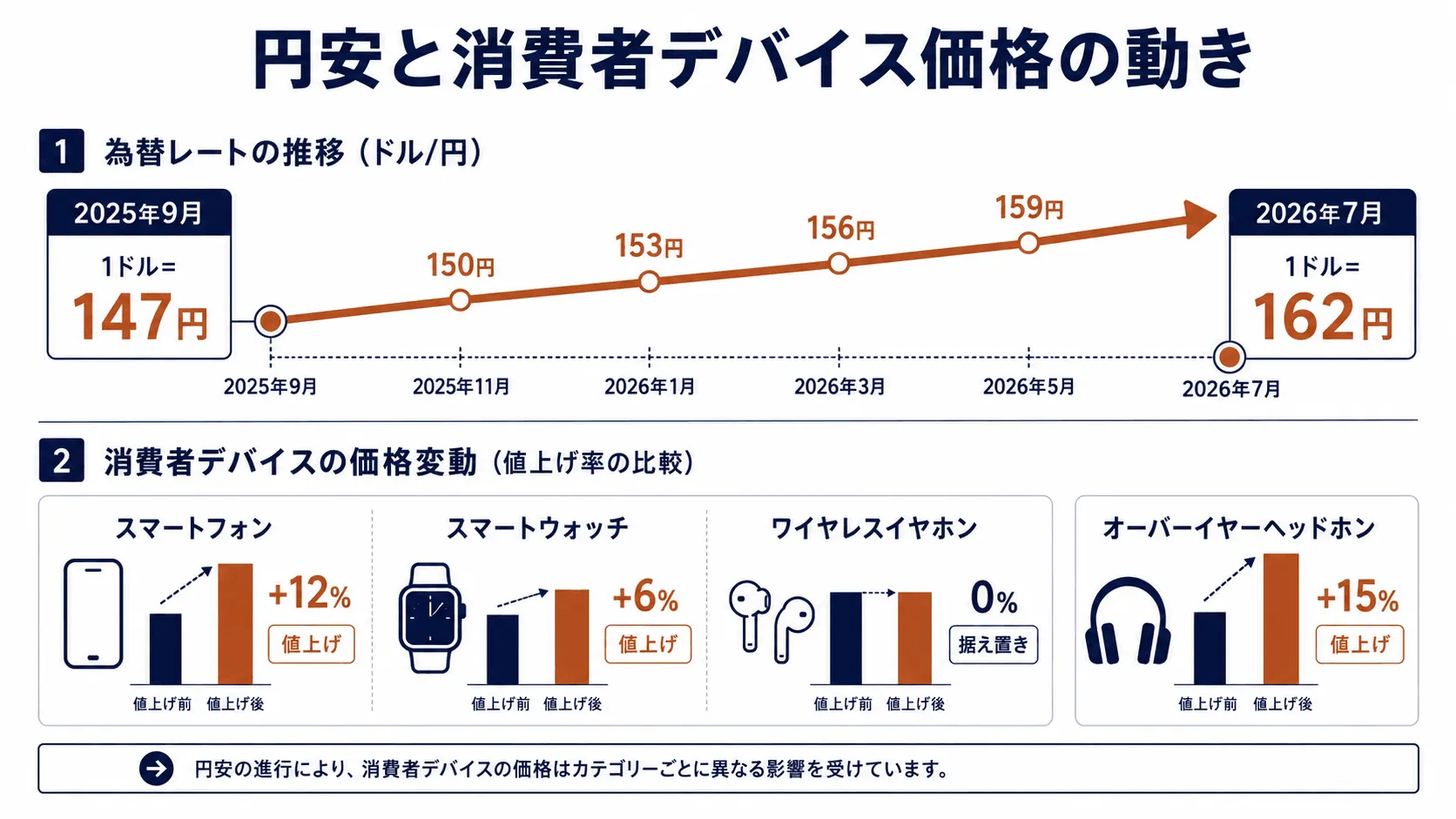
In its Form 10-Q for the second quarter of fiscal year 2026, Apple states that it typically hedges a portion of its foreign currency exposure related to net sales and inventory purchases, usually looking out as far as 12 months. At the same time, it notes that hedging can only offset the impact of currency fluctuations to a limited extent. This financial structure allows Apple to avoid changing product prices the instant exchange rates move, instead updating price lists after a certain interval.
The same filing lists changes in component costs—including NAND and DRAM—and product prices as factors affecting gross margin volatility. Currency, inflation, and tariffs appear on the same list. However, since Apple has not disclosed the reasoning behind the July 18 revision, there is no basis for tying this particular price increase to specific components or tariffs. While it's possible to confirm that the converted price rates are close to the dollar-yen exchange rate, any causal relationship beyond that remains unconfirmed.
What buyers face immediately is the rise in baseline prices, rather than any explanation involving currency. Apple Trade In offers a deduction of ¥20,000 to ¥129,000 depending on the model and condition, and Apple also offers 36-month, 0%-interest installment plans. Trade-in applies the value of an existing device, while installment payments simply shift the burden into the future—neither changes the revised baseline price.
If Apple maintains a pricing design close to today's roughly ¥162-per-dollar rate for its next lineup this autumn, the July revision will prove to be not a temporary correction but a new baseline for the Japanese market. Conversely, if the yen strengthens again but prices remain unchanged, that would indicate that component costs and product-specific margins are playing a stronger role. The numbers worth watching are the gap between the next Japan and US prices, and the amount carriers absorb through discounts.