


Bloomberg reports that Apple is reworking its Mac chip generations around AI. According to Mark Gurman, Apple began the M7 tape-out just six months after starting the M6 tape-out. It will not release an M6 Pro or M6 Max, and will instead hold its higher-end chips until the M7 generation.
The six-month gap is not the gap between the launch of M6 Macs and M7 Macs. It is the gap between the points at which Apple locked down physical designs ready to hand off for manufacturing. To get the major neural processing improvements planned for M7 into products sooner, Apple is said to have broken from its usual sequence of completing the whole M6 family first. More significant than skipping a chip name is the decision itself: shifting design resources and product schedules toward an AI-oriented architecture.
What a six-month tape-out gap means
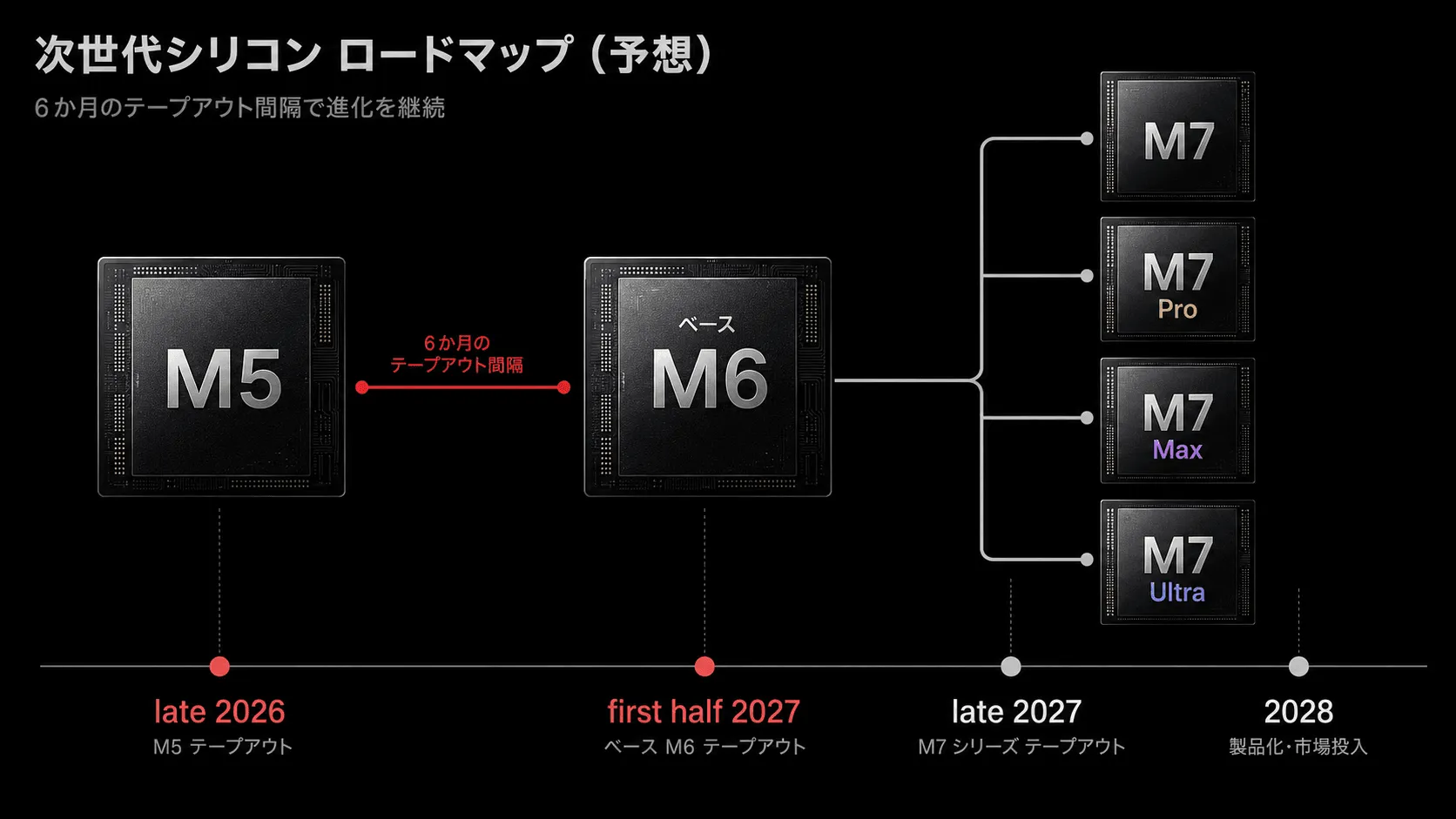
Tape-out is the milestone at which a chip's logic circuits are turned into a manufacturable physical layout, verified, and sent to the foundry. EDA giant Synopsys describes it as the process of finalizing a chip design and sending it to a foundry for manufacturing. Saying the design is "complete" is broadly accurate, but it should not be confused with a finished product.
M7 is still not a finished product. After tape-out, the first silicon from prototype wafers is evaluated for performance, power consumption, and yield. If design flaws turn up, a respin, in which a corrected version is manufactured again, is possible. Before the launch, reportedly in the first half of 2027, validation of the package combined with memory is also required. Product-side work, including cooling and the OS, remains as well.
Still, if the report is accurate that M7 taped out only six months after M6, Apple has been developing the two generations with more overlap than usual. Bloomberg reported that Apple plans to release the base M6 in late 2026, the base M7 in the first half of 2027, the M7 Pro and M7 Max at the end of that year, and the M7 Ultra in 2028. Skipping Pro and Max for M6 alone, after providing both with every generation since M1, looks less like a delay and more like a choice to redirect staff and validation time to M7.
Manufacturing technology readiness also makes this schedule feasible. TSMC began volume production of N2 in the fourth quarter of 2025, and N2P and A16 are also scheduled for volume production in the second half of 2026. However, Apple has not disclosed which processes it will use for M6 and M7. Production timing alone is not enough to conclude that M7 will be built on A16.
From 153 to 240GB/s: AI performance depends on the memory system
The key to reading M7's design changes lies in unified memory bandwidth rather than CPU core count. The bandwidth Apple published for M5 is 153GB/s. According to Bloomberg, the base M6 is targeting about 200GB/s and the base M7 about 240GB/s. That is an increase of roughly 57% from M5 to M7, and 20% even from M6.
When a large language model runs locally, the compute units repeatedly read the model's weights from memory. As conversations grow longer, the KV cache that holds past context grows as well. Adding compute units does not help if the necessary data cannot reach them, and they simply wait. Bandwidth strongly constrains response speed, while capacity strongly constrains the size of models and amount of context that can be loaded.
With M5, Apple added a Neural Accelerator to each core of its 10-core GPU, in addition to the 16-core Neural Engine. In other words, AI processing was not left to a dedicated engine alone but spread across the GPU. But if you add more places to compute, you must also widen the memory system that feeds each of them. M7's 240GB/s target is a figure that fills a gap that adding AI compute units alone cannot.
Software is also moving ahead. AFM 3 Core Advanced, which Apple announced in June 2026, stores weights totaling 20 billion parameters in NAND and loads 1 to 4 billion parameters, selected per request, into DRAM. Because transfers from NAND to DRAM are too slow for swapping on every token, the model selects the specialized portions to use for each request and periodically reselects them during generation.
That means the design does not keep all 20 billion parameters resident in unified memory. Even so, bandwidth matters for inference on the weights loaded into DRAM, for the KV cache, and for image and audio processing. The time to read the initial weights from NAND remains, so 240GB/s alone does not determine response speed. M7's aim is less about peak benchmark numbers and more about increasing headroom to run multiple AI features in parallel on the device.
That said, 240GB/s alone does not determine performance. Effective speed also depends on memory capacity and latency. Performance results only when software can draw out the cache configuration and the throughput at each compute precision. What is known so far is the target bandwidth; M7's core count and power consumption have not been disclosed.
The missing M6 Pro/Max disrupts Mac upgrade cycles
The decision not to build M6 Pro and M6 Max may improve Apple's development efficiency, but it changes when people should buy Macs. The base M6 is due in late 2026, while high-performance MacBook Pro and Mac mini models are expected to wait for their next generation until the M7 Pro/Max arrive at the end of 2027. The MacBook Pro with M5 Pro/Max went on sale on March 11, 2026. If M7 Pro/Max arrive at the end of 2027, the generational update for higher-end laptops will be about 21 months apart.
The base models face the opposite problem. If an M7 model is planned for the first half of 2027 after an M6 14-inch MacBook Pro in late 2026, the period in which the M6 can claim to be the latest generation in stores will be short. According to Bloomberg, M6 will include a new memory architecture and an enhanced Neural Engine, and Apple has also experimented with a redesigned GPU of up to 12 cores. It is not a minor update. Even so, in the shadow of M7's AI improvements, its role as a bridge in the product lineup grows stronger.
This stepping-stone roadmap carries execution risk too. If M7's first silicon needs fixes, updates to higher-end Macs could slip. Conversely, completing M6 Pro/Max in parallel would require allocating staff from circuit design through product validation, and manufacturing masks cost money too. That would dilute the benefit of pulling M7 forward. Apple has dropped a generation that would have served as insurance and prioritized the timing of completing its AI-oriented design.
For consumers, it becomes harder to judge when to buy from generation numbers alone. For CPU-centered uses, M6 may be a sufficient upgrade. For those who prioritize local LLMs, image generation, or video analysis, it will matter more to check memory capacity and sustained performance on actual M7 hardware. M7 will not be fast simply because it is AI-oriented; the difference will depend on whether the apps you use can draw out the new compute units and bandwidth.
Look at capacity and power, not the phrase "Blackwell-class"
Bloomberg reported that the M7 Ultra is being designed to bring its AI performance closer to NVIDIA's Blackwell-family dedicated accelerators and to support up to 1.5TB of unified memory. However, 1.5TB is not a configuration that has been confirmed for sale. Whether Apple will actually offer it depends on industry conditions, including memory supply and pricing.
"Blackwell-class" also cannot be read as performance parity. Blackwell is not the name of a single product. NVIDIA's compact DGX Spark has 128GB of unified memory and 273GB/s of bandwidth, and the GB10's TDP is 140W. The workstation-oriented RTX PRO 6000, meanwhile, runs 96GB of GDDR7 at 1,792GB/s, with maximum power consumption reaching 600W. Capacity, bandwidth, and power budgets differ greatly, and so do the use cases.
The niche Apple can aim for is probably not a head-on collision with data center training infrastructure. It is a workstation where the CPU, GPU, and Neural Engine share one large memory pool and macOS apps can run inference without sending data off the device. If a 1.5TB configuration were realized, it could hold models exceeding the 96GB of a single GPU. But being able to hold a model and being able to process it quickly are separate matters. Until M7 Ultra's bandwidth and per-precision performance figures emerge, no verdict is possible.
M7's tape-out is the first strong signal that Apple has moved beyond conceiving AI-oriented Macs and into manufacturing validation. What to check in 2027 is neither the generation number nor the label "Blackwell-class." Only when the 240GB/s bandwidth target, per-product memory capacities, and power consumption and inference speed under sustained load all come together will we see whether the decision to pull M7 forward, even at the cost of leaving a gap in the M6 lineup, paid off.