


Apple has quietly but fundamentally revamped the Mac purchasing process on its online store. The long-standing style of choosing from several "standard configurations (base models)" with different specs has been abolished, and the company has shifted to a "fully build-to-order (BTO)" approach where every user builds their specifications from scratch.
Behind this change lies an extremely intricate management strategy tied to rising component costs, optimization of inventory management, and preparation for the rollout of the next-generation silicon, the "M5" series.
What Apple is aiming for isn't simply offering greater "ease of purchase." Rather, it represents a sophisticated shift in business model—one that dissolves the complexity of increasingly intricate product specifications and the uncertain realities of the supply chain into the customer's "experience" of choice.
The End of Preset Models and the Shift to a "Full À La Carte" System
Previously, when purchasing a Mac on the Apple online store, users were first presented with several "standard configurations (presets)." For example, with the MacBook Pro, there were options with pre-combined chips, memory, and storage—a base model, mid-tier model, and top-tier model—and users would go through a two-step process: first selecting one of these, then customizing it as needed (CTO).
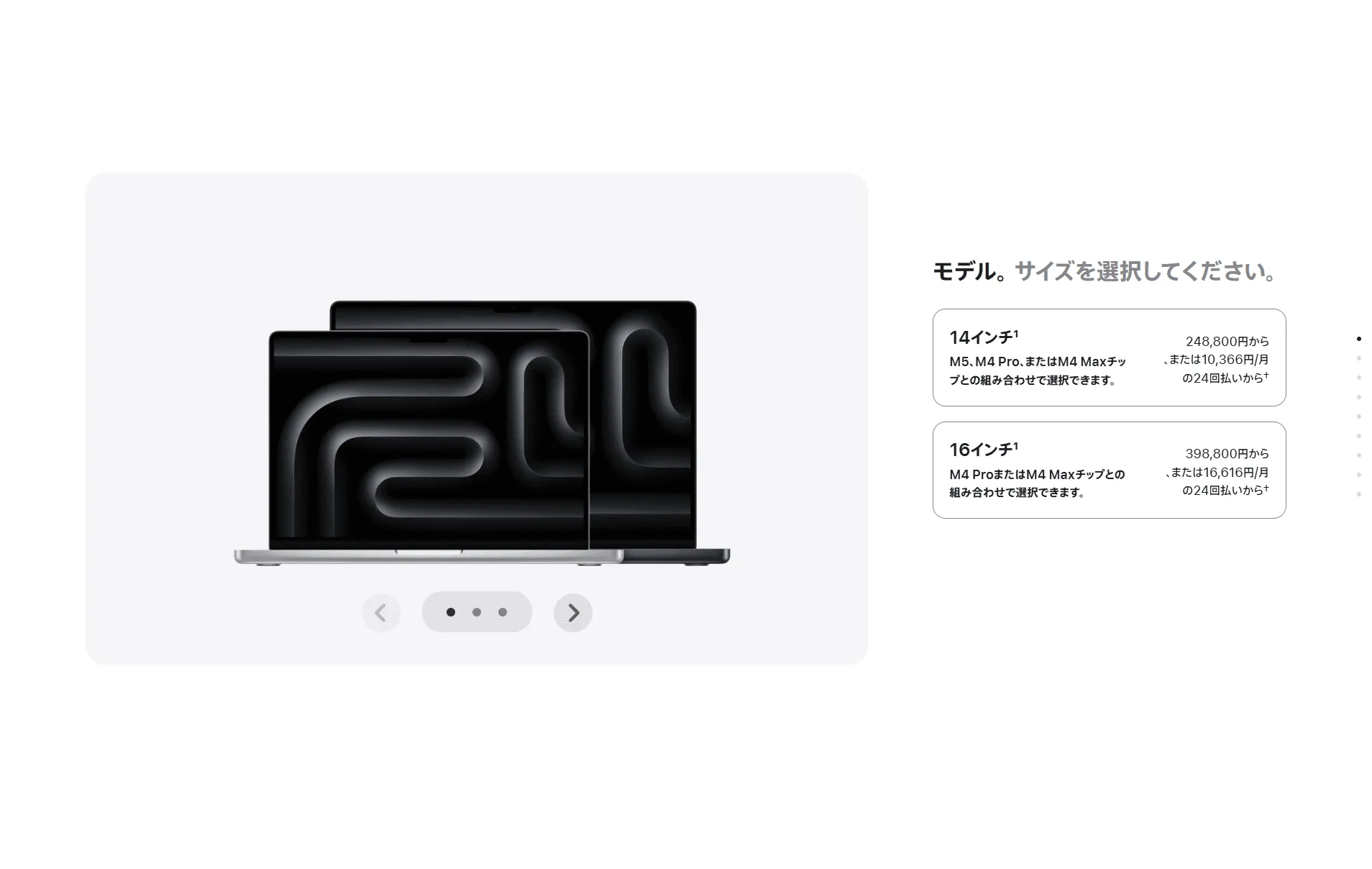
With this overhaul, this "entry point" standard configuration page has been completely eliminated. Now, when users click the "Buy" button, they are taken directly to the configurator (configuration selection screen).
- Physical specification selection: Determine screen size (14-inch or 16-inch) and color.
- Display options: Select panel characteristics such as the nano-texture display.
- Defining the heart of the machine: Choose from chipset variations such as M4, M4 Pro, and M4 Max, including core count.
- Breaking down resources: Determine the capacity of unified memory (RAM) and SSD storage.
- Finalizing peripheral elements: Specify power adapter output and keyboard language.
This flow closely resembles the experience of ordering an iPhone or iPad. However, given the nature of the Mac as a product, the number of possible combinations is far greater than for iOS devices. Apple has consolidated all these elements into a single dynamic page called "Build Your Mac."
A Price Pass-Through Mechanism Disguised as "Transparency"
Why has Apple deliberately shifted to a format that forces users to make more choices? The biggest reason lies in the price fluctuations of memory (DRAM) and NAND flash memory that have become pronounced from 2025 into 2026.
Until now, Apple had created a price "staircase" by offering preset models with specific spec combinations, guiding customers toward more expensive models. However, in the current market environment where component costs fluctuate rapidly, fixed configurations and pricing pose a risk.
Under the new "à la carte" system, it becomes easy to dynamically reflect the upgrade price of each component. For example, if memory prices rise 30% globally, instead of revising the price of entire preset models, Apple only needs to fine-tune the "upgrade cost from 16GB to 24GB" within the configurator. To customers, this appears as improved "transparency"—clarity on exactly how much they're paying for which component. But from a management perspective, it functions as an extremely flexible price pass-through mechanism that can immediately reflect cost increases in specific option prices.
This approach also skillfully leverages the "anchoring effect." By presenting the base model price as low while showing additional charges of tens of thousands of yen for each feature, there's a psychological effect where users more readily accept a final total that exceeds their initial expectations, viewing it as "the result of choosing what I needed."
Supply Chain Optimization: Freedom from the Curse of SKUs (Minimum Inventory Management Units)
In Apple's supply chain management, holding pre-assembled "inventory models" always carries the risk of cash flow pressure and obsolescence.
Under the previous preset-model-centered sales approach, supply-demand mismatches were unavoidable—certain configurations (say, "Space Black, M4 Pro, 32GB memory, 1TB SSD") would go unsold while other configurations ran short.
The UI emphasizing this shift toward "fully build-to-order (BTO)" effectively brings the following benefits to Apple:
- Componentization of inventory: By reducing finished-product inventory and shifting to managing inventory at the parts level—logic boards, enclosures, and so on—Apple gains the flexibility to assemble products in response to demand changes.
- Higher-resolution demand data: Apple can collect raw demand data on which chip and memory capacity combinations customers tend to choose, unconstrained by the "mold" of presets. This becomes an extremely valuable asset when determining specs for next-generation models.
- Direct logistics: By consolidating the bulk of online orders into direct shipping from the factory, intermediate inventory can be reduced.
A Sign of the M5 Chip Era: Toward Silicon-Level Customization
Some observers point out that this UI overhaul is laying the groundwork for the MacBook Pro models equipped with the "M5 Pro" and "M5 Max," which are expected to be announced soon.
According to industry observations, the M5-generation silicon may feature even more finely segmented combinations of CPU and GPU cores than before. Under the old preset system, every increase in chip variations would cause the number of choices to explode, confusing users.
However, with the new "hierarchical configurator," a natural flow can be built where users first select the type of chip (such as M5 Pro), and then choose the detailed core configuration afterward. This is a method long used by PC workstation makers such as Dell, suggesting that Apple is entering a phase where it treats the Mac as a "true professional tool," catering to more granular needs.
Especially as the Neural Engine handling AI processing and unified memory bandwidth become increasingly important, users will likely end up choosing the silicon configuration best suited to their workflow, in a manner closer to building a custom PC.
The Risk of Decision Fatigue: The "Simplicity" Apple Has Lost
At the same time, this strategy carries a clear risk: the psychological phenomenon known as the "paradox of choice."
The advantage of preset models was that Apple, by offering its endorsement of "this is the recommended configuration," reduced decision fatigue for users. For novice users, building the optimal machine "from scratch" out of dozens of possible combinations is by no means an easy task.
Apple has addressed this challenge by retaining "default settings" within the configurator, but the simple, straightforward comparison of "this one, or this one, or this one" that used to be possible is no longer available. This change risks pushing some casual users into the anxiety of "not knowing what to buy," potentially delaying their purchase decisions.
The growing divergence from third-party retail partners (such as Amazon and Best Buy) also cannot be ignored. These stores will continue to sell boxed "standard configuration models," and as the gap in purchasing experience between them and Apple's own online store widens, there is a risk of undermining brand consistency.
A Return to the "Professional's Tool" and Apple's Cold-Blooded Rationalism
Apple's latest decision can also be seen as an attempt to redefine the Mac—shifting it from a "consumer appliance" back into a "precision instrument for professionals."
Unlike the iPhone, which offers the same experience to everyone, the Mac must meet the demands of a diverse range of professionals—creators, engineers, scientists, and more. This UI overhaul absorbs such diverse needs through "component-level selection," while behind the scenes maximizing supply chain efficiency to the utmost—a culmination of the kind of cold-blooded rationalism characteristic of Apple.
Going forward, when purchasing a Mac, users will likely find themselves asking more than ever before: "What do I need to do, and what specs does that require?" This signifies a transformation in the experience itself—from simply owning a product to building the computing resources best suited to oneself.
Will Apple's "quiet revolution" become the new standard for sales models in the 2026 PC market? Its true value will likely become clear with the arrival of next-generation M5 chip-equipped Macs.
Sources
- MacRumors: Apple Changes How You Order a Mac