

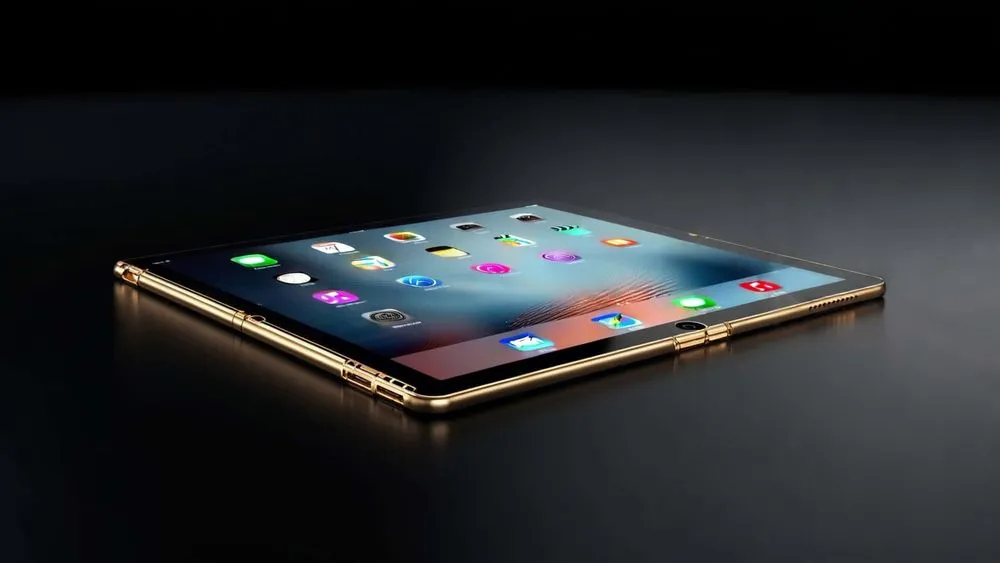
Apple may have achieved a groundbreaking breakthrough in foldable smartphone development. According to a report by Korean media outlet ETNews, the company has reportedly succeeded in virtually eliminating the crease at the center of the screen—the biggest challenge facing foldable devices. With component supplier selection progressing, development toward a launch in the second half of 2026 may have taken a major step forward.
Solving the Crease Problem the Industry Couldn't Overcome
The Crease That Undermines the Aesthetics of Foldable Smartphones
The biggest challenge for foldable smartphones has been the prominent crease that forms in the middle of the screen when unfolded. This issue not only detracts from the device's appearance but has also affected the overall user experience, including an uncomfortable feel during touch operations and degraded content display quality. Major manufacturers such as Samsung, Huawei, and Oppo have worked on this problem for years, but none have achieved a complete solution.
Apple's Uncompromising Solution
According to the ETNews report, Apple "decided to completely eliminate the crease to differentiate the product from existing models, regardless of cost." An industry source testified that "the crease disappeared thanks to the development of new material properties." About a year ago, Apple was reportedly dissatisfied with early samples and instructed its suppliers to revisit the design—an effort that appears to have paid off.
Results from Collaboration Between Two Companies
This technical breakthrough is said to have been achieved through close collaboration between Samsung Display and Amphenol, Apple's hinge supplier. Solving the crease problem required not only improving the properties of the display panel itself but also achieving harmony with the mechanical structure of the folding section (the hinge mechanism). Through the cooperation of both companies, a challenge that the industry had previously been unable to overcome was reportedly solved.
Oppo's Latest Model Demonstrates Technical Progress
Oppo's latest foldable model, the "Find N5," is cited as an example that supports this technical progress. This model has been described as follows: "the crease hasn't completely disappeared, but it has become considerably less noticeable."
Supply Chain Construction Enters Final Stage
Supplier Selection to Be Finalized by April
According to the report, Apple plans to finalize its supply chain for the foldable iPhone by April of this year. This step is typically taken 12 to 18 months before a product launch, suggesting a release in the second half of 2026. According to ETNews, mass production of components is expected to begin in the latter half of 2025.
Key Component Suppliers Revealed
The OLED display, a core component of the foldable iPhone, is expected to be supplied exclusively by Samsung Display. The company has been developing specialized displays for Apple on its own since last year. Its track record as the world's first company to mass-produce foldable OLED panels appears to have been a key factor in its selection.
Ultra-thin glass (UTG), which serves as the protective material for the display surface, is likely to be supplied by Corning of the United States. Apple has traditionally used Corning glass in iPhones and has also made direct investments in the company. Korean and Chinese companies are also being considered as candidates for the ultra-thin glass processing technology.
Amphenol of the United States is considered the frontrunner for the hinge mechanism that forms the folding section of the smartphone. The company is already part of Apple's supply chain and has a track record of producing hinges for the MacBook Pro. It reportedly also supplies smartphone hinges to companies such as China's Vivo.
Design and Launch Timing of the Foldable iPhone
Book-Style Design and a Unique Display Aspect Ratio
The foldable iPhone is said to adopt an "in-folding" structure that folds inward. This design is operated with a book-opening motion, similar in shape to the foldable smartphones that are currently mainstream.
According to prominent Chinese leaker Digital Chat Station, the device will feature a 5.49-inch display on the outside (when folded) and a 7.74-inch display on the inside (when unfolded), with both featuring an "unprecedented aspect ratio." The outer display is reportedly designed to be shorter and wider compared to Oppo's recently released Find N5.
A Launch in the Second Half of 2026 Looks Increasingly Likely
Regarding the launch timing, multiple sources point to the second half of 2026. Bloomberg's Mark Gurman has reported that "Apple is focused on completing development of its first foldable device targeted for 2026." Prominent analysts Ming-Chi Kuo and Jeff Pu, as well as major media outlets including The Information and The Wall Street Journal, have also predicted a timeframe of late 2026 to early 2027.
While there is no specific information on pricing, it will almost certainly be the most expensive iPhone ever released. As for the product name, "iPhone 18 Fold" has been mentioned as a possibility.
Market Impact and Industry Outlook
Apple's Development Philosophy of "Aiming for the Best, Not the First"
Apple is known for its approach of "aiming to be the best, not the first" when introducing new technologies. The same applies to foldable smartphones, and the company has reportedly been dissatisfied with the quality of Android models that have been on the market so far. The screen crease issue, in particular, was said to be one of the aesthetic challenges that concerned Apple the most.
This latest technical breakthrough is seen as having made it possible to realize a product that meets Apple's high quality standards. This can be considered a development that aligns with Apple's product development philosophy.
New Developments in the Foldable Smartphone Market
The current foldable smartphone market is led by Korean and Chinese manufacturers such as Samsung, Huawei, and Oppo. However, Apple's entry could significantly change the market structure. ETNews analyzed that "Apple is expected to substantially expand the foldable smartphone market, whose growth rate has been slowing, and transform the market competition that has so far been centered on Korea and China."
Some also see Apple's accelerating push toward commercializing foldable smartphones as an attempt to find new growth opportunities in a maturing smartphone market. The foldable iPhone holds the potential to drive new market expansion as a differentiated product in a saturated market.
Source