

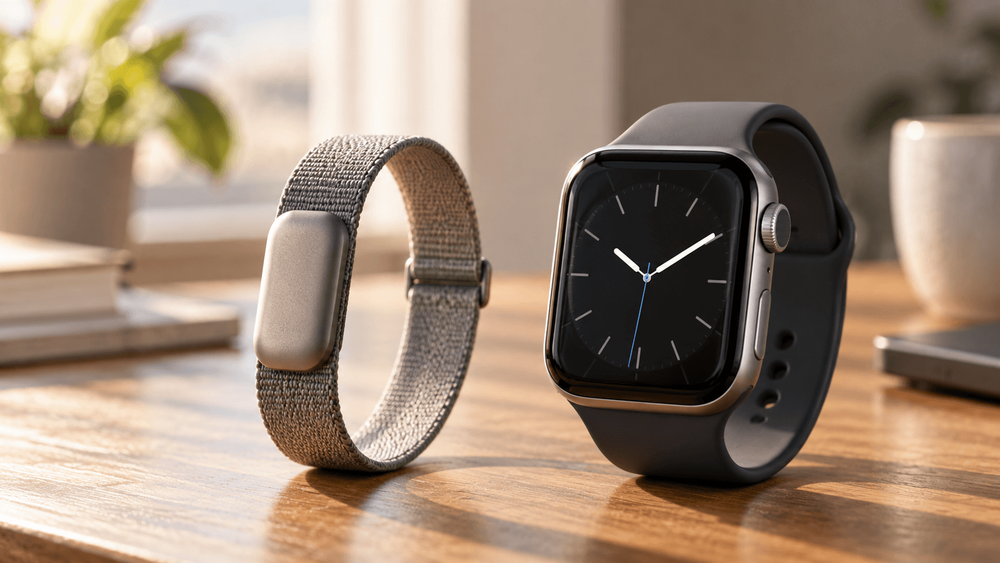
On September 22, Bloomberg reported that Apple is prototyping a screenless health and fitness band. The concept reportedly pairs a fabric band with a small sensor-equipped module that measures data at the wrist. But this is not a report that Apple has decided to make it a product. Apple only this month announced updated heart-rate measurement for Apple Watch and a revamped Health app. If a company that keeps strengthening health features on a wrist-worn screen is testing a different form of wearable, what is it trying to change?
Is the prototype a product with a confirmed launch?
According to Bloomberg, Apple has been considering a screenless health band for several months and has built prototypes of a thin fabric band and a small sensor-equipped module. Whether it will be released is undecided, and even if Apple goes ahead, it reportedly does not expect to launch before 2028. That year is not a release date. This information is not an Apple announcement but an exclusive report on an internal exploratory stage.
The types of sensors, the connectivity, the charging interval and the price are all unknown. Nor can we conclude that, because it has no screen, it would be a cheaper version of Apple Watch.
In form alone, the prototype resembles products from the US company WHOOP. WHOOP emphasizes wearing its device for long periods to record the body's condition and checking the results on a smartphone, rather than operating notifications or apps on a screen. But a similar shape does not mean the same data or the same guidance. Let's look at the differences through the health features Apple has already announced.
Removing the screen does not mean health features carry over
The health measurements of Apple Watch Series 12 and Ultra 4, announced by Apple on September 9, use optical and electrical heart sensors. The optical sensor reportedly measures heart rate every five seconds, including during the day. Heart rate variability is also measured more often than before, and together with recent activity, vitals and sleep score, it produces a daily "readiness" rating from 0 to 10. Readiness updates during the day as new data comes in. All of these are features Apple described for the Watch it has already released, not specifications of the screenless prototype.
Apple also announced that it will overhaul the Health app on iPhone and iPad in the second half of 2026. The plan is to show long-term health data and offer advice on daily behavior. However, supported devices and conditions of use vary. The revamped app is limited to Apple Intelligence-compatible models, and some features are iPhone-only. Health Age requires Apple Watch. The test that estimates maximal oxygen uptake requires Apple Watch, AirPods Pro 3 or a third-party heart rate monitor. Some features are unavailable in certain regions and languages. Whether a new screenless device could use features that require a Watch has not been disclosed.
Apple's screenless band is a prototype in reporting only, and whether it would have the same health features as Apple Watch is undisclosed. Laying out the current information by status makes the gaps clear.
| Item | Apple Watch Series 12 / Ultra 4 | WHOOP 5.0 / MG | Apple's screenless band |
|---|---|---|---|
| Status | On sale. Apple announced specs in September 2026 | On sale. WHOOP announced specs in May 2025 | Prototype reported by Bloomberg. Launch undecided |
| How information is shown | Watch screen and the iPhone Health app | Screenless device and smartphone app | Reported to have no screen. App specs undisclosed |
| Heart rate / health features | 5-second heart rate measurement and readiness announced | Continuous health and fitness data measurement announced | Sensor module reportedly prototyped. Measurements undisclosed |
| Battery | Apple's stated figure for Series 12: up to 24 hours of normal use | WHOOP's stated figure at launch for 5.0 and MG: more than 14 days | Undisclosed |
| Pricing model | Purchase the Watch itself | WHOOP is membership-based. Annual plans were shown at the 2025 announcement | Undisclosed |
The battery figures for Watch and WHOOP in the table are stated values from each company for different products and conditions. You cannot calculate a performance gap by dividing 14 days by 24 hours. For Apple's prototype, there is no number to compare in the first place. Nor should the Watch's measurement intervals or readiness display conditions be assumed to carry over to a new band.
Is "no screen" the only difference from WHOOP?
WHOOP 5.0 and MG, announced in May 2025, are products with no screen, designed to be worn for long periods with the measured data read in an app. Besides a stated battery life of more than 14 days, the company promoted clothing and accessories that let them be worn somewhere other than the wrist. Annual membership plans include the device and analysis features for exercise and sleep. At the 2025 announcement, US prices were $199 per year for One, $239 for Peak and $359 for Life. Apple has not disclosed a price or billing method for its prototype.
The competition here is not only about the number of sensors. Apple Watch lets you check the time and notifications and operate apps on your wrist. For people who want to keep that use, a screenless device is unlikely to be a replacement. On the other hand, for people who do not want to wear a watch that delivers notifications, a form that simply keeps recording could be appealing. This is a difference in usage scenarios derived from form; Apple has not said it is targeting that group.
Apple already has a mechanism for receiving the data. According to the Health app privacy explanation, health information can be collected from iPhone, Apple Watch, other companies' devices and apps, and the user controls who it is shared with. If Apple releases a new sensor, the questions will be which health item its measurements are stored as and how they are used in existing guidance. But the extent of integration between the prototype and the Health app has not been shown.
What to check before deciding to switch
For people who want a screenless band, what can be confirmed now goes only as far as the actual product conditions of Apple Watch and WHOOP. For Apple's prototype, the decision to launch itself remains open. There is little reason to postpone buying a current Watch in anticipation of a report pointing to 2028 or later.
If Apple does choose to productize it, the first things to look at are a form that can be worn continuously and the charging interval. Next, confirm what it measures for heart rate and sleep, and whether it supports Apple Watch's readiness rating and future Health app features. Whether the cost is just the purchase price or involves ongoing subscription fees will also shape comparisons with WHOOP. Launch in Japan and regional conditions for health features are also essential.
Apple has already expanded a system that measures health data and interprets it on iPhone. Even if a screenless device joins it, its value cannot be measured as "the Watch minus the screen." How comfortably it can be worn for long periods, which metrics can be trusted, and how much extra cost it involves: if it is productized, those three points will be the first things that can be compared.