


Whenever a series of destructive or high-profile earthquakes strikes, scientists get asked the same question: are earthquakes becoming more frequent?
Over the past three months, several large earthquakes have struck near populated areas around the world, with devastating effects on people and infrastructure.
- The Philippines (magnitude 7.8)
- Indonesia (M7.7)
- Venezuela (M7.5 and M7.2)
- Colombia (M7.4)
- Japan (M6.8)
In addition, moderate earthquakes struck the island of Hawaii (M6.0) and Granada, Spain (M5.2), causing minor to moderate damage.
Is this unusual? To answer that question, we need to look at the data.
How often do earthquakes occur?
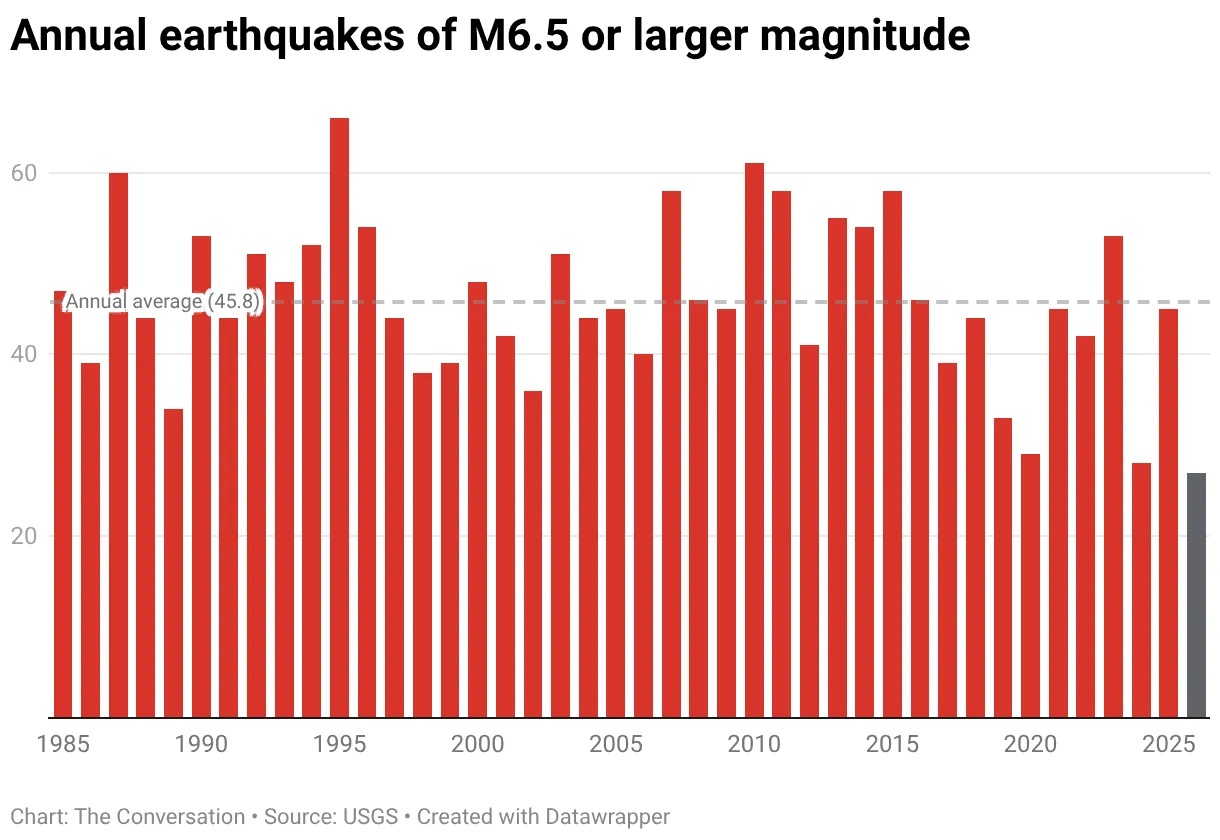
The Earth is a dynamic planet, and earthquakes are occurring somewhere all the time. Most are too small or too distant to be felt, and go unnoticed by the vast majority of people. On average, however, a large earthquake of M6.5 or greater occurs somewhere in the world about once every eight days.
That works out to roughly 46 earthquakes of M6.5 or larger per year.
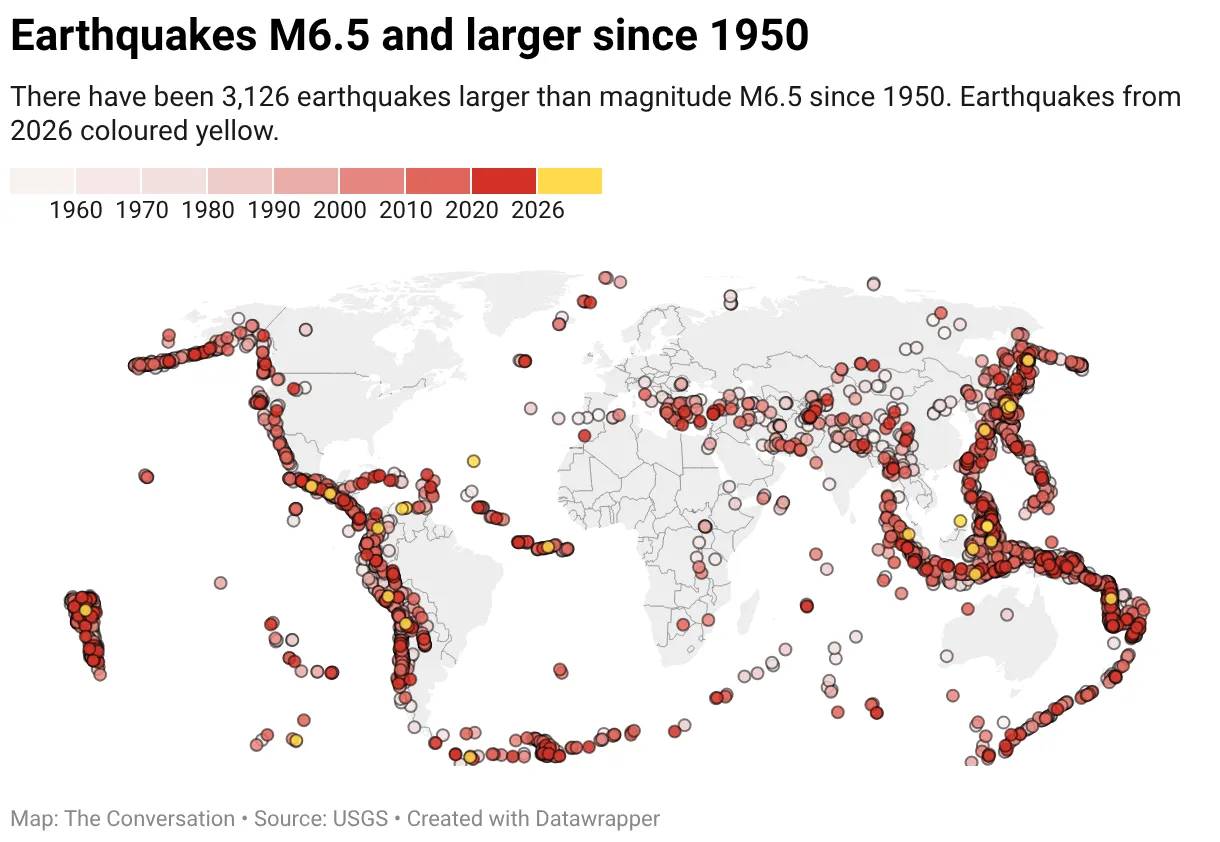
As of August 21, 26 earthquakes of M6.5 or greater have occurred in 2026, shown as yellow dots on the world map above.
Statistically, the number of M6.5+ earthquakes so far this year is running slightly below average, and slightly lower than the annual frequency over the past 40 years (shown by the dashed line in this graph).
Tectonic setting
Earthquakes are concentrated mainly along plate boundaries, and are driven by the movement of these plates.
These regions have high seismic hazard. They include areas near California's well-known San Andreas Fault, New Zealand's Alpine Fault, the southern Caribbean, and the so-called Ring of Fire along the edge of the Pacific Plate, where volcanic activity presents another geological hazard.
To better understand earthquakes and their hazards, we monitor and record them on a global scale, and strategically place sensitive instruments in seismically active regions.
Over the past several decades, the amount of data from these instruments has grown dramatically, and new technologies and methods for learning more about earthquakes have been developed.
In other words, we have more data for detecting and locating earthquakes, but that doesn't mean the number of earthquakes themselves is rising. This is evident from the fact that the average number of large earthquakes in earthquake catalogs has remained constant. Scientists have been recording the largest earthquakes over a very long period of time.
So why does it feel like there are more large earthquakes?
Large earthquakes occur frequently, but most happen far from major population centers, so many people never notice them.
The recent series of earthquakes isn't unusual in number. They are getting attention because they have had major impacts on people and communities. Still, as shown below, the number of earthquakes causing major damage has stayed at a relatively stable level.
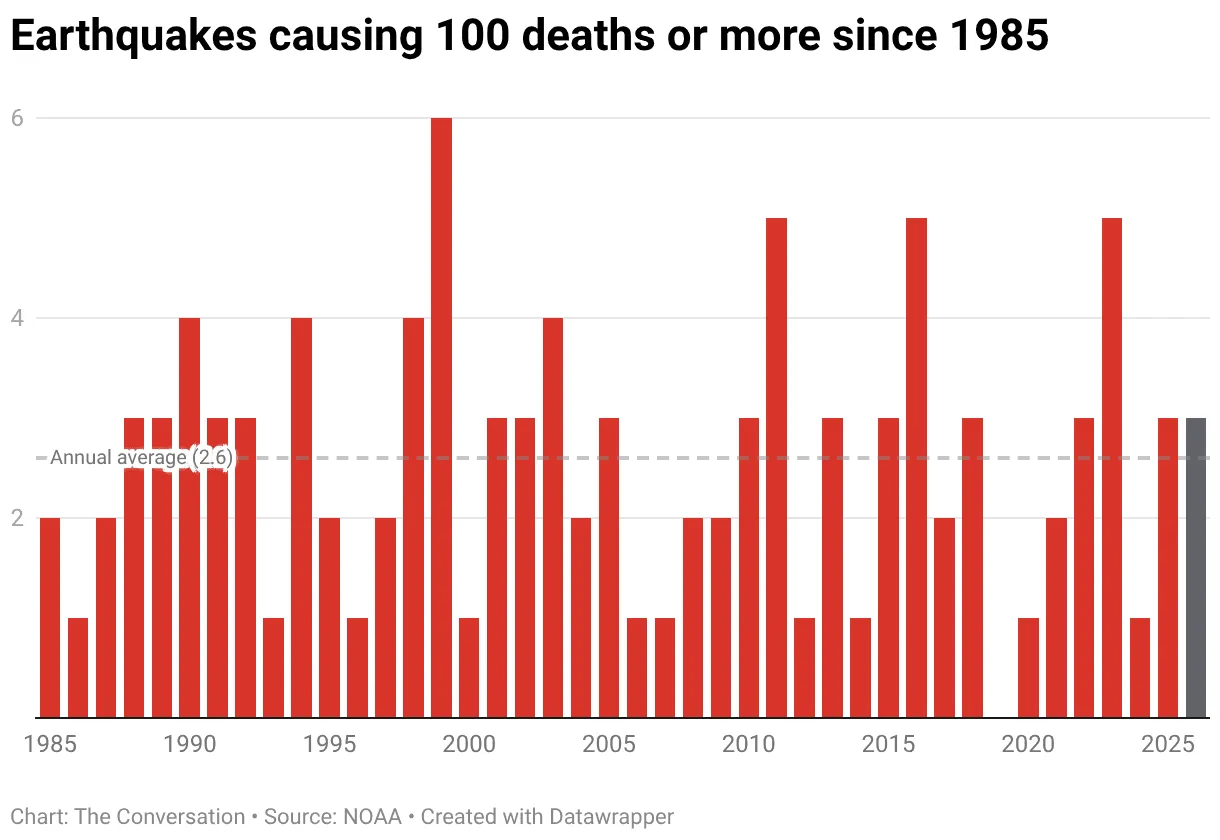
Nevertheless, the severe damage these earthquakes caused and the profound impact on people have led to extensive media coverage. This combination of scale of damage, visibility, and timeliness can trigger psychological biases that make it seem as though earthquakes (or other risks) are on the rise.
Two of the most prominent of these are recency bias and the frequency illusion. Recency bias refers to our tendency to give more weight to recent events than to earlier information. The frequency illusion, also known as the Baader-Meinhof phenomenon, is the psychological effect in which, once we become aware of a particular phenomenon, we start noticing it more often.
So when several destructive earthquakes pile up and dominate the news cycle, it can appear that earthquakes are increasing, even when long-term data show otherwise.
In reality, only a small fraction of the 26 earthquakes above M6.5 this year have made the news. Moreover, earthquakes in the Western Hemisphere tend to be covered in Western Hemisphere news cycles, and vice versa.
Preparedness still matters
Although there is no evidence that the number of destructive earthquakes is rising, this series of events is a reminder of the importance of preparedness for people living in earthquake-prone regions.
Preparedness is something both governments and individuals can work on. Understanding earthquake hazards and where they occur, ensuring earthquake-resistant design and construction, and building an "earthquake-ready" society all help reduce earthquake risk and keep these natural hazards from becoming catastrophes.
For people in New Zealand, the AF8 program is working on scientific modeling, coordinated response planning, and community engagement, aiming to build resilience for the next Alpine Fault earthquake. Similarly, for people in California, additional information and resources on earthquake preparedness are available.
Depending on where you live, there are also many resources that explain how to prepare, as well as information on what to do during an earthquake.
The authors thank Wendy Bohon, Chief of the Earthquake Hazards and Earthquake Engineering Section at the California Geological Survey, for her contributions.