

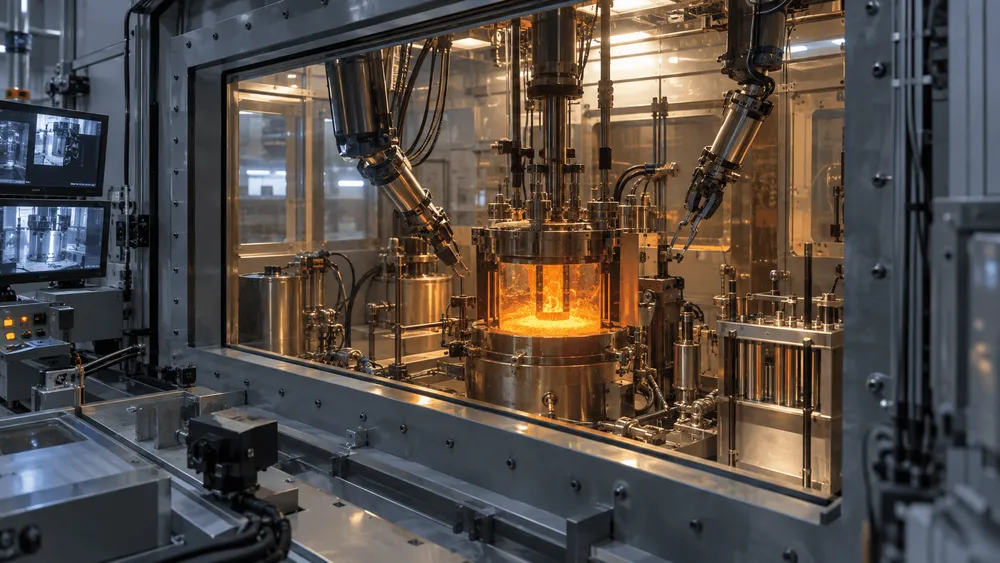
In the United States, surging data center electricity demand, manufacturing electrification, and decarbonization goals have made a fundamental expansion of nuclear power a pillar of national strategy. The U.S. Department of Energy (DOE) and industry stakeholders have set an ambitious target of adding 300GW of nuclear generating capacity by 2050—expanding the fleet to roughly 400GW, about four times its current size. However, simply scaling up existing reactor operations would proportionally increase the burden of storing Used Nuclear Fuel (UNF).
Against this backdrop, Argonne National Laboratory (ANL) is accelerating efforts to support the commercialization of fuel recycling technology by partnering with private startups, building on nearly 50 years of expertise in spent fuel reprocessing. Applying high-temperature dry reprocessing (pyroprocessing) and centrifugal extraction technologies established during the former Integral Fast Reactor (IFR) program, ANL is working to bridge the gap between bench-scale basic research and commercial-scale plants. The goal is to dramatically reduce the burden of radioactive waste requiring extremely long management periods, while establishing a sustainable fuel cycle that provides a stable supply of new fuel for next-generation reactors.
The Goal: Shrinking 100,000 Years of Storage to Just Centuries
The United States currently operates 94 commercial light-water reactors, providing approximately 100GW of capacity—about 20% of the nation's total electricity generation. The target of adding 300GW by 2050 would mean expanding existing nuclear capacity roughly fourfold. The single greatest bottleneck in this expansion plan is considered to be the issue of final disposal of spent nuclear fuel.
Fuel assemblies used in current light-water reactors have consumed only a small fraction—a few percent—of uranium's fission energy, retaining over 90% of their potential energy within the fuel pellets. However, spent fuel also contains transuranic elements (TRU), including plutonium and americium generated through neutron capture, in addition to uranium and fission products. These long-half-life actinides possess extremely persistent radiotoxicity; if disposed of directly through deep underground burial (direct geological disposal), it would require isolation for over 100,000 years for radiotoxicity to decay to levels comparable to natural uranium ore. With disposal site plans—including Nevada's Yucca Mountain—stalled amid political and social opposition, a disposal framework premised on 100,000 years of safety management has become a serious constraint on expanding the nuclear fleet.
The key to overcoming this challenge lies in advanced spent fuel recycling technology. If unburned uranium and TRU can be separated and recovered from spent fuel, then loaded into fast reactors with high-energy neutrons for fission and transmutation, these materials can be reused as an energy resource while eliminating hazardous substances. The high-level radioactive waste remaining after separation would primarily consist of relatively short-lived fission products such as cesium and strontium, meaning radiotoxicity would decay rapidly over a much shorter period.
While U.S. nuclear capacity aims to roughly quadruple from about 100GW today to approximately 400GW by 2050 through the addition of 300GW, spent fuel recycling could shrink the storage period required for high-level radioactive waste requiring ultra-long-term management from over 100,000 years down to a scale of centuries. Reducing the required safety management timescale from a geological era of 100,000 years to an order of centuries—within the span of recorded human history—holds the potential to dramatically lower the engineering hurdles and the difficulty of building social consensus around final disposal.
Argonne's 50-Year Legacy and the Reassessment of Pyroprocessing
Argonne National Laboratory has a history spanning roughly 80 years dating back to the dawn of nuclear power, and has dedicated approximately half a century (50 years) specifically to spent fuel reprocessing research. At the core of this effort is a technology known as pyroprocessing—high-temperature metallurgical dry reprocessing.
Conventional commercial reprocessing (the PUREX method used in France, the UK, and Japan's Rokkasho facility) is a wet process that dissolves spent fuel in nitric acid solution and uses organic solvents to perform liquid-liquid extraction of uranium and plutonium. While wet reprocessing is well-suited for large-scale processing, it faces challenges including susceptibility of organic solvents and water to radiolytic decomposition under high-radiation environments, equipment geometry constraints for criticality safety management, and generation of large volumes of low- and intermediate-level liquid waste. Above all, the greatest concern has been that this method extracts high-purity plutonium in isolation, requiring constant vigilance against the risk of diversion for nuclear weapons (proliferation). Indeed, this very concern over isolated plutonium separation and its proliferation risk was a key factor behind the freeze on commercial reprocessing under the Carter administration.
By contrast, the pyroprocessing technology refined by Argonne National Laboratory through the 1980s—centered on the Experimental Breeder Reactor-II (EBR-II) under the Integral Fast Reactor (IFR) program—is a dry method that uses no aqueous solutions whatsoever. This technology employs molten salt heated to high temperatures (such as the eutectic salt LiCl-KCl, a mixture of lithium chloride and potassium chloride) as an electrolyte, recovering uranium and actinides through electrochemical methods.
The decisive advantage of pyroprocessing lies in its excellent proliferation resistance. Due to the characteristics of electrochemical reduction potentials, plutonium precipitates in a state tightly co-mingled with other transuranic elements like americium, as well as some rare earth elements and uranium, making it thermodynamically and engineering-wise extremely difficult to extract pure plutonium in isolation. The extracted metal mixture carries extremely strong radioactivity, physically preventing weapons diversion, while simultaneously forming an ideal fuel composition for sodium-cooled fast reactors that use metal fuel. Additionally, compared to aqueous systems, pyroprocessing offers greater criticality safety margins and allows reprocessing equipment and fuel fabrication equipment to be integrated on-site within compact cells, eliminating security risks associated with long-distance transport.
This advanced fuel cycle technology from Argonne is once again drawing renewed international attention. Since the 1980s, Japan had chosen a path of wet reprocessing combined with plutonium-uranium mixed oxide (MOX) fuel, taking a step back from the IFR program. However, the Japan Atomic Energy Agency (JAEA) has now resumed evaluation of Argonne's IFR technology, pyroprocessing, and metal fuel systems in preparation for a next-generation fast reactor fleet expected to begin operation in the 2040s, deepening research collaboration between Japan and the United States. As both countries look ahead to the transition period from light-water reactors to fast reactors, the inherent safety and efficiency of dry reprocessing are being reconsidered on both sides of the Pacific.
Engineering Division of Labor With Three Private Companies: Three Pieces of the Commercialization Puzzle
The most distinctive feature of Argonne National Laboratory's current initiative is that it extends beyond basic in-house experimentation, directly partnering with market-focused private startups to close specific engineering gaps needed to cross the commercialization "Valley of Death." Specifically, ANL is collaborating with three companies of different characters—Oklo, Deep Isolation, and SHINE Technologies—dividing responsibilities across critical elements spanning the fuel cycle from upstream to downstream.
The first pillar is the partnership with Oklo, which is developing the sodium-cooled fast micro-reactor "Aurora." Oklo uses metal fuel, and to obtain fuel licensing, the company is leveraging the vast operational and irradiation data that Argonne accumulated over decades through the former IFR program and EBR-II. Through DOE technology commercialization support voucher programs and similar mechanisms, work is underway to align historical test data with modern NRC (Nuclear Regulatory Commission) licensing standards. Furthermore, the two organizations are focusing on developing advanced monitoring and control technology for electrorefining equipment. This includes developing real-time sensors capable of operating in the harsh high-temperature, high-radiation environment inside molten salt cells, alongside building "digital twins" that combine machine learning algorithms with physical models. This enables real-time online material accountancy—tracking the movement of uranium and actinides within cells—while also enabling anomaly detection and process efficiency optimization across the entire facility.
The second pillar is the partnership with Deep Isolation, which handles spent fuel pretreatment and final disposal technology. Most spent fuel discharged from existing light-water reactors consists of stable oxide pellets—ceramic-hardened uranium dioxide (UO2). However, electrorefining through pyroprocessing requires feedstock in metallic form. Argonne and Deep Isolation are advancing demonstration and optimization of the initial "electrochemical reduction" process step—converting oxide fuel into metallic uranium and actinides—within the laboratory's advanced nuclear chemical engineering facilities. Additionally, Deep Isolation is developing "Deep Borehole Disposal" technology, applying oil and gas drilling techniques to isolate waste by drilling horizontal or vertical boreholes into crystalline basement rock or stable shale formations several thousand meters underground. By recovering the majority of fuel material through electrochemical reduction and pyroprocessing, and combining deep borehole disposal for the final residue of vitrified or ceramic waste forms that inevitably remain, the partnership aims to establish an integrated model that completes disposal faster and at lower cost, without relying on conventional massive underground cavern-type disposal facilities.
The third pillar involves advancing wet, liquid-liquid separation processes in partnership with Wisconsin-based SHINE Technologies, a developer of medical isotope production and fusion neutron sources. This collaboration utilizes Argonne's proprietary "Annular Centrifugal Contactors"—devices that bring two liquid phases into contact and mix them within a rapidly rotating cylinder, then instantaneously separate the phases using powerful centrifugal force. Compared to conventional mixer-settlers, these contactors offer dramatically shorter residence times and a drastically reduced equipment footprint. Argonne's research team uses specialized 3D printers to rapidly prototype contactor components with complex flow channels, enabling quick verification of optimal separation structures. Notably, the joint research with SHINE also focuses on optimizing processes that recover plutonium in a mixed state with other nuclides, rather than extracting it in isolation. Dr. Peter Tkac, Argonne's radiochemistry group manager, emphasizes: "Optimizing separation steps that keep sensitive nuclear materials in a mixed state, rather than isolating them individually, becomes extremely important." Dr. Tkac's team uses the laboratory's Van de Graaff electron accelerator to simulate the intense radiation fields found in commercial reprocessing facilities, precisely tracking how extraction solvents and chemicals undergo radiolytic breakdown over time. Demonstrating resilience under harsh real-world conditions in advance is intended to prevent costly rework during the transition to commercial scale.
Challenges and the Path Toward Commercialization
The collaboration between Argonne National Laboratory and its private-sector partners is building an important bridge from principle demonstration toward industrial-scale deployment. As Dr. Tkac puts it, "We have excellent strategies for recycling used nuclear fuel. Which approach is adopted depends on the reactor technology selected for energy production"—underscoring that reprocessing process design is inherently linked to the specifications of future next-generation reactors, whether metal-fueled fast reactors, molten salt reactors, or advanced light-water reactors.
However, numerous challenges remain before this can become a truly self-sustaining commercial fuel cycle. First is equipment scale-up and engineering reliability. Corrosion resistance in high-temperature molten salt environments and intense radiation fields, maintainability of centrifugal contactors under continuous operation, and long-term durability of 3D-printed components in real-world conditions must all be demonstrated through the construction of commercial pilot plants. Second is building a regulatory licensing framework. Since no commercial reprocessing facility has been built in the United States for several decades, much of the NRC's current regulatory framework is designed around the once-through (direct disposal) cycle of light-water reactors. New consensus must be formed with regulators regarding what material accountancy standards and safety criteria should apply to pyroprocessing and centrifugal separation processes that do not isolate plutonium as a standalone element. Third is securing economic viability. Given that natural uranium prices and enrichment costs currently remain relatively low, market penetration hinges on whether new fuel recovered through recycling can achieve cost competitiveness against new fuel made from virgin uranium. That said, when comprehensively evaluating the cost reduction benefits for high-level radioactive waste disposal and the energy security value of reduced mined uranium consumption, sufficient medium-to-long-term competitiveness is expected to be achievable.
The scientific legacy that Argonne National Laboratory has accumulated over half a century is being transformed by a new generation of nuclear venture companies—from mere historical experimental records into a trump card supporting practical decarbonized energy infrastructure. As the industry pursues the massive goal of adding 300GW by 2050, all eyes remain on how technological innovation and public-private collaboration will unfold.