


On September 8, 2026, UK-based Arm unveiled its next-generation smartphone compute platform, "Arm CSS for Mobile 2," at its annual "Arm Everywhere China" event in Shanghai. The company has retired the "Lumex" branding used in the previous generation, pushing forward with an integrated deployment of subsystem-based IP.
The shift this announcement represents is that the center of gravity for AI processing on mobile devices has moved from single-shot inference functions to autonomous "agentic AI." Workflows that interpret user intent, assess context, and autonomously coordinate multiple applications and models demand not just strong individual accelerator performance, but also system-wide orchestration capability.
In response to this requirement, Arm has presented CSS for Mobile 2 as a package in which various IPs are optimized as a unified whole. The CPU cluster, GPU, and system interconnect have been optimized together, with integration extending all the way down to physical implementation and the software stack. At the core of this effort are two key components: the "C2" CPU cluster, equipped with two units of the Scalable Matrix Extension 2 (SME2) for matrix operations, and the "Mali G2-Ultra NX," the first AI-native GPU to integrate a dedicated neural accelerator directly inside its shader cores. Within the strict thermal design constraints imposed by a smartphone chassis — a sustained power budget of roughly 1W — these components provide a concrete answer for delivering both desktop-class gaming experiences and responsive agentic AI processing.
Doubled SME2 and the "C2" CPU Cluster Take On Parallel Agentic AI Workloads
When agentic AI runs on a device, the job doesn't end with a single AI model executing inference. The system must process the user's voice input, retrieve relevant information from past activity history and contextual memory (RAG), build a plan using a reasoning model, invoke local applications, and carry out web browsing — a chain of operations that occurs continuously and in parallel.
In this multitasking environment, the CPU sits at the core of preventing processing delays and maintaining system-wide responsiveness. In an agentic environment where multiple workloads run concurrently, a cluster design that can smoothly handle parallel processing is essential, on top of raw single-core CPU performance.
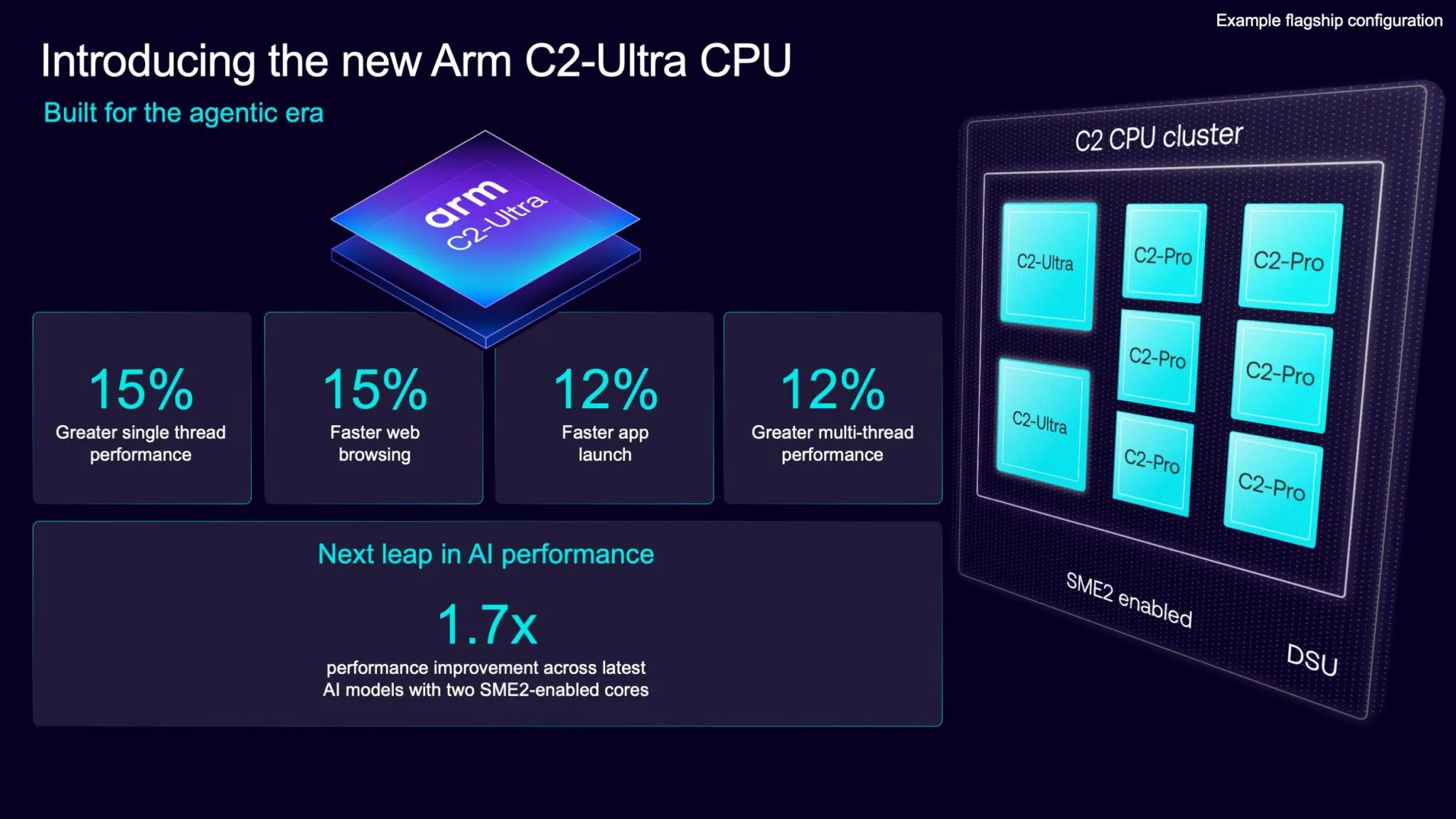
The "C2" CPU cluster built into CSS for Mobile 2 consists of the flagship "C2-Ultra" core, which delivers peak performance, and the power-efficient "C2-Pro" core. As a typical flagship configuration, Arm presented a combination of two C2-Ultra cores and six C2-Pro cores.
The most significant enhancement is that the number of SME2 units — the architectural extension that accelerates matrix operations — has doubled from one in the previous generation to two. This SME2 enhancement boosts the inference speed of the latest small language models (SLMs) running on-device by up to 70%.
データを表で見る
| Improvement / Reduction Rate (%) | |
|---|---|
| Single-Thread | 15 |
| Web Browsing | 15 |
| App Launch | 12 |
| Multi-Thread | 12 |
| Full Agentic Workflow Reduction | 24 |
| Power Reduction at Same Performance | 38 |
The flagship C2-Ultra core alone represents a remarkable leap over its predecessor, the C1-Ultra. To improve the efficiency of feeding the instruction pipeline, Arm enlarged the execution engine to expand the number of in-flight instructions, while also improving branch prediction accuracy and fetch precision. As a result, C2-Ultra achieves a 15% improvement in single-thread performance, a 15% improvement in web browsing speed, and a 12% reduction in application launch time. Cluster-level multi-thread performance has also improved by 12%.
On top of this, AI processing performance has improved by up to 1.7x on the latest models, while power consumption at equivalent performance has been reduced by up to 38%. In tests measuring an entire agentic AI workflow — combining voice processing, memory retrieval, inference, application execution, and web browsing — total processing time was successfully cut by 24%.
Supporting the coordinated operation of these CPU clusters is the system interconnect "SI L2," which balances low latency with high bandwidth. By linking the private caches within each CPU cluster and the large shared L3 cache while providing cache coherency and QoS (quality of service) control, it minimizes data buildup between each compute resource and external memory.
Shader-Integrated Neural Acceleration Redefines the "Mali G2-Ultra NX"
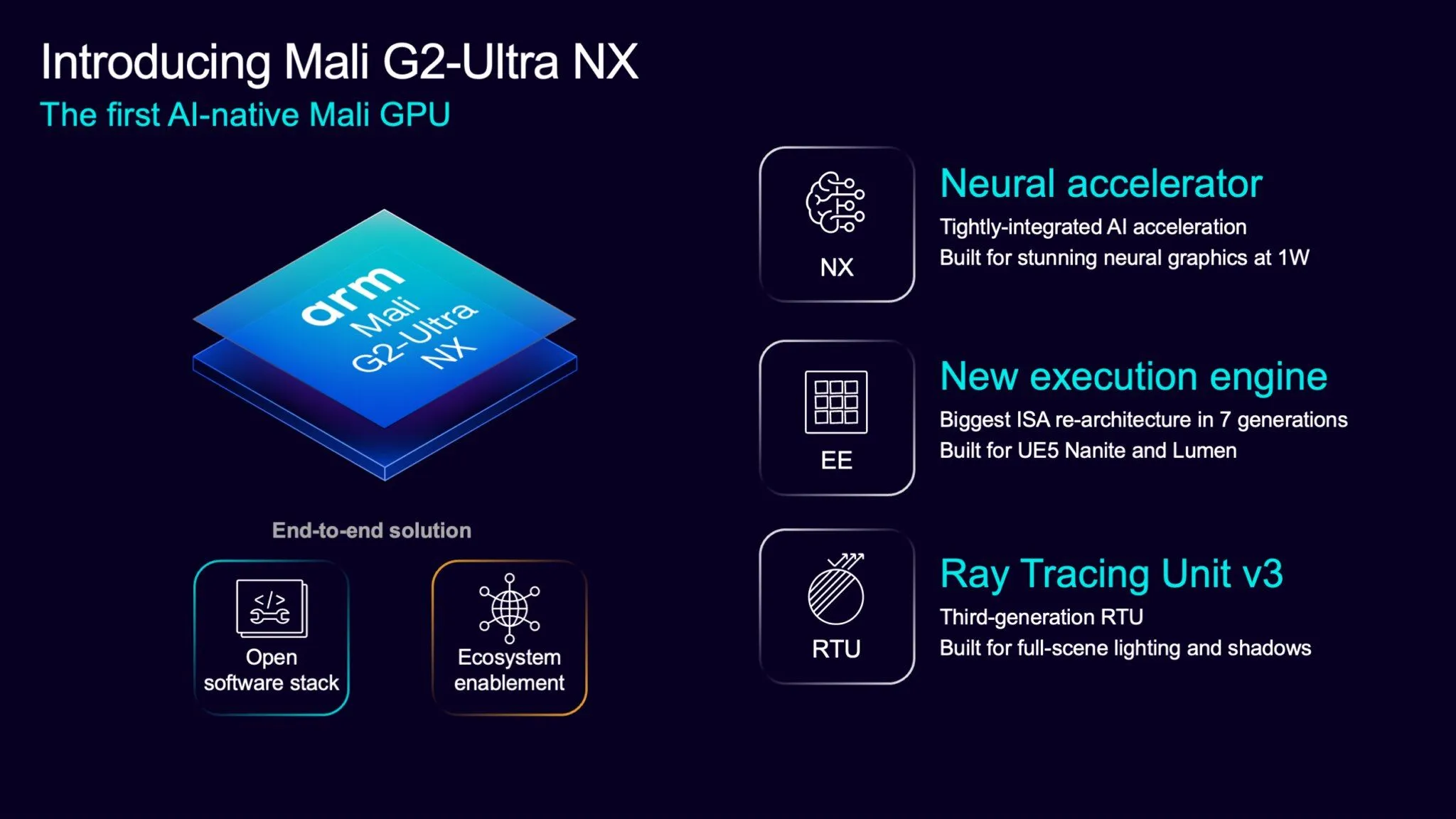
The other pillar of CSS for Mobile 2 is the "Mali G2-Ultra NX," which brings a design overhaul to graphics processing. Positioned by Arm as the "first AI-native GPU," this new GPU is the first in the Mali series to integrate a dedicated neural accelerator directly inside its shader cores.
In conventional mobile GPUs, the mainstream approach has been to offload AI processing to a separate NPU chip, or to temporarily repurpose general-purpose shader compute units. However, this approach frequently requires data transfers between graphics rendering data and AI models via external DRAM, creating thermal and bandwidth constraints. In the Mali G2-Ultra NX, the neural accelerator is placed inside the shader core itself, sharing the GPU's memory system, coherent cache, and control structures. This minimizes the burden of data movement and allows AI reconstruction to be executed in the same location as the conventional graphics pipeline.
Three neural graphics technologies were introduced to take advantage of this dedicated hardware:
- Neural Super Sampling (NSS): A super-resolution technology that uses temporal history information and integrated anti-aliasing to AI-reconstruct a high-resolution image (e.g., 1080p) from a frame rendered at a lower resolution (e.g., 540p).
- Neural Frame Rate Upscaling (NFRU): A technology that feeds two actually rendered frames, along with depth information and motion vectors, into a neural network to generate high-quality intermediate frames, effectively doubling the frame rate.
- Neural Super Sampling and Denoising (NSSD): A technology that simultaneously performs super-resolution and denoising in complex lighting and shadow scenes using ray tracing, improving image quality.
The biggest benefit these technologies bring is a dramatic reduction in the GPU's physical rendering burden. By combining super-resolution via NSS with intermediate frame generation via NFRU, the number of pixels the GPU actually rasterizes ends up being just "one-eighth (1/8)" of the total frame sequence ultimately displayed on screen. The remaining seven-eighths of pixel information is efficiently reconstructed by the neural accelerator inside the shader.
This mechanism makes it possible to sustain stable 30fps gameplay in intricately detailed ray-traced environments, all within the smartphone's 1W sustained power envelope. Depending on the title, high frame rate rendering of up to 120fps is also within reach. As a result, the Mali G2-Ultra NX achieves up to 4x greater power efficiency (performance per watt) in neural graphics processing.
The fundamental capabilities of conventional graphics processing without AI have also been improved. The GPU features a new execution engine with a full instruction set architecture (ISA) overhaul — the first such overhaul in seven generations — and doubles the number of registers per warp. This boosts processing capability in high-load scenes, delivering a 14% performance improvement in existing game content and up to a 24% score improvement across various benchmarks.
Additionally, a third-generation ray tracing unit (RTU) has been integrated. The new design reduces DRAM traffic in major ray tracing benchmarks by up to 13%, and adds hardware-level support for "Opacity Micromaps," which efficiently handle fine transparent geometry. By skipping intersection checks for tree leaves, fabric, and complex overlapping semi-transparent objects, this reduces ray tracing workload by up to 70% when Opacity Micromaps are applied, boosting frame rates by 30%.
A Developer Ecosystem Rising Vertically, from Game Engines to MCP
Even advanced hardware architecture won't gain traction unless it's actually incorporated into real game titles and development pipelines. Ahead of launching the Mali G2-Ultra NX, Arm has spent the past two years building out its software ecosystem through "Arm Neural Technology."
The results have materialized as concrete game implementations and demos. The technical demo "Neural Dawn," co-developed with UK-based Sumo Digital, integrated NFRU and NSSD into a commercial game development pipeline. It demonstrated up to 4x greater power efficiency and up to 70% reduction in external memory bandwidth compared to native rendering. This has opened a path to bringing Unreal Engine's next-generation lighting technology, "MegaLights" — previously confined to high-end PC environments — into practical use under mobile constraints.
Adoption in commercial game titles has also begun. NetEase's open-world period action title "Where Winds Meet" is being integrated into the company's Messiah Engine, with plans to deliver an NSS-supported version to players before the end of the year. Tencent Games has also released an NSSD technology demo using "Arena Breakout Infinite" and is proceeding with feature integration into its own MagicDawn engine. In addition, NSS integration into Infold Games' "Infinity Nikki" and native integration into Unity China's "Tuanjie Engine" have both been announced. On the smartphone OEM side, China's vivo has announced that it will launch its latest flagship device adopting this platform.
Alongside the buildout of the graphics environment, Arm has also prepared a rapid-response development environment for agentic AI. In addition to the "Arm Neural Graphics Development Kit," which bundles machine learning extensions for the cross-platform graphics API Vulkan along with an Unreal Engine plugin, Arm is providing "Arm KleidiAI," an optimization library that leverages SME2 on the CPU side.
Furthermore, Arm has launched the "Arm AI Portal," a portal site where developers can easily search for and evaluate AI models optimized and validated for Arm. Alongside this, the release of the "Arm MCP Server" allows the latest agentic development environments, including Cursor and Claude Code, to directly invoke optimized models and tools for the Arm platform.
Breaking Through the Power Ceiling of Edge AI Through System Integration
The message conveyed by CSS for Mobile 2 is that the competitive axis in mobile semiconductors has shifted — from a race over the clock speed or peak TFLOPS of a single processor, toward the depth of system integration needed to complete a workflow within a real-world power budget.
AI models running on massive cloud data centers are powerful, but they face barriers in the form of network latency incurred with every interaction, communication uncertainty, and ballooning service delivery costs. Realizing agentic AI that responds instantly at the user's fingertips while protecting privacy and handling tasks on their behalf requires distributing processing onto the device itself.
But a smartphone can't fit a cooling fan or a large heat sink. A physical limit of roughly 1W of sustainable power consumption looms over everything. Arm's answer was an architecture that strips away wasteful data transfer to the absolute limit: packing two matrix multiplication units (SME2) into the CPU to accelerate orchestration and small language model inference, and embedding a neural accelerator inside the GPU's shader to cut the number of actually rendered pixels down to one-eighth.
Several hurdles remain before real devices reach consumers' hands. What was announced this time is an IP and subsystem design; it will take until at least next year (2027) or later for semiconductor partners such as MediaTek, Qualcomm, and Samsung to manufacture actual SoCs in silicon, and for device makers like vivo to bring finished products to market.
Moreover, the claim of desktop-quality graphics within a 1W envelope is the result achieved in a highly optimized environment premised on NSS and NFRU — not every existing title will unconditionally benefit. How aggressively individual game studios adopt the Arm Neural Graphics SDK and advance integration on the game engine side will determine how much real-world impact this delivers.
Arm's evolution from a licensor of individual processors into a provider of a vertically integrated AI-and-graphics platform marks a clear step that will shape the direction of the mobile experience going forward.