

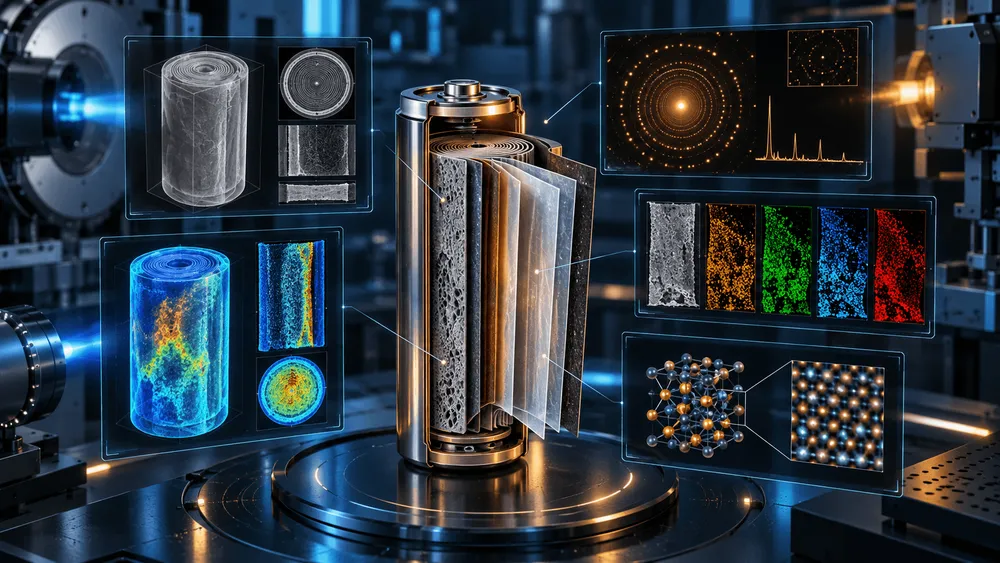
Imperial College London announced on September 16, 2026, the full public release of the Battery Imaging Library (BIL), a data infrastructure for examining the inside of batteries using multiple techniques. The release exceeds 4.5TB and spans 13 observation methods. Innovation News Network reports that 48 scientists across 18 institutions contributed to creating the dataset.
The numbers are large. But measuring BIL's significance by volume alone would miss the point. Images capturing battery cracks, elemental distributions, changes in crystal phase, and the positions of light elements cannot all be captured by the same camera. BIL brings these together into a searchable entry point, linking raw data, reconstructed images, permanent identifiers, and analysis procedures. It represents a step forward from a place to simply view rare experiments to a shared foundation where other researchers can redo the analysis.
What matters more than 4.5TB
Experiments at large synchrotron and neutron facilities are not something labs without such equipment can easily replicate. Imperial College London explains that because experiments are costly and time-consuming, and competition for beam time is fierce, image data has rarely been made public. BIL does not eliminate this disparity at the data-acquisition stage entirely, but it does widen the entry point for reusing data that has already been acquired.
The official BIL website allows users to search data by method, pixel/voxel size, and other parameters. According to the abstract of a peer-reviewed paper published in Digital Discovery in September 2026, each dataset is linked to a Zenodo DOI and metadata. In addition to raw data such as radiation projection images, sinograms, and X-ray/electron diffraction patterns, the library also includes reconstructed images. The authors position it as an infrastructure aligned with the FAIR principles—Findable, Accessible, Interoperable, and Reusable.
Here it's worth distinguishing between publication and standardization. It's true that DOIs make data location and versioning easier to track, and metadata aids searchability. However, this alone does not mean measurement conditions are uniform across all datasets, nor that ground-truth labels usable by any AI system are all in place. What BIL has opened is an entry point for verification—not the conclusions themselves.
What do the 13 methods each reveal separately?
BIL's 13 modalities are not a single all-purpose image; rather, they are designed to complement each other through separate contrasts covering shape, elemental composition, crystal structure, light elements, and atomic-scale composition.
The table below organizes the 13 methods and descriptions listed on the official BIL website according to their primary observation targets. This is not BIL's official classification but an editorial grouping intended to clarify what each method adds. The roles of these methods overlap, and the categories in the table are not mutually exclusive.
| Primary Observation Target | Example BIL Methods | What Can Be Learned |
|---|---|---|
| Shape/Structure | SEM, lab/synchrotron micro-XCT, lab/synchrotron nano-XCT, TEM | Interior of cells, voids and cracks in electrodes, particle shape, lattice/defects |
| Elemental/Local Chemistry/Composition | EDS, XANES-CT, APT | Elemental distribution, local chemical environment, near-atomic-scale 3D composition |
| Crystal/Phase/Strain | EBSD, XRD-CT, S3DXRD | Crystal orientation, phase distribution, lattice changes, grain-level heterogeneity |
| Light Elements/Electrolyte | Neutron CT | Electrolytes, polymers, separators and other materials hard to see with X-rays |
Even though all these methods are aimed at "observing batteries," the required technique changes depending on the question being asked. Research aiming to detect whether electrodes have shifted inside a cell can, and research aiming to determine whether crystal phases have changed non-uniformly inside a cathode particle require, different resolutions and different measurement principles. The number 13 does not represent an extravagant collection of methods—it reflects the fact that battery failure and degradation cannot be reduced to a single physical quantity.
What X-rays alone cannot reveal
X-ray CT is widely used—from whole cells to individual electrodes—because it can non-destructively track three-dimensional structure. According to BIL's GitHub page, lab-based micro-XCT covers alkaline, LiFeS2, NiMH, and lithium-ion batteries, ranging from pin-type cells to the 4680 format. Dynamic micro-XCT also places on a timeline the process by which internal structure changes during charge and discharge.
However, X-ray absorption contrast is not a universal solution. The neutron CT included in BIL offers a different view of low-atomic-number materials compared to X-rays. The source article cites, as an example, the positions of lithium-based electrolytes and lithium species within cells. This is a means of layering light-element information onto shape images—it does not mean that a single neutron CT scan can automatically and uniquely determine lithium quantity or chemical state.
Diffraction and spectroscopy also play different roles. XRD-CT tracks crystal phase and strain at each location, while XANES-CT follows local chemical environment. S3DXRD delves into grain orientation and crystallographic heterogeneity. When operando measurement (measurement while the battery is operating) is added, researchers can track bias as reactions progress, rather than relying on still images comparing before and after states of charge. However, the inclusion of 13 methods does not mean that the same sample was measured using all 13 techniques in a complete, corresponding dataset.
Raw data turns "viewing images" into "comparing analyses"
When only finished tomographic images are distributed, users can analyze the visible structure but struggle to verify what preprocessing and reconstruction methods produced that image. BIL publishes projection images, sinograms, and diffraction patterns. Researchers can apply different reconstruction, denoising, and segmentation methods to the same input and investigate whether differences in the results stem from the sample itself or from the processing applied.
GitHub hosts four notebooks for reconstructing neutron CT, XRD-CT, synchrotron parallel-beam X-ray CT, and lab-based cone-beam X-ray CT. It lists nDTomo and Core Imaging Library as key dependencies, and also provides environment definitions. Having code available doesn't guarantee reproducibility, but it does at least reduce the need to reconstruct processing steps through guesswork alone.
This distinction matters for evaluating algorithms. When different labs use different samples and equipment, and each claims "high accuracy" based solely on their own finished images, comparison becomes difficult. Starting from the same raw data makes it possible to align reconstruction and segmentation conditions and more easily trace where improvements occur. BIL's value lies not in having collected rare images, but in enabling tests of whether analysis methods hold up against shared experimental evidence.
What's missing for BIL to become an AI training ground
Imperial College London explains that BIL can be used for self-supervised learning applications such as denoising, super-resolution, and data fusion. For 3D data where large-scale manual labeling is difficult, self-supervised methods—which generate learning signals from the input itself—are well-suited. Combinations of raw data and reconstructed images can also be used for physics-informed learning.
However, 4.5TB does not automatically equate to "good training data." Fair comparison requires fixing the split between training, validation, and test sets, the method for creating ground-truth labels, and the evaluation metrics. Furthermore, if the data is skewed toward specific equipment, samples, or battery chemistries, performance may decline when transferred to unfamiliar facilities or materials. Based on publicly available materials, no official benchmark splits or ground-truth labels common across all of BIL can be confirmed.
Computing resources remain a challenge as well. Transferring, storing, reconstructing in 3D, and feeding 4.5TB into training requires fast storage and either CPUs or GPUs. While notebooks and environment definitions aid reproducibility on the software side, they don't guarantee that everyone can process the full volume of data. After lowering the barrier to accessing large facilities' data, a different kind of disparity emerges: whether one can actually compute with that data.
What comes next is not volume, but the quality of reuse
Imperial College London explains that BIL is designed to eventually accept data contributions from external researchers. As data grows, the range of battery chemistries, cell formats, and equipment conditions that can be handled may expand. At the same time, if measurement conditions, naming conventions, and metadata granularity are not standardized, cross-comparison will become harder even as search results increase.
Success should not be measured by total capacity alone going forward. Key questions include: How much data linking the same sample across different methods will accumulate? Can the quality and versioning of contributed data be tracked? Will common training splits and evaluation metrics be established? Can third parties reproduce reconstructions using the published procedures? If these conditions are met, BIL will transform from a warehouse preserving the output of large facilities into an experimental arena where different labs compete to develop analysis methods using the same evidence.