

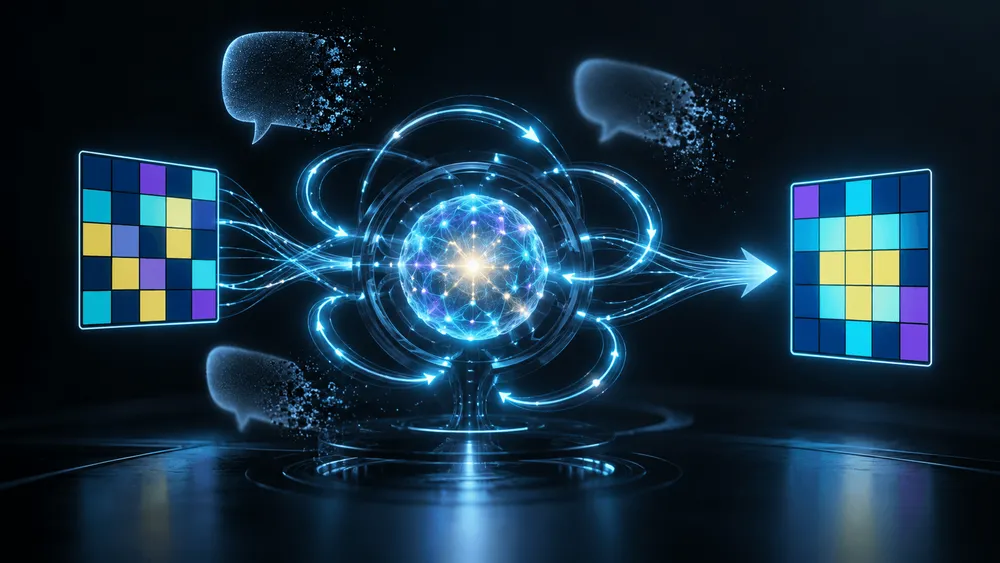
On August 10, 2026, U.S. AI company Pathway published a non-peer-reviewed paper on arXiv introducing a 150-million-parameter model called "BDH-CQ." Designed to perform computation internally rather than writing out intermediate reasoning as text, the model reportedly achieved a pass@2 rate (percentage correct within two attempts) of 29.5% on the 400-problem public evaluation set of ARC-AGI-1—a benchmark that asks solvers to infer transformation rules for colored grids—at a calculated cost of $0.00070 per problem. On September 22, ScienceNews covered the research under the question "Can AI reason without words?" The authors claim the model is about 11 times cheaper than OpenAI's GPT-5.6 Luna, but that comparison mismatches both the evaluation tasks used and the cost-calculation method; when lined up against ARC Prize's remeasurement after a price cut, the accuracy gap widens to about 10 percentage points. Under what conditions, exactly, can a small model that never converts its reasoning into language be said to have "reasoned cheaply"?
A Fixed-Size Memory That Rewrites Itself With Every Example
ARC-AGI-1 is a benchmark that shows a handful of colored-grid input-output pairs, asks a system to infer the transformation rule from them, and then apply that rule to a new input. Below, we refer to these rule-demonstrating input-output pairs as "examples."
Since the 2022 proposal of Chain-of-Thought prompting, large language models (LLMs) have improved their accuracy on hard problems by writing out intermediate steps as text before producing an answer. That written-out text directly becomes the number of tokens generated. The longer the reasoning chain, the greater the latency and computational cost.
BDH-CQ does not produce this intermediate text. According to the paper, the model rewrites a fixed-size recurrent memory each time it reads one example pair. This memory does not grow as more examples are added, and the model has no key-value cache that would otherwise keep expanding with everything it reads. After reading the entire problem, the model performs repeated computation over high-dimensional numerical representations, and outputs only the answer grid—without ever converting its intermediate states back into language.
This approach—performing repeated computation directly in internal numerical representations rather than verbalizing intermediate steps—is known as latent reasoning. Pathway CEO Zuzanna Stamirowska explained to ScienceNews: "Nothing in between ever converts into language."
Parameters are not updated during inference. The approach to an unfamiliar task is inferred solely from the examples shown at that moment. The authors position this in-context learning (learning solely from the examples shown at inference time) as a central pillar of the design. The authors state that the example pairs and task IDs from the evaluation set were not used in training; training instead combined independently collected examples with the ARC-AGI-1 training set, RE-ARC, ConceptARC, ARC-Heavy, and ARC-GEN100K, along with data augmentation.
Breaking Down the $0.0007-Per-Problem Cost
According to the paper, BDH-CQ reached a correct pass@2 answer on 118 of the 400 problems, for a rate of 29.5%. Counting only first-attempt answers (pass@1), it solved 97 problems, or 24.25%. The Wilson-method 95% confidence interval reflecting the variability inherent in a 400-problem sample is 25.24–34.15% for pass@2.
The cost figure is not a billed amount. The authors measured the actual NVIDIA H200 GPU time required to solve one problem—approximately 0.85 seconds—and converted it to a dollar figure assuming an H200 rental rate of $3 per hour. Allocating that 0.85 seconds of usage at $3 per hour yields the reported figure of $0.00070 per problem (under 0.1 cents). This figure comes from the HIGH reasoning-intensity setting, which the paper reports as its main result; other sections of the paper also report per-problem costs under other settings, such as STANDARD and MIN, and the numbers vary by setting.
Using the authors' calculated figure of $0.00070 per problem, solving the entire 400-problem ARC-AGI-1 public evaluation set would cost about $0.28, requiring roughly 340 seconds (about 5.7 minutes) of H200 runtime. Converting at a rate of 150 yen to the dollar (as of September 2026), that comes to roughly 42 yen for the full set of 400 problems, or about 0.1 yen per problem.
Two caveats apply to these figures. First, they exclude training costs. Second, this is a result the authors themselves ran on the public evaluation set—not a value verified by ARC Prize, which administers the benchmark.
Where Does the "About 11 Times" Figure Come From?
Pre-Price-Cut Accuracy Paired With Post-Price-Cut Pricing
The paper chose as its point of comparison OpenAI's low-cost model, GPT-5.6 Luna, run at Low reasoning intensity. The figures ARC Prize published in July showed 34.2% on ARC-AGI-1 at a cost of $0.040 per problem. Comparing against this figure, the authors calculate that BDH-CQ is about 57 times cheaper.
On July 30, OpenAI cut the price of GPT-5.6 Luna by 80%. Axios reported the post-cut per-token rates as $0.20 per million input tokens and $1.20 per million output tokens. The paper states that ARC Prize's data, as of August 6, did not yet reflect this price cut, and recalculated using a discounted figure of $0.008 (80% off $0.040), arriving at the "about 11 times" figure.
However, the accuracy figure paired with this recalculation—34.2%—remains the pre-price-cut evaluation value. ARC Prize has since remeasured GPT-5.6 Luna after the price cut: at Low reasoning intensity, it scored 39.5% on ARC-AGI-1 at $0.008 per problem, while at Max reasoning intensity it scored 90.7% at $0.065 per problem. Pairing BDH-CQ against ARC Prize's post-price-cut remeasurement (Low reasoning intensity: 39.5%, $0.008 per problem) keeps the cost ratio at roughly 11 times, but widens the accuracy gap with BDH-CQ from 4.7 points to 10.0 points.
The arithmetic is straightforward. The cost ratio, $0.008 ÷ $0.00070, comes to about 11.4—matching the paper's "about 11 times." But the accuracy gap is 4.7 points when compared against the 34.2% figure, versus 10.0 points when compared against 39.5%. The reading of "about 11 times cheaper, with only slightly lower accuracy" holds true only when pre-price-cut accuracy is paired with post-price-cut pricing.
Evaluation Tasks and Cost-Calculation Methods Also Don't Match
Even correcting for this mismatched pairing, the foundation for comparison still isn't aligned. BDH-CQ's 29.5% figure comes from the authors running their own model against the publicly available 400-problem evaluation set. ARC Prize's verified leaderboard, by contrast, uses a private evaluation set that is not publicly released.
The cost-counting methods also differ. BDH-CQ's figure is derived by multiplying measured GPU time by an assumed hourly rate, whereas ARC Prize calculates costs from retail prices such as publicly listed per-million-token rates. ScienceNews likewise notes that the two use different cost-calculation methods.
| System | ARC-AGI-1 Accuracy | Cost Per Problem | Evaluation Set | Cost Calculation | Timing |
|---|---|---|---|---|---|
| BDH-CQ | 29.5% (pass@2) | $0.00070 | Public eval set (author-run) | Measured GPU time × $3/hour | Aug. 2026 paper |
| GPT-5.6 Luna (Low reasoning, original) | 34.2% | $0.040 | Private eval set | Retail pricing | July 2026 |
| GPT-5.6 Luna (Low reasoning, post-price-cut) | 39.5% | $0.008 | Private eval set | Retail pricing | After July 30, 2026 price cut |
| GPT-6 Luna (Low reasoning) | 37.7% | $0.003 | Private eval set | Retail pricing | Published Sept. 22, 2026 |
| HRM (Hierarchical Reasoning Model) | 32.0% | $1.48 | Private eval set | ARC Prize calculation | As of Sept. 23 |
| TRM (Tiny Recursion Model) | 40.0% | $1.76 | Private eval set | ARC Prize calculation | As of Sept. 23 |
This table is not meant to rank these systems. Lining up which value was measured under which conditions shows that the BDH-CQ row alone differs from all the others on both the evaluation set and the cost-calculation method.
As of a check of the leaderboard's text version on September 23, no entry among the group achieved 29.5% or higher on ARC-AGI-1 at a cost of $0.001 or less per problem; GPT-6 Luna (Low reasoning intensity) achieved 37.7% at $0.003 per problem. BDH-CQ's $0.00070 figure was calculated by the authors from the public evaluation set and measured GPU time—the conditions simply don't match.
The authors claim BDH-CQ pushes forward the cost-accuracy Pareto frontier for ARC-AGI-1 (the boundary beyond which no system achieves higher accuracy at the same cost, or lower cost at the same accuracy). Their basis for this claim is a comparison against the leaderboard as of August 4. HRM and TRM, which likewise perform internal recursive computation, cost $1.48–$1.76 per problem under ARC Prize's calculation because they use the evaluation set's example pairs for optimization. This gives them a fundamentally different cost structure from BDH-CQ, which solves tasks using only the examples shown at inference time.
A Lineage of Latent Reasoning Since Chain-of-Thought in 2022
BDH-CQ is not the first attempt to reason without converting intermediate steps into language. Arranging the major research by the date of its first arXiv submission produces the following timeline.
| First arXiv Submission Date | Research | Description |
|---|---|---|
| Jan. 28, 2022 | Chain-of-Thought (Wei et al.) | Prompting that has the model write out intermediate reasoning as text |
| May 23, 2024 | Deng et al. | Moves intermediate reasoning, previously written as text, into internal model computation |
| Dec. 9, 2024 | Coconut (Meta) | Reasons within a continuous numerical representation space |
| Feb. 7, 2025 | Recurrent-Depth Model (Geiping et al.) | Performs latent reasoning by recursively increasing computational depth |
| June 26, 2025 | HRM | Solves ARC and other tasks by recursively updating internal state |
| Sept. 30, 2025 | BDH (Dragon Hatchling) | Pathway's post-Transformer architecture |
| Oct. 6, 2025 | TRM | Reasons recursively using a small-scale network |
| Aug. 10, 2026 | BDH-CQ | Solves ARC-type tasks built on top of BDH |
After Chain-of-Thought had models write out intermediate reasoning as text in 2022, research into non-verbalized reasoning continued through Deng et al.'s work in May 2024, Coconut in December of that year, and the 2025 works—the Recurrent-Depth Model, HRM, and TRM. The authors of BDH-CQ cite, as their point of difference from prior work, the ability to learn unfamiliar tasks solely from examples shown at inference time.
The two researchers who commented to ScienceNews are themselves part of this lineage. Yuntian Deng of the University of Waterloo is the lead author of the May 2024 study, while Jonas Geiping of the ELLIS Institute Tübingen and the Max Planck Institute for Intelligent Systems is the lead author of the Recurrent-Depth Model. Geiping's paper is also cited among the related work in the BDH-CQ paper. As for BDH-CQ's predecessor, BDH, XenoSpectrum also covered it on October 18, 2025 as a brain-inspired design, though that article did not address ARC-AGI performance.
From Co-Author Replication to Third-Party Remeasurement: Three Checks Still Needed
Pathway states that its 29.5% result has been replicated by external evaluators. According to the paper, Remigiusz Kinas of Bielik AI and Richard Zhong of New York University reproduced the 29.5% figure through a black-box evaluation—one that did not access the model's weights—following documented procedures. However, both are listed as co-authors of the paper. Analytics India Magazine listed Łukasz Kaiser as if he were an evaluator, but Pathway's own announcement positions Kaiser as an advisor and investor of the company.
Much of the model's inner workings also remain undisclosed. The paper explicitly states that the dimensionality of internal representations, the details of the memory update rule, the implementation, and the full training procedure are not public. Pathway says it will provide API access for independent verification upon request.
The paper's controlled experiments offer some outline of the model's capabilities. On a task requiring shapes to be extended to a boundary, the model got all 48 outputs correct across distances of 2 to 8. On the other hand, on length-8 sorting tasks, it solved 0 of 24 problems; adding one example of matching difficulty to the test raised that to 13. On depth-5 nested-structure tasks, adding an example improved performance from 19 out of 24 to a perfect 24 out of 24. On tasks combining multiple transformations, the model got 72 of 72 correct for rotation-plus-translation, 47 of 72 for reflection-plus-translation, and 0 of 72 for color-swap-plus-translation.
External researchers' assessments are cautious as well. Deng told ScienceNews that this is "an interesting efficiency result," while adding that it does not demonstrate the architecture itself is superior. He said additional experiments are needed to separate the effects of the design from the effects of training, and noted that non-verbalized reasoning is harder to inspect. Geiping called the method "neat," citing its ability to tackle test problems without retraining, but pointed out that because it is built specifically for ARC-type tasks, direct comparison with general-purpose AI is difficult. The paper does not evaluate BDH-CQ on language tasks, mentioning extension to language and math only as a future direction.
Taken together, verifying the claim of "cheap reasoning" comes down to three remaining checks: an independent third party (not a co-author) remeasuring the model using the same private evaluation set and cost-calculation method as ARC Prize; the design-versus-training separation that Deng called for; and evaluation on language tasks. As Deng put it: "Human language is useful for communicating reasoning, but it doesn't need to be the most efficient representation for every computation along the way." Once these three checks are complete, it will become possible to judge with hard numbers whether reasoning that skips writing things out in words can also cut costs beyond puzzle benchmarks.