

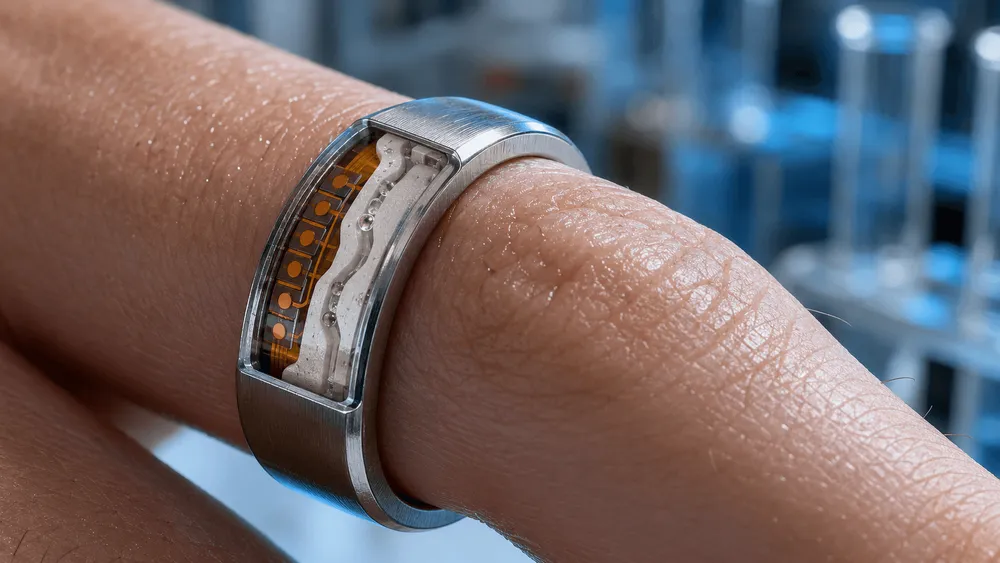
A research team at the University of California, San Diego (UC San Diego) has developed a smart ring called "CHARM" that draws sweat from the finger to continuously measure glucose, ketones, and other substances. The research findings were published in the academic journal Nature Communications on July 23, 2026. Whereas commercial rings read heart rate and sleep from optical sensors, accelerometers, and skin temperature sensors, CHARM extends the measurement target to chemical substances that reflect metabolic changes in the body.
However, the ring does not examine blood directly. It is a prototype that converts electrical currents generated by sweat into blood concentration values using individually calibrated coefficients, and the final human testing was conducted on just three people: one healthy individual and two with type 1 diabetes. While the engineering integration has advanced significantly, challenges remain—separate from accuracy—before it can become a medical device usable for treatment decisions.
Drawing sweat via osmotic pressure, without waiting for it to form
CHARM's starting point is a mechanism for obtaining sweat without exercise or electrical stimulation. A PVA-PAAm hydrogel that contacts the skin is treated with ethylene glycol to create an osmotic pressure difference with sweat. According to the research team's measurements, this gel's osmotic pressure reached approximately 2,800kPa, far exceeding the roughly 55–58kPa of a comparison gel treated with PBS.
The drawn sweat travels through a paper microfluidic channel via capillary action, reaching electrochemical sensors arranged along the way. The flow rate obtained at the ring's wearing site was approximately 100–150nL per minute. The channel is designed to last about 10 hours at 150nL per minute, moving older sweat forward while carrying fresh sweat to the sensors.
Each sensor measures the electrical current generated by the reaction between an enzyme and the target substance. Because osmotic collection requires no electrical stimulation, the battery's role can be narrowed down to chemical measurement, data processing, and wireless transmission. Separating the sweat-collection mechanism from the measurement circuitry became the premise for coexisting multiple assay systems within the ring.
Measurement delays must be divided into two types. The delay for substances to reach the sensor located approximately 1.3cm from the inlet was estimated via simulation at about 2–3 minutes. Meanwhile, the physiological delay for changes in the blood to appear in sweat reached roughly 15–30 minutes in individual tests, and about 30–75 minutes for uric acid. The concentration conversion in this study does not include processing to correct for this physiological delay.
3cm diameter supports 6 types, with simultaneous measurement of 4
CHARM weighs 5.1g with an outer diameter of 3.0cm, consisting of two semicircular sections joined by a hinge. One side houses the gel, paper channel, and sensors, while the other contains a bendable zinc-silver oxide (Zn-AgO) battery and flexible substrate. It supports glucose, β-hydroxybutyrate (BHB, a ketone body), and vitamin C. Additionally, users can select from six types by adding uric acid, lactate, and alcohol.
The design does not read all six simultaneously. Because it uses a shared reference electrode, adding a fifth and sixth measurement electrode increases voltage drop and reduces sensitivity. The configuration allows selecting up to four out of six types depending on the application.
The wireless circuit uses AD5940 and nRF52840, fitting on a substrate measuring 1.3cm × 0.67cm and weighing approximately 90mg. It reads four channels sequentially, transmits via BLE, then sleeps for approximately 8 minutes. Average current is 0.83mA, with a communication range of approximately 3m when worn on the body. A 10mAh battery made of two series-connected units supplies over 3.6V, powering the system for approximately 12 hours.
Comparison with commercial products reveals the distance remaining to commercialization.
| CHARM Prototype | Samsung Galaxy Ring | |
|---|---|---|
| Primary Measurement | Up to 4 chemical substances in sweat | Acceleration, PPG, skin temperature |
| Weight | 5.1g | 2.3–3.0g |
| Operating Time | Approx. 12 hours, channel designed for approx. 10 hours | Up to 7 days |
| Waterproofing/Charging | Waterproofing planned for future, no charging circuit installed | 10ATM/IP68, includes 361mAh charging case |
Since the measurement content and power load differ between the two, this table does not directly compare battery performance superiority. What CHARM demonstrated is that fluid processing necessary for chemical analysis can be packed into a ring. Everyday wear would require, in addition to miniaturization, sealing that withstands hand-washing and bathing, a replaceable channel, and a charging circuit built into the ring.
420 measurement points and a validation cohort of 3
In the glucose evaluation, 420 points obtained from healthy subjects and type 1 diabetics fell within zones A or B of the consensus error grid. The mean absolute relative difference (MARD) against blood values was approximately 13.72% overall, with a Pearson correlation coefficient of approximately 0.82. Lower MARD indicates smaller deviation from the reference value. Broken down, the type 1 diabetes trial averaged approximately 17.05%, while the healthy subject trial was approximately 6.14%—error widened under conditions with greater blood glucose fluctuation.
The figure of 420 does not represent the number of participants. According to published peer review records, the initial human data was repeatedly collected from one healthy person and one person with type 1 diabetes. After peer review, glucose data from a different type 1 diabetic evaluated over approximately 2 weeks was added, bringing the final total to 3 people. From the central type 1 diabetic participant, 355 points were collected over approximately 2 months. While the temporal data is substantial, the cohort size for evaluating individual variation is small.
The depth of validation also differs by substance. Comparison points against blood measurements were 251 for BHB, 136 for lactate, 110 for alcohol, and 45 for uric acid, with correlation coefficients overall ranging from approximately 0.85 to 0.90. Not all six substances, including vitamin C, were clinically validated with the same number of people and conditions.
"2-month stability" does not mean sensor lifespan
Converting sweat current into blood concentration requires deriving two coefficients tailored to each individual's response. The coefficients are calculated from changes in sensor current and reference values measured by devices such as blood glucose meters. This is because in vitro calibration curves cannot be directly applied to the human body, as sweat flow rate and enzymatic reactions change over time.
The paper's stated "approximately 2-month calibration stability" does not mean the same sensor was used continuously for 60 days. Rather, it means that individual coefficients—determined sporadically across multiple days using new sensors and channels for each measurement day—did not vary significantly. Responses to peer review also revealed an operational approach where recalibration via blood measurement occurs if coefficients deviate by more than 10%. This has not reached the stage of completely eliminating the need for blood draws.
The concept of collecting sweat via osmotic pressure itself was already published by the same team in 2024. That prior research measured glucose at the fingertip and forearm in 5 healthy individuals and 3 diabetics, with MARD at 10.56% for the fingertip and 13.17% for the forearm. The foundational technology for the bendable Zn-AgO battery was also reported in 2021. CHARM's advancement lies in combining existing extraction methods and batteries with multi-parameter sensors and wireless circuitry, packaging it all into a ring form.
The distance to a medical device shows in waterproofing and clinical trials
The U.S. Food and Drug Administration (FDA) has issued warnings that no smartwatch or smart ring claiming to measure or estimate blood glucose independently without skin puncture has been approved, cleared, or authorized. Insulin administration based on erroneous values could lead to severe hypoglycemia. CHARM is a research prototype, not a commercially available device usable for diabetes treatment.
The paper itself acknowledges it has not been validated under a wide range of conditions—including hypoglycemia, rapid blood glucose fluctuations, and dehydration—nor in large, diverse diabetic populations. Skin safety evaluation remains limited to preliminary cell testing and a 5-day wear trial, with additional testing using skin cells still needed. Daily use would require extending the gel's lifespan and developing contamination-resistant sensors. A design incorporating a replaceable channel into a waterproof structure, along with charging capability, would also be necessary.
Even so, the significance of expanding the information a ring handles—from heart rate and temperature to molecular movement—is clear. The next hurdle toward commercialization is confirming, across large and diverse populations, whether results obtained from three individuals reproduce across different people. If errors and delays during hypoglycemia or rapid changes, along with the frequency at which recalibration becomes necessary, can be quantified, the field can advance to evaluating whether it can be used for treatment decisions.