


On September 7, 2026, Reuters reported, based on a review of more than 100 Chinese military procurement notices, academic papers and patents, that China's defense authorities are accelerating research into military uses of humanoid robots and planning for their wartime use. The report also states plainly that Reuters found no evidence that armed humanoid robots have been deployed to operational PLA (People's Liberation Army) units. Reuters cites three specific procurement-related records in its article, and for two of them, 2025 bids, it could not confirm whether a contract was awarded. Nineteen days earlier, NORINCO (China North Industries Group), the state-owned defense contractor that unveiled the military humanoid robot Fuxi, had also become the lead company of a technology alliance of more than 100 organizations, including companies and universities. The question that sets the speed of China's robot militarization is increasingly not whether civilian technology can be converted, but where a defense contractor sits within the civilian mass-production ecosystem.
What Was Lined Up Across Ten Days in Beijing
On August 19, 2026, the World Robot Conference opened in Beijing. NORINCO timed the unveiling of its special-purpose humanoid robot Fuxi to the event and showed 68 products from 18 affiliated organizations. Global Times reported before the opening that the robot was "scheduled to be exhibited," but Xinhua reported on August 20 that Fuxi performed a night urban patrol demonstration at the NORINCO booth and drew visitors' attention, confirming it was actually demonstrated at the venue.
At the opening ceremony the same day, the Central Enterprise Robot Innovation Alliance, led by NORINCO under the guidance of the State Council's State-owned Assets Supervision and Administration Commission (SASAC), was formally launched. More than 100 organizations, including companies, universities and research institutes, are taking part, and the alliance itself states its aims as joint technology research, developing application scenarios and sharing results. Jiji Press placed this launch, together with the surrounding developments, as the starting gun for early mass production with an eye on competition with the United States. A demonstration of a military humanoid robot and the launch of an industry-academia-government technology alliance happened on the same day under the name of the same company.
Three days later, on August 22, the World Humanoid Robot Games opened at a different venue, drawing more than 2,000 robots from 16 countries. In the 100m sprint on opening day, a machine from Beijing-based X-Humanoid ran 9.39 seconds, faster than the 9.58 seconds Usain Bolt set in 2009. That said, the machine crashed into a cushion after the finish line to stop, and the conditions were not the same as those for human timing. In the same week, on August 24, Yang Kun of AgiBot told CBS News that Chinese companies are "5 to 10 years" away from the ultimate goal of humanoid robot soldiers.
Two days after the Games ended, the PLA Daily urged researchers to speed up moving advanced technology from the laboratory to military training grounds for robot "combatants." Lined up on one timeline, the ten days look like this:
| Date | Event | Source |
|---|---|---|
| August 19, 2026 | NORINCO-led Central Enterprise Robot Innovation Alliance launched under SASAC guidance (more than 100 organizations, including companies and universities) | Baidu Baijiahao and other Chinese-language reports |
| August 19, 2026 | NORINCO unveils and demonstrates Fuxi (Xinhua reported a night patrol demo at the venue on August 20; the conference ran August 19–23) | Global Times / Xinhua |
| August 22, 2026 | World Humanoid Robot Games open. X-Humanoid machine runs 100m in 9.39 seconds | CBS News |
| August 24, 2026 | AgiBot's Yang Kun says humanoid robot soldiers are "5 to 10 years away" | CBS News |
| Two days after the Games ended | PLA Daily urges faster transfer of technology from labs to military training grounds | Reuters |
That these events fall in the same city within the same ten days does not mean they are causes or effects of one another. The World Robot Conference and the Games are separate events with different organizers, and for the PLA Daily article, Reuters says only "two days after the Games ended" and does not state the publication date. Even so, the fact remains that leadership of a technology alliance and a demonstration of a military machine overlapped in the same company.
What the Fuxi Announcement Does Not Say
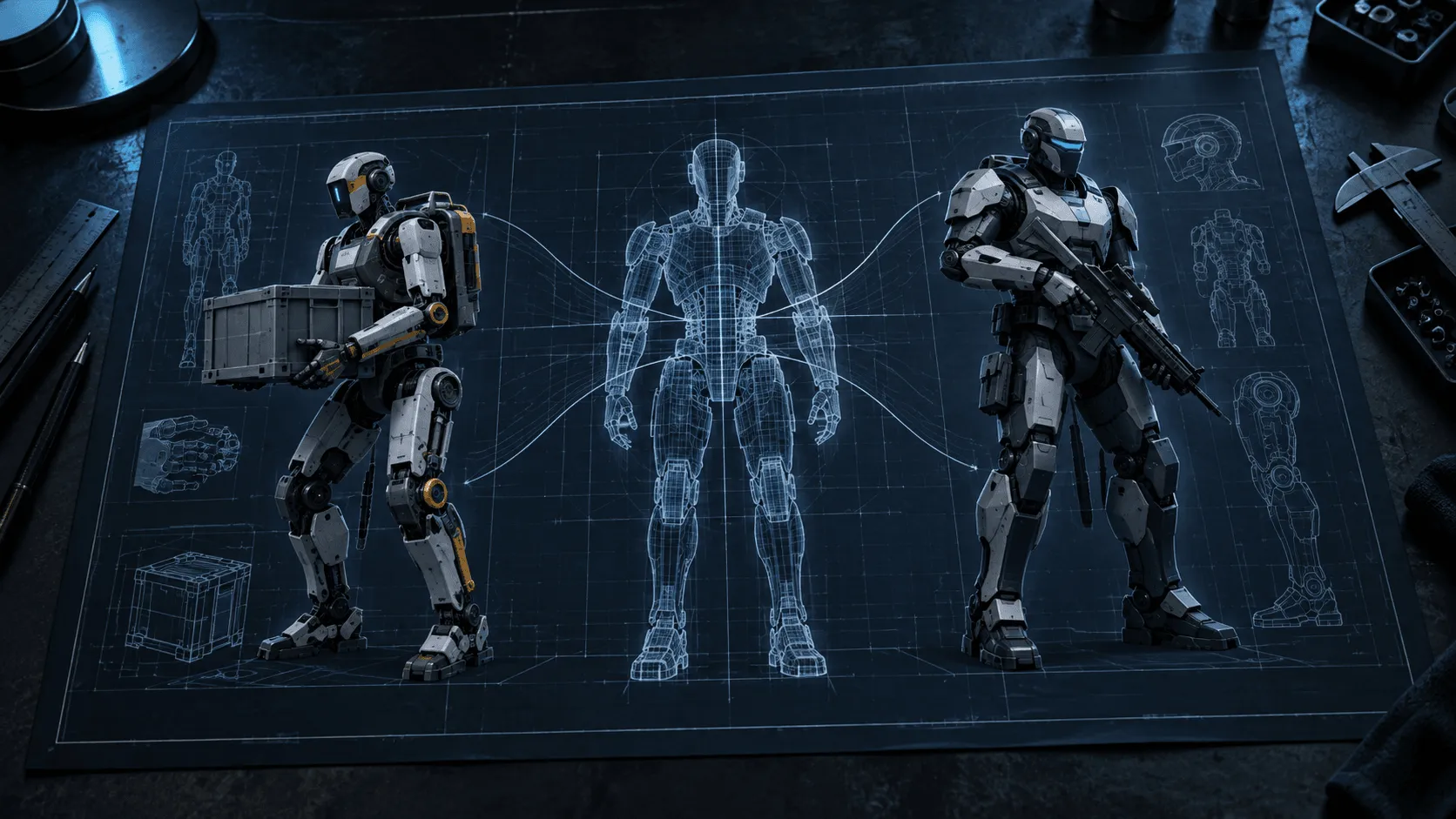
NORINCO lists the uses of Fuxi as sentry duty that identifies personnel and raises an alarm in anomalies, all-weather reconnaissance, intelligent patrol, and substitute work in hazardous areas. It explains that, combined with the teleoperation system "external avatar," this would be China's first independently controllable teleoperation solution for a full-body humanoid robot in the roughly 90 kg class, and it announced it would demonstrate multi-unit formation operations and night urban patrols. All of this is NORINCO's own announcement, and the text carried by Global Times and People's Daily Online's English edition is the same wire article, not independent verification.
Reading through the two published articles, four numbers needed to judge military suitability are all missing: continuous operating time, payload capacity, level of autonomy, and unit price.
These four items directly determine whether a mission works. For sentry duty, continuous operating time sets the rotation cycle and the number of machines required. Payload sets the upper limit on how many sensors, communication devices and spare batteries can be carried. Level of autonomy determines what the machine does when communications are cut and how many operators must be assigned to each unit. And unit price decides whether losing a machine can be tolerated as an expendable item.
Professor Dennis Hong of UCLA told Reuters that going where you don't want to send humans is one of the most compelling reasons to build robots, and that if losing a robot avoids a loss of human life, the robot can be expendable. But whether it can be used as an expendable asset cannot be judged without knowing the unit price.
Applying the same four items to a machine tested under combat conditions shows the difference in disclosure. Foundation's Phantom MK-1 from the US, used in Ukraine since February 2026, is reported to have a payload of about 20 kg and a unit price of about $150,000 (about ¥22 million at ¥147 to the dollar), and it has also been disclosed that it is not waterproof and that its battery life is insufficient for large-scale operations.
| Item needed for judgment | Fuxi (announced by NORINCO) | Phantom MK-1 (test reports from Ukraine) |
|---|---|---|
| Continuous operating time | Not stated | Reported as insufficient for large-scale operations |
| Payload | Not stated | About 20 kg |
| Level of autonomy | Only a description of the teleoperation method | Mainly used for logistics missions in hazardous areas |
| Unit price | Not stated | About $150,000 (about ¥22 million) |
This is not to say Phantom MK-1 is the better machine. If anything it is the opposite: Foundation CEO Sankaet Pathak says the tests in Ukraine showed the potential of the application but that the machine is still far from the concept of a "super soldier." The difference lies less in performance itself than in whether outsiders are in a position to grade the capability.
The absence of information in public materials does not prove that specifications do not exist. Explanations at the exhibition venue, the Chinese-language announcement or non-public product materials may touch on these four items.
What the 95% Figure Rests On
The premise that Chinese manufacturers account for nearly all global humanoid robot shipments is widely shared. Yet the figures do not line up when set side by side.
| Source | Period | Chinese manufacturers' share | Unit denominator |
|---|---|---|---|
| BofA Global Research (cited by Reuters) | Full year 2025 | About 95% | Not stated |
| Smart Analytics Global | First half of 2026 | More than 97% | 19,100 units |
The two figures cover different periods, so they cannot simply be read as a rise from 95% to more than 97%. The definition of the population is not aligned either. SAG states explicitly that it includes full-body bipedal, half-body bipedal, wheeled and ultra-biomimetic types, but BofA does not indicate the scope of what it calls "humanoid robots." BofA's 95% also gives no unit denominator, so there is no way to confirm whether it counts the same population as SAG's 19,100 units.
A similar figure comes from TrendForce, which forecasts that Unitree and AgiBot alone will account for about 80% of 2026 shipments, but whether this refers to the world or to China's domestic market is not stated in the original. Because it is neither "all Chinese manufacturers" nor an actual result, its subject differs from the two figures above, so it is not used for comparison.
Even where the precision of the numbers does not match, the breakdown from Smart Analytics Global shows the outline of the industry. Global shipments in the first half of 2026 were about 19,100 units, more than triple the 5,100 units in the same period a year earlier. By company, AgiBot shipped 8,400 units for a 44% share and Unitree 5,900 units for 31%. The share going to industrial and commercial uses rose from about 50% in the same period a year earlier to more than 70%. The center of gravity appears to be shifting from exhibition spectacle to machines working in factories and facilities.
The path by which these units become military assets is not the machines themselves. Humanoid robots use large numbers of reducers, actuators and force sensors, and as production volume rises, component unit costs fall and production line yields improve. At the same time, the more machines in operation, the more data accumulates on grasping objects, climbing stairs, and losing and recovering balance.
The PLA's June 2026 procurement confirmed by Reuters does not target robot bodies. It is a system that collects and labels camera, radar and motion data, which fits this path. A scale of about $300,000 is far from bulk procurement of machines, but it makes sense as spending to prepare a foundation of training data on the military side. The significance of a state-owned defense contractor being involved in developing application scenarios through a technology alliance lies in the same place. Without a conversion step in between, component unit costs, production lines and motion data all grow from the start in the same vessel.
Ukraine Approved 67 Models, and None Were Bipedal
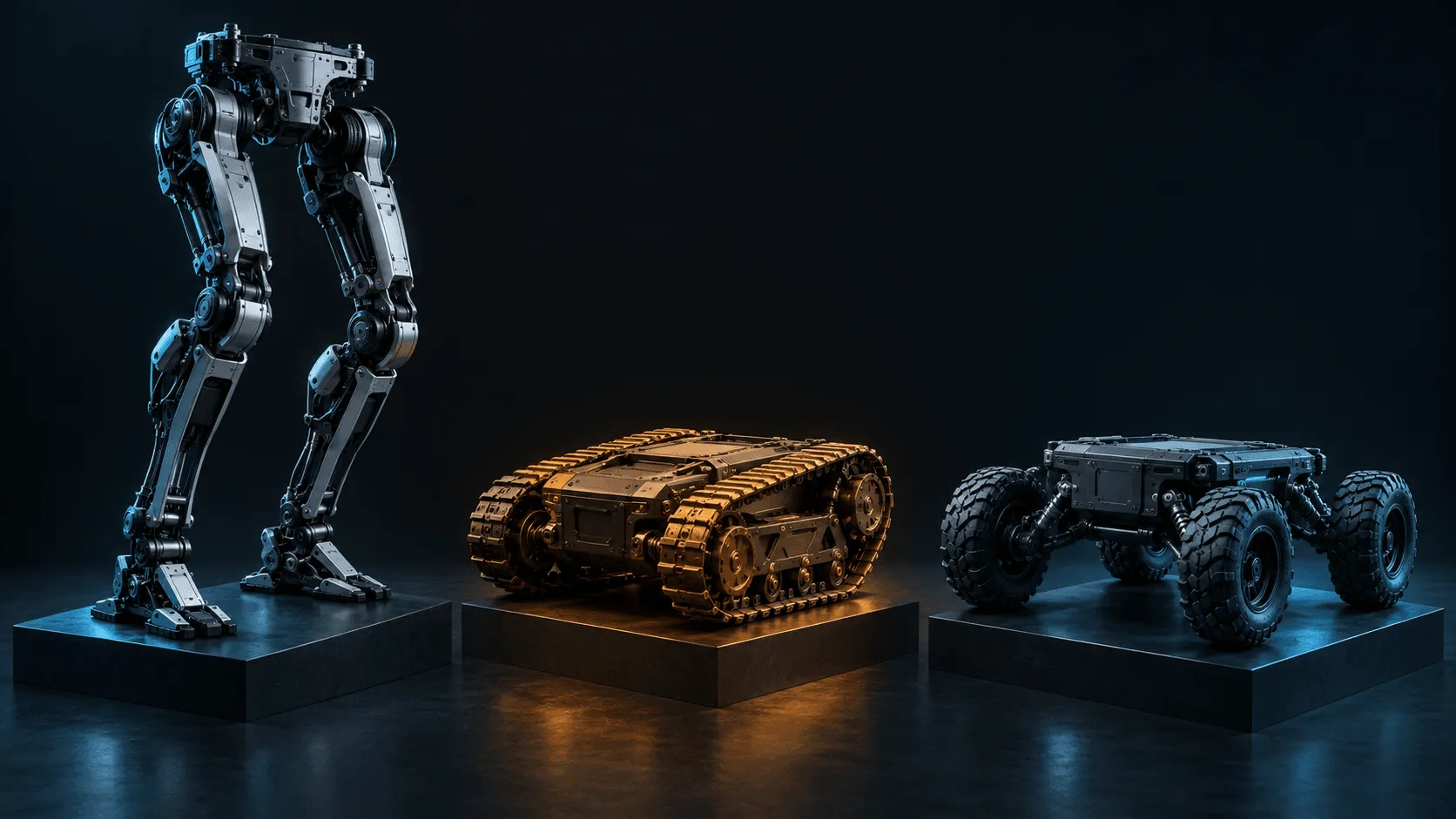
Ukraine codified 67 ground robot models in the first half of 2026. Of those, zero were bipedal. As a ratio, 0 ÷ 67 is 0%, leaving no room for rounding. What is counted here is the number of models, not units procured. Codification also refers to the procedure of registration on the list of models approved for use.
Even so, the fact remains that the military making the most intensive use of robots under combat conditions included not a single humanoid among the 67 options it approved in these six months. In the same period, ground robotic complexes delivered to units through the procurement platform DOT-Chain Defense came to 1,028 units, at 487 million hryvnia (about $11.7 million, about ¥1.7 billion at ¥147 to the dollar). Wheeled, tracked and quadruped types are reported as the configurations achieving results in actual combat, but the breakdown of the 1,028 units has not been confirmed.
Ukraine is not excluding humanoids as a matter of policy. In July 2026, Brave1 opened a grant call for combat humanoid robots. Andrii Hrytseniuk, CEO of the organization, said he can see that the humanoid robot industry is developing rapidly in China and the United States. The judgment is to begin investing in the future while codifying wheels and tracks now.
Why this happens is clear from the explanation Juo-Min Chou, a researcher at Taiwan's Institute for National Defense and Security Research, gave Reuters. Two hands and two legs could in theory combine movement, climbing and manipulation in a single machine. But for simple reconnaissance and logistics, quadruped, tracked and wheeled types are cheaper and easier to deploy at scale. The humanoid's advantage works in situations where it handles stairs, doorknobs and vehicle controls built for humans in place of a human, and before reaching those situations there are walls of operating time and unit price.
Professor Aaron Johnson of Carnegie Mellon University told Reuters that the many variables of the battlefield environment test a robot's capabilities in unpredictable ways. The breakdown of the 67 models is also the answer to who has passed that test so far.
This figure of zero models was reported by Euromaidan Press. Also, the only humanoid robots to have undergone testing under combat conditions in Ukraine are the two Phantom MK-1 units mentioned above, which US-based Foundation sent for testing in February 2026, and they fall outside the population of codified models.
When "5 to 10 Years" Is Said From Three Directions
On the number of years before humanoid robots become practical for military missions, three parties with different interests cite the same range.
| Speaker's position | Speaker / entity | Years and content given |
|---|---|---|
| PLA-affiliated research institution | National University of Defense Technology (NUDT) Xi'an test center | An August 2025 paper simulated urban combat scenarios assuming equipment available within 5 to 10 years |
| Think tank on the allied side | Malcolm Davis (Senior Analyst, Australian Strategic Policy Institute) | Does not see them as practical battlefield systems at present, but in 5 to 10 years they are quite possible |
| Chinese manufacturer | Yang Kun (AgiBot) | Chinese companies are 5 to 10 years from the ultimate goal of humanoid robot soldiers |
When three parties in different positions settle on the same number of years, one would normally be tempted to think the confidence of the estimate has risen. Here there is reason to read it the other way. None of the three presents a technical indicator supporting that timeframe. None of the statements says how many hours of continuous operation, how far unit price must fall, or what level of autonomy must be reached to call it practical. A 5-to-10-year range without indicators cannot be ruled out as merely a rule of thumb shared within the industry and repeated.
Moreover, two of the three reach us as quotations within the Reuters article.
An exception that gives conditions is Wang Yonghua, a researcher at the Chinese Academy of Military Science. In a commentary cited by Reuters, he acknowledged that humanoid robots have unresolved problems in locomotion, perception and intelligence, and wrote that if three conditions were met, namely technological breakthroughs, lower manufacturing costs and industrial-scale production, then "humanoid robots will flow onto the battlefield." Because he speaks in conditions instead of years, his statement is easier to verify. And two of the three conditions, manufacturing cost and industrial scale, lie in an area governed more by the civilian mass-production curve than by military procurement.
The scenario described in the NUDT paper has the same structure in that it places its equipment assumptions 5 to 10 years ahead. The paper simulated urban combat in which six combat robots, made up of humanoid, quadruped and unmanned vehicle types, were divided into two assault teams and, working with ground troops, cleared an enemy-held building floor by floor and room by room. It did not specify rules of engagement, onboard weapons or handling of civilians. It remains research based on assumptions, and the paper's content reaches us through Reuters' reporting.
The Speed of the Production Curve, and Why the US Is Moving Against the Companies

The United States is moving to stop this structure from the company side. The Department of Defense added 65 companies including Unitree to its 1260H "Chinese military companies" list published on June 8, 2026, bringing the list to 188 companies in total. Jiji Press also reports that the FCC restricted certification of Unitree's new model in July 2026. The target of the designation is not a specific military machine. It is the company responsible for civilian mass production itself.
Seen as a counter to the structure in which NORINCO, which unveiled Fuxi, leads a technology alliance, this choice of target makes sense.
Meanwhile, the resources the US military itself is directing at humanoid robots are still at the scale of demonstrations. The xTechHumanoid competition, announced by the US Army on September 5, 2025, is designed so that up to 10 applicants, commercial or non-profit, each receive a $25,000 prize to take part in a demonstration event in August–September 2026, with up to two winners in the basic humanoid category receiving $75,000 each and up to three winners in the advanced subsystem category receiving $30,000 each. The ceiling on immediate prize money so far is $490,000, and the ceiling on the overall budget, including funds for follow-on contracts, is $1.74 million (about ¥256 million at ¥147 to the dollar). Set against the 19,100 units shipped worldwide in the same half-year, more than 97% of them by Chinese manufacturers, this is clearly a budget for the stage of searching for promising technology, not at a scale to enter a mass-production race.
Converting to yen makes the orders of magnitude easier to grasp. The total for the 1,028 ground robots Ukraine delivered to units in six months is about ¥1.7 billion, whereas the budget the US Army prepared for xTechHumanoid is, at its ceiling, about ¥256 million. The military budgets countries are putting into humanoid robots are small as defense equipment procurement. The gap is not on the military budget side. It lies in civilian production volume and the component supply and motion data that come from it.
The 1260H list is a designation by the US Department of Defense and does not directly bind private-sector procurement in other countries, including Japan. Whether Japanese manufacturers and research institutions use Unitree or AgiBot machines comes down to a judgment on how to treat this designation, in addition to performance and price.
What is moving China's humanoid robots from spectacle toward fighting force is not direct PLA procurement. The procurement-related records Reuters presents in its article come to just three: two bids (whether contracts were awarded is unconfirmed) and one expenditure on a data collection system. Meanwhile, the state-owned defense contractor that unveiled Fuxi is pulling together a technology alliance of more than 100 organizations.
Hence, the next things to check are not new model announcements or competition records. They are three points: whether Fuxi's continuous operating time, payload, level of autonomy and unit price are published; whether PLA procurement notices move from prototype units to units in the hundreds; and whether a military like Ukraine's, which builds its procurement list under combat conditions, approves a bipedal model. When all three line up, humanoid robots will actually enter what Dennis Hong calls the places "you don't want to send humans," and become machines lost in place of human lives.