

The expanding adoption of renewable energy sources such as solar and wind power brings benefits to the global environment, but it is also placing unprecedented strain on national power grids. When power generation fluctuates wildly depending on weather conditions, voltage and frequency within the transmission network are in a constant state of flux. Stabilizing this complex power flow requires advanced control capable of instantly detecting even the slightest fluctuations across the entire grid and dynamically reconfiguring transmission routes. However, conventional sensors and computing systems have been unable to avoid delays in detecting minute anomalies or bottlenecks in computational processing, meaning the risk of large-scale blackouts could never be completely eliminated.
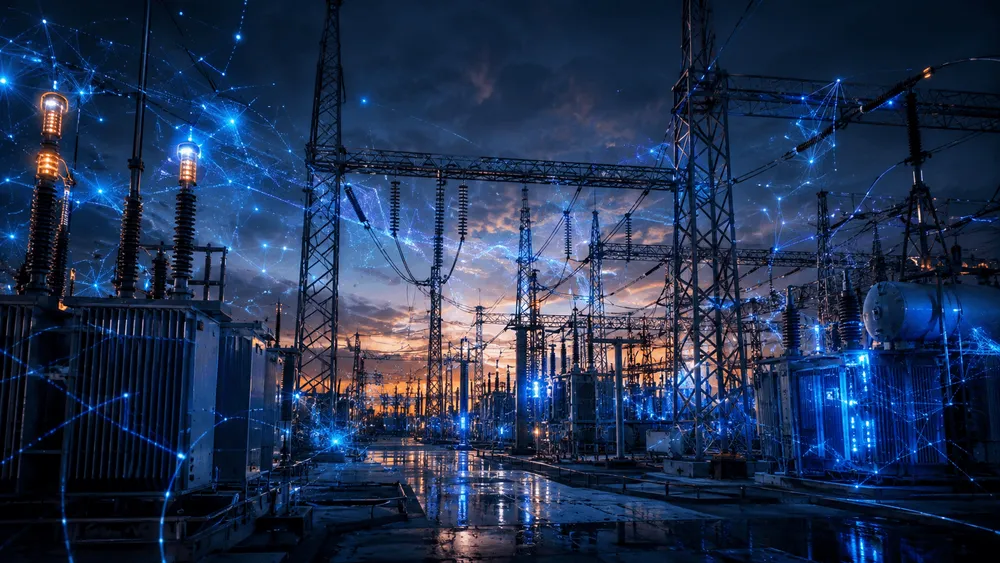
As an attempt to break through these limitations, the "Hefei Houdian 220kV Quantum Application Demonstration Substation," built in Hefei City, Anhui Province, China, has released the results of an 18-month trial operation period. Officially brought online in November 2024, this substation is the world's first to integrate quantum technology, incorporating 85 sets of devices across 18 different types of quantum technology spanning three domains: quantum measurement, quantum communication, and quantum computing. This substation demonstrates that quantum technology—long discussed only under the strict, controlled conditions of laboratories—is becoming a force that directly supports critical, noise-filled social infrastructure.
The Ultra-High Precision of 'Quantum Sensors' That Prevent Blackouts
The greatest challenge in maintaining stable operation of the power grid lies in how quickly and accurately equipment degradation and minute anomalies can be detected. Current transformers and Hall-effect sensors, which have been mainstream in conventional substations, have physical constraints such as drift caused by temperature changes and magnetic hysteresis. As a result, discrepancies arose between the actual amount of power transmitted and the values recorded by meters, revealing a fundamental limit to measurement precision.
To solve this problem, the Hefei Houdian substation adopted quantum precision measurement technology using diamond materials. This quantum sensor utilizes lattice defects known as nitrogen-vacancy (NV) centers within diamond crystals. By reading how electron spin states change in response to external magnetic fields, it can capture extremely faint magnetic field variations—as small as one ten-thousandth of Earth's magnetic field—and detect minute fluctuations in electrical current with high precision. According to state media reports, the introduction of this technology could reduce measurement errors by more than 500,000 kilowatt-hours (kWh) annually. By eliminating oversight of minor power leaks or transmission losses, power companies can cut unnecessary costs while enhancing safety.
Furthermore, quantum dot multi-parameter sensors have been installed in high-voltage switchgear rooms. These small devices not only monitor temperature and humidity changes inside the switchgear cabinets in real time, but can also detect extremely faint signals of "partial discharge"—an early warning sign of equipment damage or power outages—at a remarkably early stage. Partial discharge caused by insulation degradation was, under conventional technology, difficult to detect until an anomaly had already progressed significantly. With quantum sensors, it becomes possible to take preemptive action before a fatal failure occurs, completely shifting infrastructure maintenance from a reactive approach to predictive maintenance.
Complex Power Grid Simulations Solved by 'Origin Wukong'
In addition to improving hardware monitoring capabilities, software-side processing power has also been boosted through quantum technology. In today's power grids, where distributed energy sources have proliferated, the flow of electricity has shifted from unidirectional to bidirectional, and deriving optimal operations requires simulating an enormous number of patterns. Calculations to minimize line losses by switching the grid's topology, and route searches to minimize impact in the event of a fault, both involve combinations that grow exponentially as the number of substations increases. With conventional classical computers, limitations in computational resources have been a bottleneck for real-time responsiveness.
To address this, the Hefei Houdian project brought quantum computing into grid analysis and power flow calculations. China's third-generation superconducting quantum computer, "Origin Wukong," was used to verify these simulations.
The parallel computing methods enabled by Origin Wukong's qubits boost real-time power system analysis capabilities at a speed fundamentally different from that of conventional computers. By instantly calculating the constantly shifting balance between power demand and supply and deriving optimal control measures, the system is designed to preemptively avert the risk of large-scale blackouts. Even in the event that some transmission lines go down, quantum algorithms can instantly calculate optimal detour routes, playing a role in preventing a chain reaction of blackouts.
Defending Infrastructure Through Quantum Cryptographic Communication
In addition to enhanced physical anomaly detection and advanced simulation, data communication security has also been strengthened. Cyberattacks targeting power grids have become a global threat, and there have been past instances overseas of large-scale blackouts caused by hacking. At the Hefei Houdian substation, quantum cryptographic devices have been integrated into the grid's optical fiber communications and 5G networks, building a system that prevents external interception or tampering at the level of physical law itself. This ensures that control commands sent from the central control room remain robustly secure.
Implementation From Lab to Infrastructure, and Future Prospects
The greatest obstacle for the development team was the "engineering wall"—getting faint quantum signals to operate stably in the noisy environment of an actual substation. Devices that function perfectly in a laboratory setting can easily malfunction in the field, where they are exposed to intense electromagnetic waves and severe temperature swings. To maintain quantum coherence and perform accurate measurements in an environment crackling with 220kV of high voltage, the team spent months optimizing algorithms and thoroughly refining shielding structures. As a result, they achieved a level of stability suitable for practical use.
Building on the results achieved at the Hefei Houdian substation, State Grid Anhui Electric Power has already begun rolling out quantum products to other cities, with plans underway for demonstrations at higher-voltage substations (such as the 500kV class) and a nationwide rollout going forward. This move to break free from laboratory technology and place quantum technology at the very foundation of the power grid—a pillar of social infrastructure—marks a concrete milestone for China as it seeks to take the lead in next-generation smart grids.