

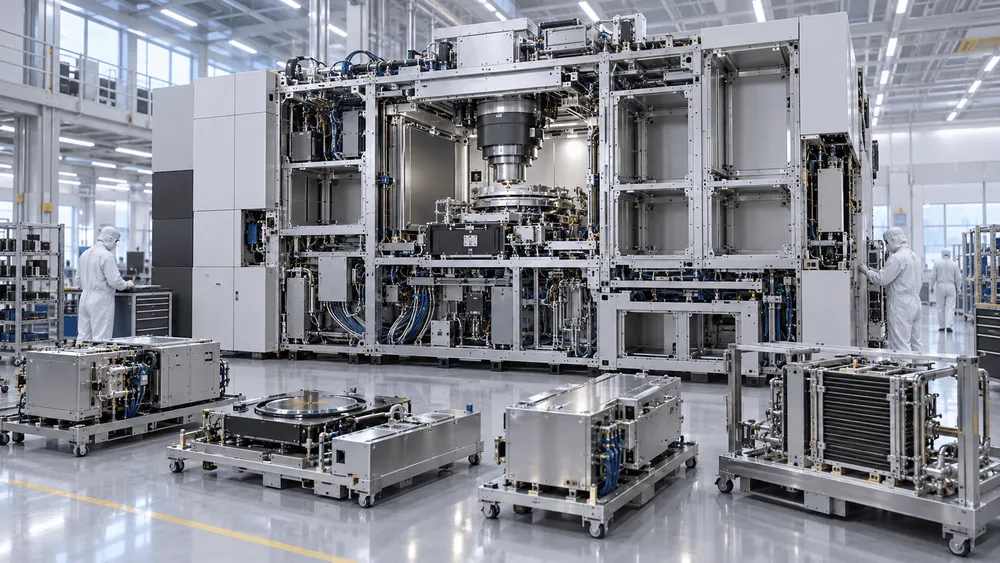
On September 16, 2026, South Korea's Electronic Times reported that lead times for parts used in semiconductor manufacturing equipment are getting longer, reaching up to 40 months for some key components made in Japan. Boosting output of AI chips requires manufacturing equipment, but obtaining the parts to build that equipment is also taking time. The figures in the report are individual cases from anonymous companies. They do not mean that every tool or fab will be delayed by 40 months. Even so, when considering when higher capital spending will translate into actual output, supply capacity upstream of equipment makers can no longer be overlooked.
Forty months applies to some key parts, not the industry average
The Electronic Times report cited procurement cases from makers of deposition equipment, laser processing equipment and packaging equipment. Here, lead time refers to the period from placing an order for a part to receiving it. The companies in the article are anonymized as Company A, Company B and Company C, and neither part numbers nor supplier names are given.
| Equipment maker | Part in question | Previous lead time | Reported lead time |
|---|---|---|---|
| Company A (deposition equipment) | Parts for deposition equipment | 4 months | Up to 10 months |
| Company B (laser processing equipment) | Key components made in Japan | Not stated | Up to 40 months |
| Company C (packaging equipment) | Parts sourced within South Korea | 4 months | 6 months or more |
Source: Electronic Times, September 16, 2026. These are individual cases involving different equipment and parts, not a regional comparison of the same part.
The 40-month figure reflects the wait for some of the key components that Company B procures. Because the previous lead time is not disclosed, it is impossible to calculate how many times longer it has become for Company B. Companies A and C have past figures for comparison, but the equipment and parts differ. The three cases cannot be used to calculate an average lead time for the semiconductor equipment industry as a whole.
Company C's case shows that sourcing within South Korea has not escaped delays either. However, this comparison alone makes it hard to say whether overseas or domestic suppliers are stronger, since the specifications and order conditions differ by part. What the cases have in common is that some companies are waiting longer than planned to secure parts before they can build equipment.
Paying extra has not shortened lead times
An official at Company B told Electronic Times that the company would like faster delivery even if it meant paying a premium, but was told by the supplier that limited production capacity makes it difficult to move the date forward. It appears that raising the procurement budget does not guarantee the parts will arrive when needed.
Price and lead time need to be read separately here. The statement shows that the buyer was willing to bear additional costs, but it is not clear whether suppliers raised prices or by how much actual purchase prices have risen. What can be confirmed is a supply-side constraint: improving payment terms does not easily shorten delivery times.
As background, Electronic Times relayed an industry view that component makers had not expanded capacity ahead of the surge in AI-related demand. According to anonymous sources, even if they start increasing output now, it would not be in time to meet current demand, and uncertainty over how long the AI boom will last is making them cautious about investing.
Strong current orders and decisions to add factory capacity operate on different timelines. If demand could change before new production facilities are ready, component makers would find it hard to decide on investment by looking only at today's shortages. This is a way of understanding the reported caution, not confirmation that any individual supplier has given up on expanding output.
The time gap between $52 billion in investment and production capacity
On the demand side, investment in memory fabs is expected to grow. In an official announcement on June 29, 2026, industry group SEMI projected that global 300mm memory fab equipment investment will rise 29% year on year to $52 billion in 2026 and grow a further 11% to $57 billion in 2027. It said demand for HBM and DDR5, along with data storage needs accompanying the spread of AI, is underpinning the investment.
The $52 billion figure is an outlook for equipment investment in 300mm memory fabs and differs from the total sales of the entire semiconductor equipment market. It is also a June forecast, so it cannot be treated as actual results that factor in the longer part lead times reported in September. SEMI's announcement provides background on investment demand; it is not a document verifying the lead times of the three companies cited by Electronic Times.
In the same announcement, SEMI projected global 300mm memory production capacity at 4.1 million wafers per month in 2026 and 4.2 million per month in 2027. It explained that the shift in manufacturing technology toward advanced DRAM, HBM and taller NAND, along with increasingly complex processes, will restrain the growth of effective capacity.
Higher investment does not necessarily mean a proportional increase in finished products, because spending also includes upgrading equipment to make new generations of memory. Moreover, wafer throughput and shipped memory capacity are different measures, so monthly wafer counts alone cannot be used to derive growth rates in HBM or DRAM supply.
The burden of technology transitions that SEMI cites is a constraint on fab capacity. The parts shortage, by contrast, is a constraint that has appeared at the stage of building the equipment delivered to fabs. The two arise in different places, and each points to a time lag that is hard to capture from investment amounts alone.
To read expansion plans, follow the chain from parts to fabs
For equipment makers, the timing of receiving parts matters for planning; for chipmakers, what matters is when tools arrive and can be used as production capacity. If equipment cannot be completed because parts are lacking, subsequent delivery schedules could be affected. However, the wait for parts cannot be directly converted into the length of a delay in overall fab operations.
For example, a plan that ordered long-lead parts early and one that is only now placing orders would presumably be affected differently even with the same lead time. This does not describe the situation at any individual fab; it is a condition for judging the size of a delay. Electronic Times does not report order timing or the process schedules of each company.
When following AI-related investment announcements, it is worth checking not only the scale of funding but also whether equipment delivery schedules are being kept and whether the planned capacity at fabs is ramping up. If stronger parts supply leads to equipment deliveries, and fab-side preparations, including technology transitions, also progress, investment plans can move closer to actual semiconductor supply.