


Google's Chrome may be criticized by some as having become "bloated" due to feature creep, but it still appears to remain the fastest browser out there. It has now been revealed that the latest version of Chrome achieved the highest score ever recorded on Speedometer 3.0, the open-source, industry-standard benchmark tool used to measure web browser performance.
Chrome Boosted Performance by 70% Over Two Years
Back in March of this year, the "Speedometer 3.0" benchmark was introduced, developed through industry-wide collaboration among companies including Google, Mozilla, Microsoft, Intel, and Apple.
Speedometer 3.0 is essentially designed to test the responsiveness of modern web apps and how well they handle various tasks, simulating real user actions such as adding items to a to-do list or editing text to check a browser's responsiveness. By repeatedly executing these tasks at very high speed, the benchmark measures performance and clearly demonstrates the capabilities of each browser. Because it was jointly developed by major players in the browser market—Google, Mozilla, Microsoft, Intel, and Apple—it is recognized as an industry-standard benchmark test that allows for fair comparisons.
For this round of Speedometer 3.0 testing, Google focused on several optimizations. "By examining Speedometer's workloads and the features where Chrome was spending the most time, we made targeted optimizations to those features, each of which contributed to improving Chrome's score," the company stated.
Engineers conducted a detailed investigation into resource-consuming features such as "SpaceSplitString," streamlining operations like string processing and stylesheet deduplication. They also fine-tuned rendering to reduce excess memory usage when drawing form elements and other components. Additionally, Google worked with the maintainers of the HarfBuzz text shaping engine to improve the rendering of Apple's AAT font format. The company also focused on a process called "tiering up code," achieving further improvements by selecting optimized engines. At the same time, improvements to garbage collection reportedly boosted the Speedometer score by about 3%.
According to Google, performance improved by 72% over the roughly two-year span from Chrome version 101 to Chrome 127.
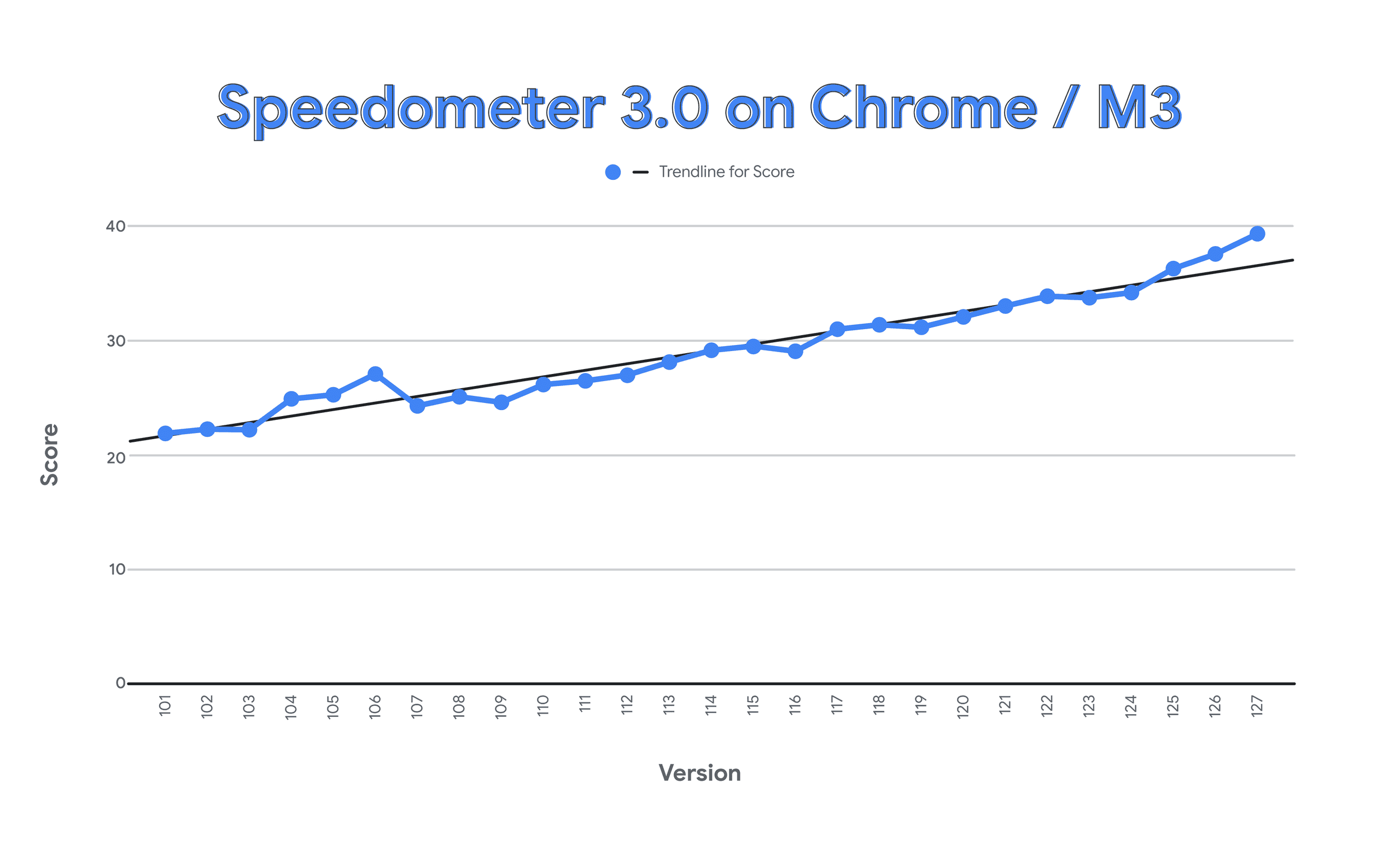
Of course, speed is just one of the elements that make up a great browsing experience, and pure benchmark results only convey part of the appeal. In fact, since most browsers are now based on Chromium, performance differences aren't as pronounced as they once were. Nevertheless, browser makers continue to compete fiercely to boost speed.
Source
- Chromium Blog: How Chrome achieved the highest score ever on Speedometer 3