

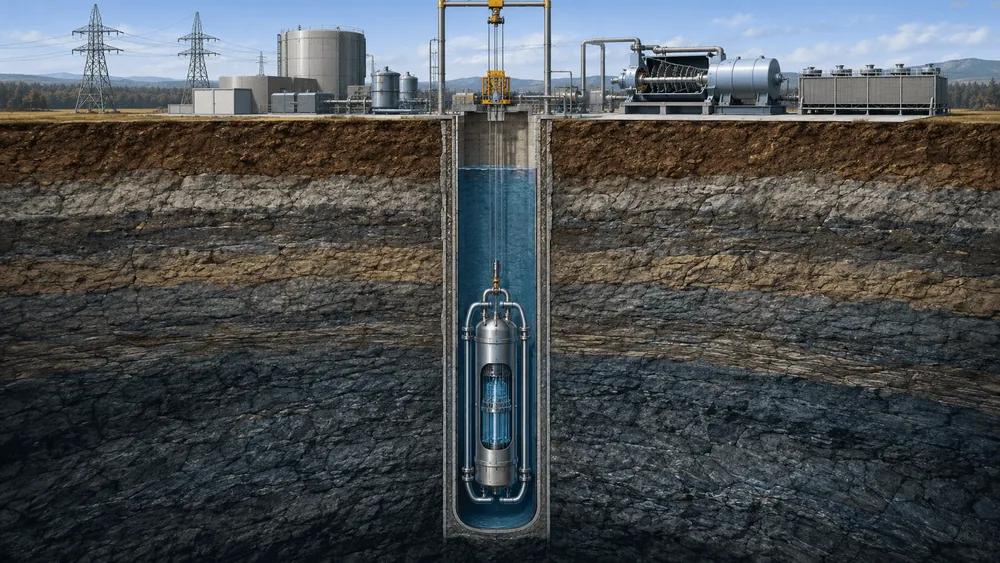
Deep Fission's underground reactor concept has moved from a phase of presenting demand figures to a phase of testing the procedures for actually placing hardware underground. On July 7, 2026, US-based Deep Fission announced that a prototype reactor canister had arrived at its site in Parsons, Kansas. The canister was manufactured at a factory, completed hydrostatic testing, and was then delivered to the site. It will be used in the fuel-free Proof-of-Concept Well program.
This is neither the start of commercial operation nor an announcement of nuclear fuel loading. Rather, what matters is that the company has begun breaking down its claimed design—placing a small PWR roughly one mile underground—into a sequence of tasks: drilling, assembly, lowering, and connection to surface equipment. Deep Fission announced non-binding LOIs totaling up to 18.5GW in June, but to convert customer interest into actual generating capacity, it must first demonstrate that underground deployment works in the field.
What the Non-Nuclear Canister Tests: Installation Procedures
This canister will be used in what Deep Fission describes as a "nearly full-scale" verification program. Its purpose is to confirm, using commercial-grade non-nuclear components, that large-diameter boreholes, the installation workflow, infrastructure readiness, and operational procedures all work under real site conditions. Before nuclear fuel comes the testing of the hole, the equipment, and the procedures.
This sequencing carries particular weight for the company's design. In a conventional plant that houses its reactor in an above-ground building, access to and replacement of key equipment can be treated as a design problem for surface facilities. In Deep Fission's case, the reactor canister must be lowered into a deep vertical shaft and connected to heat exchangers and surface-side equipment. This makes questions of whether the canister can be manufactured, transported, and subjected to the necessary inspections and connections before and after lowering—separate from core physics—an early-stage risk.
Deep Fission states that the prototype completed manufacturing, hydrostatic testing, and delivery to Kansas. Completion of hydrostatic testing indicates the vessel has reached a stage where it can be treated as a functioning pressure vessel prior to site delivery. This announcement alone does not prove operational reliability, but it does mark progress from a vessel on paper to actual hardware being handled in the field.
The Design: A PWR One Mile Underground
Deep Fission's Gravity Nuclear Reactor uses a pressurized water reactor as its basic reactor type. What is novel is not the reactor type itself but the manner of its placement. The company describes combining existing PWR technology, deep drilling techniques from the oil and gas industry, and a heat exchange approach similar to geothermal power generation. Fuel is planned to fall within the range of low-enriched uranium used in commercial reactors.
The core of the design is placing a small PWR in a borehole approximately one mile underground. Deep Fission's technology page explains that a one-mile column of water exerts 160 atmospheres of pressure, which supports the reactor's operating pressure and cooling. Heat moves from the reactor canister through a closed loop to a heat exchanger, then through a separate closed loop to the surface, where it is converted to electricity using equipment similar to geothermal power facilities.
The approach to generating capacity also assumes deploying multiple deep vertical shafts side by side. The company assumes up to 15MWe per unit, with 1–9 units yielding 15–135MWe for remote or small-scale applications, and 10–19 units yielding 150–285MWe for commercial and industrial applications. For Tech & Energy applications such as data centers and large-scale power plants, the plan calls for 20 to over 100 boreholes to deliver anywhere from 300MWe to over 1.5GWe.
These figures show that the success or failure of underground installation is directly tied to business scale. A single demonstration unit running successfully does not by itself constitute a large power source for data centers. Whether the company can repeatedly drill numerous holes, install canisters with consistent quality, and connect them to surface equipment will determine whether it can scale up.
Remaining Permits and Drilling at Parsons
At the Parsons site, the first data acquisition well has already been drilled. According to Deep Fission's Parsons page, as of June 2026 the company had drilled the G1 data acquisition well to approximately 6,000 feet and entered a phase of collecting geological, hydrological, and thermal data. The next test well is expected to investigate thermal behavior and lower key components to a depth of roughly 2,500 feet.
The July 7 announcement also indicated that the company is pursuing permits for a non-nuclear borehole with the Kansas Department of Health and Environment. This non-nuclear borehole will be the next major milestone in the current Proof-of-Concept Well program—a step to confirm that large-diameter drilling and equipment lowering can be executed on-site before nuclear fuel is involved.
At the federal level, Deep Fission is participating in the DOE's Reactor Pilot Program. This program was established under Executive Order 14301 as a pathway for testing advanced reactors outside of national laboratories, with a stated goal of bringing at least three advanced reactor concepts to criticality by July 4, 2026. As of July 8, 2026, Deep Fission's current milestone is not reaching criticality but rather verifying non-nuclear installation.
Separate NRC procedures remain necessary for commercialization. In its explanation for Parsons, Deep Fission states that the DOE pilot involves a single demonstration reactor in a single borehole, and that subsequent commercial deployment will require additional regulatory approval. The company began pre-application engagement with the NRC in May 2024 and aims to obtain a high-capacity commercial license as early as 2027.
What It Takes to Convert 18.5GW of Interest Into Capacity
In June 2026, Deep Fission announced that non-binding LOIs with data centers, co-developers, and industrial parks, among others, indicated up to 18.5GW of potential generating capacity. This figure shows that large customers requiring near-constant power are broadening their options to include unproven reactor designs. However, an LOI is not a contract committing to plant construction or power purchase.
This canister delivery provides another yardstick for evaluating that 18.5GW figure. What customers ultimately look for is not a cumulative theoretical output figure, but whether a plant will actually operate on a fixed schedule. For Deep Fission, the evidence needed to make that judgment will appear in sequence: large-diameter drilling, underground installation, heat exchange, DOE demonstration, NRC commercial licensing, and formal customer contracts.
The idea of an underground reactor is bold in that it shrinks the massive above-ground containment structure and incorporates natural pressure and geological strata into the design. But this advantage simultaneously creates verification challenges. How does one monitor and maintain equipment placed at depth, and how does one handle it in the event of an anomaly? This non-nuclear canister test sits right at the entrance to that very question.
The figure Deep Fission should present next is not the total volume of LOIs, but how deep, through what procedures, and with what degree of repeatability it was able to complete installation at Parsons. If the company is aiming for an NRC application in 2027, the results of this non-nuclear demonstration will not simply be a progress report—they will be the first field data determining whether an underground reactor can become a viable candidate for power procurement.