


The new OLED iPad Pro has gone on sale, and teardown videos have already appeared on YouTube. As previously revealed by bend test videos, the new iPad Pro has increased rigidity despite becoming thinner, and the teardown videos have revealed many of the ingenious design choices Apple made to achieve this.
The Apple Logo and Battery Made of Copper
The teardown of the 13-inch M4 iPad Pro by the YouTube channel Phone Repair Guru reveals a beautifully organized internal structure. The components are stacked and firmly screwed together, which increases rigidity—but this also made it difficult to remove the screen.
The internal battery is symmetrical, which contributes to the device's ease of handling by evenly distributing weight when held. The battery appears to be 39.99Wh (10,209mAh), which is slightly smaller than the 6th generation's 40.33Wh. Thanks to improved power efficiency of the M4 chip and reduced power consumption of the OLED display, the M4 iPad Pro maintains the same level of battery life as the previous model.
As Apple itself has disclosed, several new cooling solutions were implemented in the M4 iPad Pro to ensure adequate cooling performance despite the thinner design.
Graphite sheets are used internally for cooling, and in addition, it had been rumored that the large Apple logo on the back center of the body is made of copper—and the video confirms this by actually scraping the logo to reveal the copper material underneath. One clever aspect of this design is that the M4 chip is positioned directly beneath the logo to make this possible.
Battery Replacement Difficulty Dramatically Improved
The teardown video by iFixit also praises the M4 iPad Pro for being far easier to repair compared to the previous model. Specifically, it notes that unlike before, users no longer need to remove numerous components to access the battery—simply removing the screen provides immediate access to the battery, marking a significant improvement.
The Apple Pencil Pro Is Disposable
iFixit's video also tears down the new Apple Pencil Pro, but as before, it's impossible to access the internal structure without destroying it, making it effectively a "disposable device" that cannot be repaired.
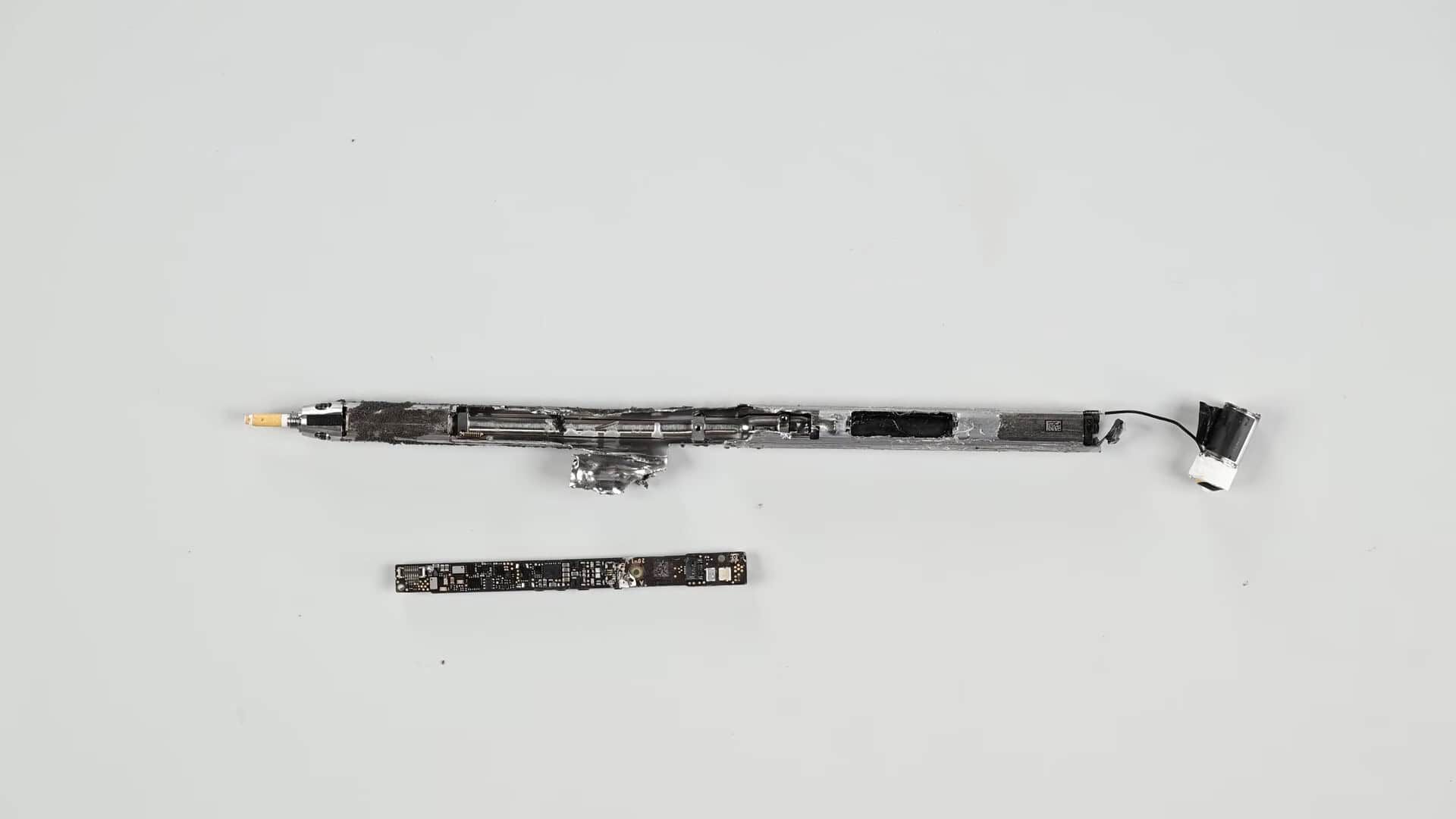
The teardown also reveals the gyroscope and MEMS sensors that enable the "barrel roll" feature of the Apple Pencil Pro, showcasing the impressive engineering packed into such a small enclosure.
Apple's Explanation of Tandem OLED Is Misleading
Incidentally, iFixit's accompanying blog post offers a detailed explanation of the "Tandem OLED" technology that Apple has adopted in the M4 iPad Pro, and it's worth a read.
According to iFixit, the iPad Pro's Tandem OLED screen is not two panels stacked on top of each other, but rather a single OLED substrate with more electroluminescent layers for each OLED diode.
At its presentation, Apple likely simplified the explanation to aid understanding, describing it as if two OLED layers were stacked together—but this description appears to be misleading.
Sources