


Mod developer PureDark published two videos on August 27, 2026 showing NVIDIA's not-yet-released "DLSS 5" technology running in a modified version of The Elder Scrolls V: Skyrim. The day before, an unannounced DLSS Neural Rendering (DLSS-NR) runtime had been discovered in an early access build of NBA 2K27. PureDark took that component and integrated it into the existing Skyrim Upscaler. In the footage, the shading and depth of characters' faces shift in real time, and the way light wraps around hair changes as well. In another scene, skin sheen and light hitting wood surfaces shifted dynamically.
However, Skyrim is not on NVIDIA's list of supported titles, and the setup shown in the videos is not the vanilla game. What this confirms is that neural rendering could be injected into an older game before an official SDK was even released—not the final image quality, retail performance overhead, or whether the visual results align with art direction Bethesda would approve.
A 158MB DLL Was Running in Skyrim the Next Day
The story began with an image posted by Renan Maniero on August 26. An early access PC build of NBA 2K27 contained a file named nvngx_dlssnr.dll, which Windows identified as "NVIDIA DLSSNR" version 310.8.0.0. VideoCardz confirmed the file was 158MB in size, with a modification date of the same day, August 26.
NBA 2K27 has no menu option to enable DLSS-NR, and NVIDIA has not announced the game as a DLSS 5-supported title. The presence of the DLL in the game's folder is a separate matter from whether it functions as a usable feature. Still, because an executable component became publicly accessible inside a game, modders managed to invoke it in an entirely different game just one day later.
The videos PureDark released consist of a 4-minute-56-second character-focused test and a 4-minute lighting-and-shadow test. The description contains no download link, and there is no announcement of a finished mod release. This should be read as experimental footage from a work in progress.
How Skyrim Upscaler Opened a Retrofit Pathway
The right side of the video shows the settings screen for "Skyrim Upscaler AIO Build." Alongside a toggle to enable DLSS-NR, there are options for Preset, Style, and Intensity, as well as controls for local tone and local structure. Skin structure strength and an automatic skin mask sit separately. Toggling the feature on and off changes skin shading and sheen, and shifts the dimensionality of the nose and cheeks. The way light wraps around hair and the wood in the background also changes.
According to NVIDIA's official explanation, DLSS 5 takes each frame's color image and motion vectors as input, then estimates skin, hair, fabric, and light direction. From there it generates lighting and materials while aiming for consistent output across frames. NVIDIA states that it integrates through Streamline, the same pipeline used for existing DLSS and Reflex features. However, it's unclear whether PureDark actually used that official pathway. What the video proves is only that DLSS-NR could be invoked from within the Skyrim Upscaler interface and that its output could be toggled.
This is a different job from DLSS 4.5 Ray Reconstruction, which was also released the same week. Ray Reconstruction, which spread to RTX Remix mods on August 25, reconstructs insufficient light samples from ray tracing or path tracing and removes noise. DLSS 5, by contrast, starts from a color image the game has already finished rendering, estimates the meaning of the scene, and generates how lighting and materials should appear. The shift in facial impression seen in PureDark's video is the result of DLSS 5's processing specifically.
Meanwhile, PureDark has not disclosed implementation details or input buffers. What exactly was extracted from Skyrim, and in what format it was passed to DLSS-NR, cannot be determined from the video alone. While the possibility of retrofitting older games has grown more plausible, one cannot conclude that simply swapping in the DLL would make it work in other titles as well.
What Changed the Face Was "Meaning," Not Resolution
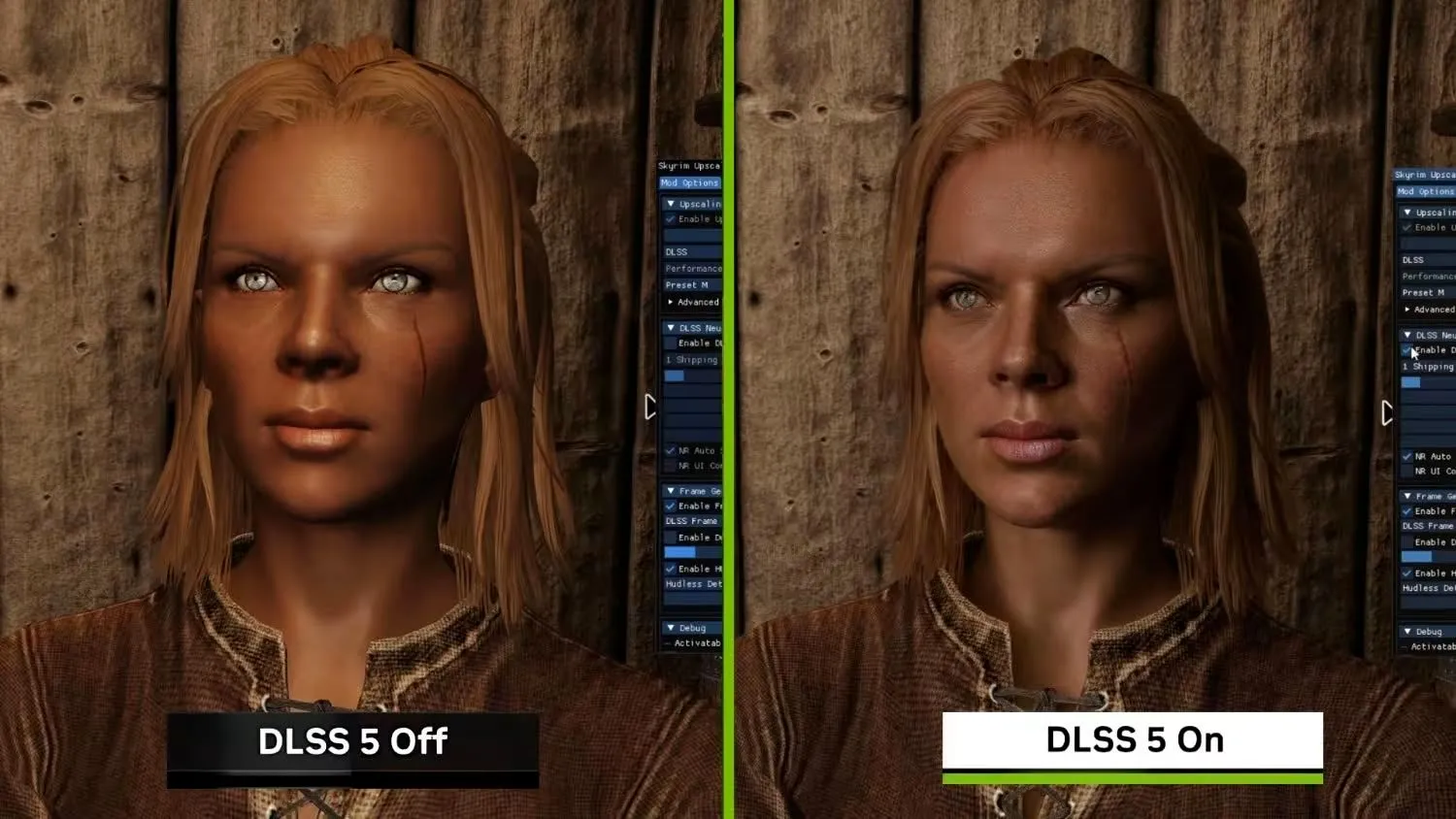
What stands out in PureDark's test is not sharper edges, but scenes where the character's overall impression itself shifts. Skin sheen and shading intensify, and the appearance around the eyes, cheeks, and lips changes before and after toggling the feature. Because DLSS 5 is not limited to upscaling low-resolution images but instead identifies objects on screen by meaning to generate lighting and materials, this kind of change is consistent with NVIDIA's official technical explanation.
The Auto Skin Mask and Skin Structure Strength options in the video also indicate that facial intervention is not designed to be applied uniformly. NVIDIA has stated that in the official release, it will provide developers with controls over intensity, color grading, and application-range masking—tools meant to let each title decide where to adopt the model's output and where to hold it back.
However, the character creation screen in the video shows CBBE 3BA-related elements, indicating that the character model, hair, body type, and lighting are all part of a modified environment. Even the face before DLSS 5 was applied is not vanilla Skyrim. Therefore, one cannot conclude from this video that "Skyrim's default character would look like this," nor can the degree to which the original mod setup influenced the output be separated out.
From 80–120fps to 60fps—Not a Measure of Retail Performance
In the character creation screen, frame rates run roughly 80–120fps with DLSS-NR disabled and drop to around 60fps once it's applied. Outdoor footage shows readings around 45–50fps. The on-screen change is not insignificant.
However, PureDark has not disclosed the GPU or resolution used. There is no list of rendering settings or installed mods, and no repeated measurements from the same camera angle. It also remains unknown whether the 158MB runtime represents a final build, a release candidate, or a debug version. While the fps figures in the video hint that processing overhead exists, they cannot be used to compare supported GPUs or to predict the performance of the retail version launching this fall.
NVIDIA states that DLSS 5 is designed to run in real time at up to 4K. Verifying that claim would require using the official SDK and supported drivers to measure on/off performance under the same scene, resolution, and quality settings. This footage predates that kind of measurement.
Official Integration Requirements Emerge Ahead of Skyrim Support
The list of supported titles NVIDIA announced on March 16 includes Bethesda's Starfield and The Elder Scrolls IV: Oblivion Remastered. Skyrim is not among them. The fact that Bethesda supports DLSS 5 elsewhere is not grounds to assume the company approved this experiment or is preparing an update for Skyrim.
At SIGGRAPH 2026, NVIDIA narrowed its research challenges for 3D-guided neural rendering to three points: preserving artistic intent, maintaining frame-to-frame stability, and achieving real-time 4K rendering. PureDark's video demonstrates that an individual developer can now get from raw input to generated visual output. Beyond that point, it falls to each title's creators to decide and verify which masks to apply to faces and UI elements, and whether the model can preserve form as the camera and animation move.
What should be verified in the official fall release is reproducibility, not a single striking scene: whether the same settings reliably produce the same face and lighting in supported titles using the public SDK, whether processing time can be measured on supported GPUs, and whether developer-defined masks behave as intended. Only once those conditions are met will the kind of "retrofitting" glimpsed in the Skyrim experiment move closer to becoming a genuine product feature.