


Stretchable, flexible electronics need semiconductors that do more than survive bending and stretching. They must also be elastic, returning to their original shape once the force is removed, while still transporting charge well. On November 20, 2026, a joint research team led by Professor Joon Hak Oh of Seoul National University, with Queensland University of Technology and Fudan University, announced a new polymer semiconductor, "PySeF1," that maintains high electron mobility even when stretched to twice its original length (100% tensile strain). The work, with Park as one of the co-first authors, was published in Science Advances (Vol. 12, No. 47, article eaej3331). The paper was submitted on June 1, 2026 and accepted on October 14.
An n-type semiconductor that stretches to 2x and recovers
Building complementary circuits, the foundation of electronics, requires both p-type semiconductors, which carry holes (positive charge carriers), and n-type semiconductors, which carry electrons (negative charge carriers). Polymer semiconductors can be manufactured through solution-based printing, but n-type polymers generally have more rigid molecular structures than p-type ones. Stretching them damages the charge transport pathways and sharply degrades performance. PySeF1 is ambipolar, meaning it can transport both electrons and holes, and it is particularly strong at electron transport.
Charge carrier mobility indicates how fast electrons or holes move in response to an electric field. A 100% tensile strain means the material is stretched to twice its original length. Elasticity here means more than not breaking when bent or stretched: the material returns to its original shape when the load is released. The team synthesized the polymer semiconductor, evaluated the stretching behavior of thin films, and built transistors, inverters, and phototransistors to measure their electrical performance.
In a Seoul National University press release, Professor Oh said: "This study turns poor solubility, long regarded as an obstacle, into a tool for materials design."
A "nano-anchor" design that turns low solubility to advantage
Conventional stretchable polymer semiconductors have mostly relied on flexible spacers in the polymer chain or on hydrogen bonding. These approaches can lower the crystallinity of the whole material and even disrupt the overlap between molecules (π-π stacking) that forms the charge transport pathways.
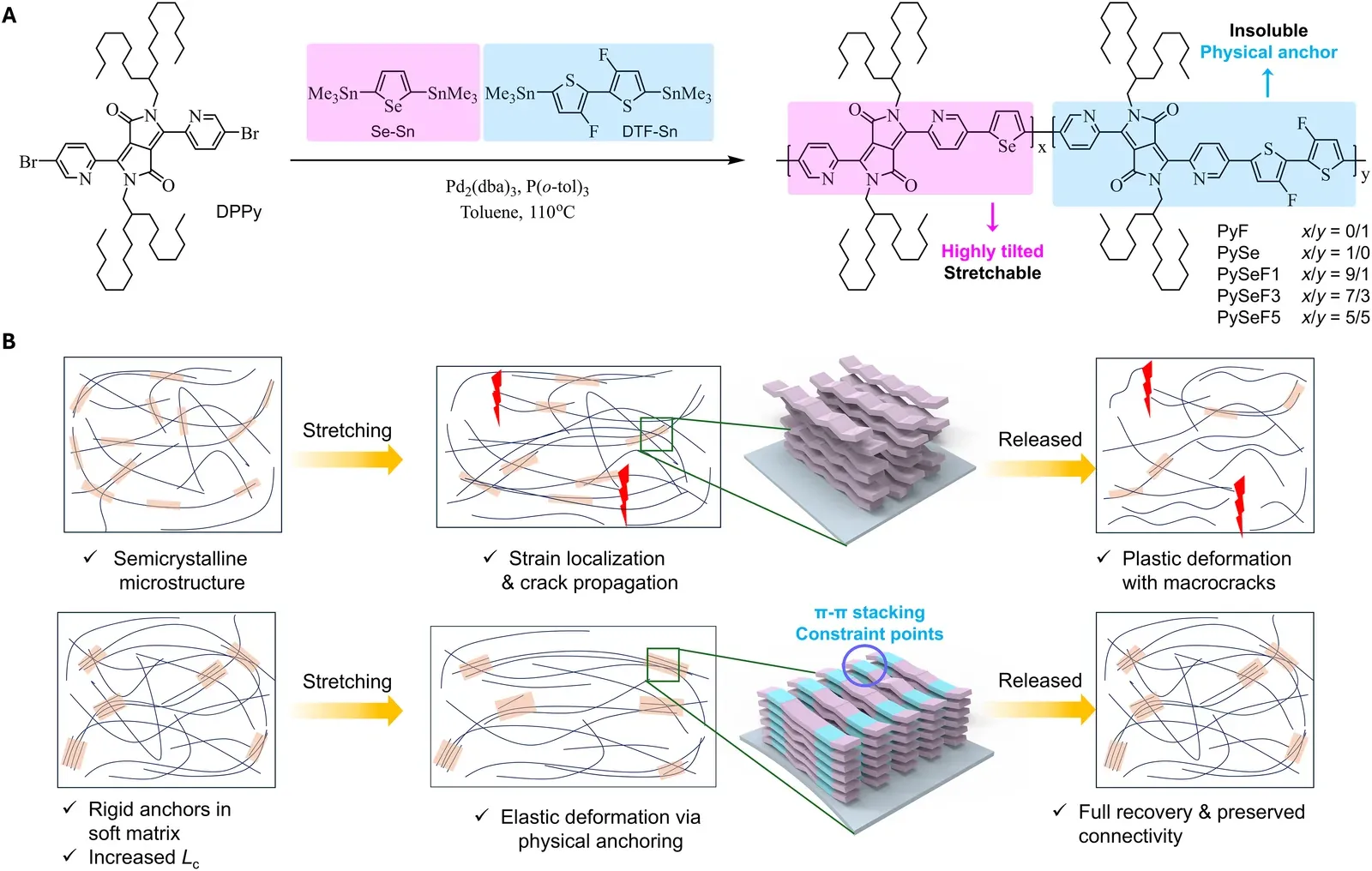
The team instead adopted a design strategy called "solubility-driven morphological decoupling," which uses differences in molecular solubility to control local molecular structure and overall material structure independently. They made a terpolymer by incorporating about 10% of "PyF," a highly planar, poorly soluble molecular unit, into the backbone of "PySe," a highly soluble, flexible semicrystalline polymer. The aim is to preserve the π-conjugated structure of the backbone that carries charge while controlling local molecular arrangement and aggregation.
The precursor PySe is highly flexible, but repeated stretching causes plastic deformation that does not recover, leaving wrinkles and cracks on the surface. In PySeF1, which incorporates PyF, interactions between fluorine (F) and sulfur (S) within the molecule keep it planar, making it easier for molecules to stack in an orderly way.
Structural analysis by grazing-incidence X-ray diffraction (GIXD) showed that PySeF1 suppresses the formation of long-range crystalline order while maintaining strongly aggregated structures locally. After the 100% tensile strain was released, relative crystallinity and the spacing of the molecular layer arrangement recovered to values close to the initial state. However, crystallite size did not fully recover: a difference from the initial state remained, at 6% parallel to the stretching direction and 13% perpendicular to it. The published materials did not allow confirmation of the initial crystallite sizes in either direction or the absolute values after strain release.
The team interprets the PyF-rich ordered aggregate regions as functioning as physical "nano-anchors" that tie down the polymer chains, suppressing plastic deformation while maintaining charge transport pathways. This mechanism is supported by the structural analysis, but dynamic changes in the anchor structures during stretching have not been observed directly. The authors say in situ observation under applied strain could further clarify the mechanism.
Electron mobility comparable to amorphous silicon, even at 2x stretch
To evaluate the material's electrical performance, the team first fabricated transistors on flexible PET substrates and measured them under optimized conditions, with heat treatment at 160°C. In a comparison using 15 independent devices per condition, PySeF1 reached an initial average electron mobility of 1.07 cm² V⁻¹ s⁻¹ and an average hole mobility of 0.20 cm² V⁻¹ s⁻¹.
In measurements under applied tensile strain using at least 8 independent devices, PySeF1 maintained an electron mobility of 0.5 cm² V⁻¹ s⁻¹ even at 100% tensile strain. The paper rates this value as comparable to the electron mobility of hydrogenated amorphous silicon (about 0.5 to 1 cm² V⁻¹ s⁻¹), which is widely used in displays and other applications. This is a comparison of charge transport performance of the material, not the result of building a display.
In repeated stretching durability tests, retention of electron mobility and the presence of surface cracks in the thin film were examined under different conditions. The results for the precursor PySe and the newly developed PySeF1 are as follows:
| Item | PySeF1 (new material) | PySe (precursor) |
|---|---|---|
| Initial average electron mobility | 1.07 cm² V⁻¹ s⁻¹ (transistors on PET substrate, average of 15 devices) | — |
| Tensile strain in electrical durability test | 100% | 75% |
| Electron mobility retention after 100 cycles | 67% | 7% |
| Thin-film surface durability | No cracks visible under an optical microscope after 1,000 cycles at 100% strain | Extensive cracks and wrinkles appeared during repeated stretching at 75% strain |
PySeF1 retained 67% of its initial electron mobility after 100 stretching cycles at 100% tensile strain. PySe, by contrast, dropped to 7% of its initial value after 100 cycles at a smaller 75% strain. The published materials did not allow confirmation of the absolute electron mobility values at the start and after 100 cycles in this durability test. Optical microscopy also showed no cracks in PySeF1 films after 1,000 consecutive stretching cycles at 100% tensile strain. Electron mobility retention was evaluated only up to 100 cycles; the 1,000-cycle test assessed the structural durability of the film surface.
Applications in stretchable circuits and light sensors
To demonstrate the usefulness of PySeF1, the team also built an ambipolar inverter and an organic phototransistor. A separate comparison material, "PySeF3," showed an average electron mobility of 2.63 cm² V⁻¹ s⁻¹ in transistors on flexible PET substrates, the highest among the materials examined. However, PySeF1, which offered a better balance between mechanical durability under 100% tensile strain and charge transport performance, was chosen for the circuit and photodetector prototypes.
The ambipolar inverter using PySeF1 maintained high voltage gain even at 100% tensile strain, with relatively small shifts in switching threshold voltage. In contrast, the inverter using PySe saw its voltage gain drop sharply under strain, and its threshold voltage shifted substantially.
The team also built a fully stretchable phototransistor using poly(styrene-butadiene-styrene) (SBS) for the substrate and insulating layer and carbon nanotubes for the gate, source, and drain electrodes. The device showed no delamination or cracking at 100% tensile strain. In experiments with monochromatic light at a wavelength of 670 nm, it maintained a "photogating" response across the entire range of strain measured. Photogating is a phenomenon in which charges generated by light act like a gate voltage and modulate the current. At 100% tensile strain, the light-induced threshold voltage shift was −10.2 V.
Photodetection performance at 100% tensile strain included a responsivity, which indicates the photocurrent produced per unit of incident optical power, of 15.8 A W⁻¹. The external quantum efficiency (EQE), the ratio of extracted charge carriers to incident photons, exceeded 2,900%. An EQE above 100% arises because photoconductive gain accompanying photogating lets multiple charge carriers flow through the external circuit for each incident photon. It does not mean that energy conversion efficiency exceeds 100%.
In the paper, the authors assess the electron mobility obtained at 100% tensile strain as, to their knowledge, among the highest to date for intrinsically stretchable, electron-dominant semiconductors. Seoul National University's press release also places the phototransistor's photodetection performance among the best of stretchable organic photosensors.
The demonstration so far covers evaluation of material properties and laboratory-scale prototypes of electronic devices. No tests have been done on human skin, nor measurements of pulse or blood oxygen, animal experiments, or clinical evaluation. Applying the material to practical wearable devices will require verifying electrical stability over more than 1,000 stretching cycles and operation in biological environments.