


Few people would picture the plastic bottle they just emptied of soda transforming into a future meal. Plastic and food have long been regarded as polar opposites in modern industrial society. One is a synthetic polymer that persists in the environment for what amounts to eternity without breaking down; the other is organic matter metabolized to sustain life.
Yet at the level of chemical structure, both are built from the same carbon backbone.
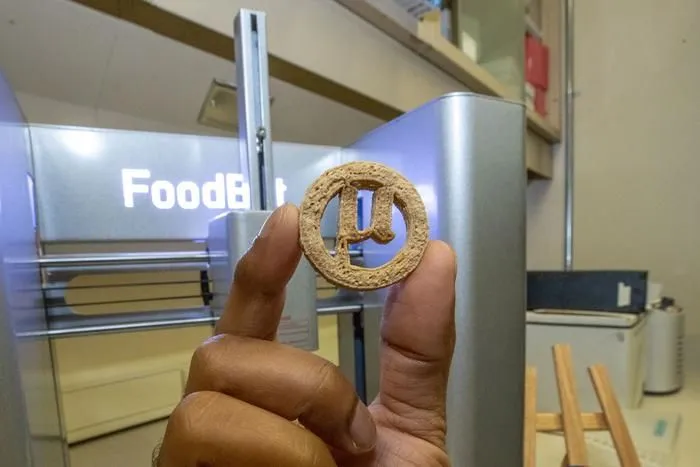
A research team at Southern Illinois University Carbondale (SIU Carbondale) in Illinois has focused on this shared carbon foundation. By dissolving discarded polyethylene terephthalate (PET) and agricultural residues such as corn stalks and leaves under high temperature and pressure, then feeding the resulting compounds to genetically engineered yeast, the team has built a technology pipeline that reconstructs this waste into edible protein, vitamin precursors, and vanilla flavoring. They named the cookie-like food product molded from this process "µBites" and presented their findings at an academic conference.
But a successful biochemical conversion in a test tube is not the same as a food that is safe for people to eat. A deep gap still separates a provocative laboratory prototype from the realities of supply chains and food regulation.
A Conference Presentation Offers a New Option for Carbon Recycling
The research was presented orally by graduate student Sandhya K. Jayasekara on August 24, 2026, at the American Chemical Society's ACS Fall 2026 national meeting, held at McCormick Place in Chicago. The session, part of a biochemistry and chemical biology symposium, was titled "Engineered yeast consortia for converting plastic and biomass-derived compounds into valuable food additives."
The research is led by Lahiru Jayakody, an associate professor in the university's Department of Biological Sciences and its Fermentation Science Institute. The project's origins trace back to the Deep Space Food Challenge, co-hosted by NASA and the Canadian Space Agency. In closed environments cut off from resupply—such as lunar bases or Mars expeditions—there is a need for systems that can autonomously produce food for astronauts from limited materials and waste. In November 2021, the SIU team was selected as one of 18 U.S. Phase 1 winners, earning $25,000 in seed funding. The research has since continued with public funding, including a National Science Foundation (NSF) CAREER grant awarded in 2024.
It is worth noting that this presentation represents an oral report at an academic conference, not a peer-reviewed paper in a scientific journal. The team's principal peer-reviewed publication to date remains a brief two-page opinion piece published on May 15, 2024, in Trends in Biotechnology (Volume 42, Issue 6, pp. 799–800). Rigorous peer-reviewed data on specific yields for vanillin synthesis and beta-carotene production, along with details of metabolic pathway optimization, remain a matter for future verification.
A 33-Step Process Bakes Waste Into Cookies
The transformation from plastic to food is not accomplished through a single reaction. It is realized through a pipeline of 33 total steps, combining multiple physicochemical and biological processes: raw material depolymerization, microbial fermentation, and food processing.
The overall flow proceeds in four broad stages. In the first stage, PET waste and agricultural residue are dissolved using high-pressure hot water. In the second stage, the resulting material is fed to a consortium of three yeast species that synthesize protein, lipids, and flavor compounds. In the third stage, the harvested biomass is blended with fiber and starch and extruded into shape using a 3D printer. In the fourth stage, the shaped product is solidified through microwave heating.
The first challenge is how to break down PET's robust polymer structure and the lignocellulose of plant cell walls into small molecules that microorganisms can use. The solution employed here is a patented technology called Oxidative Hydrothermal Dissolution (OHD), developed roughly a decade ago by SIU geology professor Ken Anderson.
OHD uses only water and oxygen, applied under high pressure and subcritical water conditions above 300°C. Without relying on hazardous organic solvents, it rapidly breaks down recalcitrant polymers into water-soluble low-molecular-weight organic acids and other small compounds. According to public materials from SIU's technology transfer platform, Flintbox, this process dissolves more than 90% of the carbon in the raw material into water-soluble carbon.
The resulting carbon-rich liquid is then fed to a yeast consortium in a bioreactor. Rather than relying on a single strain, the research team combined three yeast species, each playing a distinct role.
Saccharomyces cerevisiae—baker's and brewer's yeast that humans have safely used for millennia—serves as the primary protein source, proliferating on the feedstock. Saccharomyces boulardii, a probiotic yeast known for its gut-health benefits, enhances the product's nutritional value and digestive safety. And Rhodosporidium toruloides, a red yeast with a strong capacity for lipid accumulation, synthesizes fats and functional compounds from the carbon source.
After the yeast has consumed the carbon compounds and grown sufficiently within the reactor, the harvested yeast biomass is washed and concentrated. The resulting protein paste is blended with dietary fiber, starch, and sweeteners, then precisely extruded through the nozzle of a 3D food printer to form a shape. Finally, microwave heating evaporates the moisture and solidifies the product, completing the finished µBites. The entire process, from raw material input to finished product, takes one to two days.
Genetic Engineering and Adaptive Evolution Advances Added in 2026
The initial prototype from 2024 was essentially yeast cell protein compressed into a cookie-like form, and it faced challenges in flavor and functionality. The core advance presented at ACS Fall 2026 lies in using genetic engineering and laboratory evolution to biosynthesize flavor compounds and vitamin precursors directly from waste materials.
First, the research team modified the metabolism of S. cerevisiae to enable it to synthesize vanillin—the primary component of vanilla flavor—from ferulic acid contained in the OHD breakdown products of plant biomass (corn residue). Conventional synthetic vanillin is either chemically synthesized from petroleum-derived guaiacol or extracted from expensive natural vanilla beans. This method succeeds in having yeast produce a food-grade aromatic molecule directly from agricultural waste carbon.
Second, the team applied Adaptive Laboratory Evolution (ALE) to the red yeast (R. toruloides). When PET is depolymerized via OHD, the main products are terephthalic acid and ethylene glycol. Ethylene glycol tends to be toxic to most organisms and is inefficiently used as a carbon source. The research team serially cultured the red yeast across many generations in media with progressively increasing concentrations of ethylene glycol, selecting for mutant strains capable of efficiently metabolizing this compound. The evolved strain takes up ethylene glycol and synthesizes and accumulates high concentrations of beta-carotene, which functions as provitamin A (converted into vitamin A in the body).
| Item | 2024 Initial Proof-of-Concept (Trends in Biotechnology) | 2026 New Findings (ACS Fall 2026) |
|---|---|---|
| Carbon Source | OHD breakdown liquid from PET and corn residue | Same (combined biomass and plastic) |
| Primary Products | Crude protein and lipids derived from yeast cells | Protein plus vanillin flavoring and beta-carotene |
| Strains Used | Basic yeast strains (S. cerevisiae, etc.) | Metabolically engineered yeast + adaptively evolved R. toruloides |
| Flavor/Nutrition Control | Relies on external seasoning and sweetener additions | Yeast itself endogenously biosynthesizes vanilla flavor compounds and vitamin precursors |
The research team's conference abstract states that these results open a new path toward producing next-generation microbial food ingredients from discarded organic carbon. However, evaluated with scientific objectivity, this represents a stage at which specific metabolic pathways have been demonstrated to function in a laboratory setting—not proof of viability as a commercial food manufacturing process.
Safety Verification and Lab Costs Present a Reality Check
The research team asserts that sufficient data exists to support the safety of µBites. They report that external certified testing laboratories and in-house analyses screened for heavy metals, residual hazardous chemicals, allergens, and known foodborne pathogens, confirming that toxic substances fell below detection limits.
However, from the standpoint of food safety regulatory standards, many critical steps remain incomplete.
According to an early-stage announcement reported by the university's press office in May 2024, human sensory evaluations were conducted after confirming the safety and nutritional parameters of the finished product. That evaluation reportedly recorded an overall acceptability score of 6.5 and an aroma score of 7.33 on a nine-point hedonic scale. Meanwhile, materials released alongside the August 2026 conference presentation state that the research team is still conducting simulated digestion tests in the laboratory and is in the process of seeking approval from the university's Institutional Review Board (IRB) for human taste testing. There are discrepancies between the two sets of materials regarding the scope and subjects of testing, and formal clinical feeding data—including for the new formulation—remain in the approval process.
Significant barriers also exist in the economics and efficiency of the manufacturing process. In an interview with the trade publication Bakery & Snacks, Jayakody himself revealed that the current laboratory-scale manufacturing cost of µBites reaches approximately $60 per kilogram (about $27 per pound). In a global market where ordinary wheat flour and soy protein trade for a few dollars or less per kilogram, a $60 cookie would struggle to succeed even as an ultra-premium niche product.
The published materials do not disclose a clear absolute figure for how much of the input raw carbon is ultimately converted into edible biomass. While the research team continues working toward a theoretical maximum, it remains difficult to completely avoid carbon dioxide emissions from microbial respiration or the generation of unused residue. No applications have currently been announced for U.S. Food and Drug Administration (FDA) GRAS (Generally Recognized as Safe) certification or European Food Safety Authority (EFSA) Novel Food approval.
The Gap Between Closed-Loop Systems for Extreme Environments and Plastic Pollution
The effort to convert waste plastic into protein is not an isolated undertaking limited to SIU Carbondale. Multiple research institutions are exploring similar approaches, including the ReSource project supported by the U.S. Defense Advanced Research Projects Agency (DARPA), led by teams including Stephen Techtmann of Michigan Technological University and Ting Lu of the University of Illinois.
| Project | Lead Institution / Principal Investigator | Primary Feedstock | Converting Microorganisms | Funding Scale / Source | Development Stage (TRL) | Cost/Processing Metrics |
|---|---|---|---|---|---|---|
| µBites | SIU Carbondale Lahiru Jayakody |
PET, agricultural residue (corn stalks and leaves) | Genetically engineered yeast consortium (S. cerevisiae, R. toruloides, etc.) |
NASA Deep Space Food NSF CAREER ($25,000 + NSF) |
TRL 3–4 (laboratory prototype) |
Manufacturing cost approx. $60/kg Dissolves 90%+ of carbon |
| ReSource | Michigan Tech / Univ. of Illinois Stephen Techtmann, Ting Lu |
General plastics, military waste | Pyrolysis + bacterial consortium (Pseudomonas, etc.) |
DARPA ($7.2 million / 4 years) | TRL 3–4 (prototype portable military reactor) |
Targeting biomass production of several kg per day |
| Traditional Single-Cell Protein (SCP) | Industrial biotech companies (e.g., Quorn, Solar Foods) |
Natural gas, molasses, CO2 + hydrogen | Filamentous fungi (Fusarium), hydrogen-oxidizing bacteria, etc. | Private venture capital, industrial investment | TRL 8–9 (commercial plants operating) |
Targeting commercial-scale production at $2–5/kg |
While acknowledging the scientific value of this research, outside experts maintain a measured perspective. Professor Jason Hallett of Imperial College London, a leading authority on plastic waste processing, told New Scientist magazine:
"We can't turn all the world's plastic into cookies. This isn't a solution to the plastic crisis, and I don't see a path to deploying it commercially at scale. We won't end up eating plastic cookies as part of our daily lives."
More than 400 million tons of plastic waste are generated worldwide each year. No matter how much global food demand grows, the capacity of the human stomach cannot structurally absorb such an enormous volume of waste. The fundamental solution to plastic pollution lies in reducing emissions, achieving highly efficient material recycling, and shifting to biodegradable materials.
The research team's goal of achieving consumer-ready implementation "within a few years" should, at this point, be viewed as an aspiration on the part of researchers rather than a plan backed by clear funding or commercialization partners. While a technology disclosure exists on SIU's licensing platform, no spin-off company formation or technology licensing to food companies has been announced.
Where µBites may truly prove valuable is not as a solution for global waste disposal, but in the special extreme environment of closed ecosystems. In nuclear submarines, isolated disaster zones on Earth, or crewed lunar or Martian exploration bases—environments where the materials that can be brought along are extremely limited and not a single gram of waste can be wasted—this 33-step bioprocess could become a uniquely valuable life-support system.
Remaining Technical Challenges
Many challenges remain before microbial food made from plastic feedstock can evolve from proof-of-concept into a practical system.
First is the question of handling common plastics beyond PET—particularly polyethylene (PE) and polypropylene (PP), the world's most widely consumed plastics. Composed of linear hydrocarbon chains, PE and PP are chemically far more inert, making it much harder than with PET to break them down into biochemically usable monomers even with OHD treatment.
Second is maintaining the long-term genetic stability of genetically modified yeast. It remains unverified whether the artificially introduced vanillin synthesis pathway and the adaptively evolved metabolic functions will persist without being lost across many generations when continuously exposed to harsh breakdown products and mutagenic substances.
Third, and perhaps the greatest barrier, is consumer psychology. Overcoming the public's psychological aversion to food originating from plastic may prove even more difficult than proving technical safety. Whether an unfamiliar food system gains social acceptance depends not only on metabolic efficiency inside a reactor, but on progress in ethical and psychological dialogue as well.