


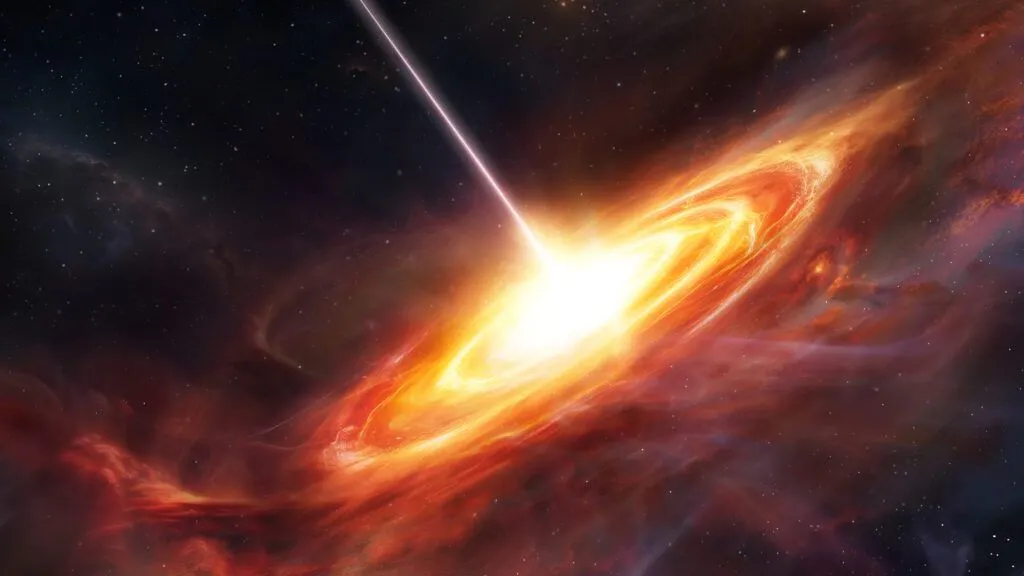
On November 24, 2026, the team behind the Euclid space telescope and the European Space Agency (ESA) announced the first spectroscopic confirmation of a quasar at a redshift above 8. Light from J1504+6252 (nicknamed Dún Aonghasa) was emitted about 630 million years after the Big Bang, roughly 39 million years earlier than the previous record holder. A quasar is an active galactic nucleus: it shines extremely brightly as gas falls onto the supermassive black hole at the center of a galaxy.
Using the research team's baseline estimation method, the black hole's mass reaches about 360 million times that of the Sun. How could such a massive black hole have formed in just 630 million years after the Big Bang? Using the growth model from the paper, our editorial team estimated how much the roughly 39-million-year difference from the previous record affects the conditions needed for the black hole to form.
The Most Distant Quasar Confirmed by Spectroscopy
According to ESA, the team searched for candidates among millions of objects that Euclid observed over about 18 months. According to the paper by Julien Wolf and colleagues, the search covered 3,644 square degrees, observations completed as of August 2025. The team narrowed the field to objects that are faint in visible light but appear point-like in the near-infrared. J1504+6252 emerged as a leading candidate in all three methods for estimating redshift from observed brightness. The average redshift from the three methods was 8.13 ± 0.10.
In follow-up observations, the near-infrared spectrograph MOSFIRE on the Keck telescope detected the continuum light. The Hubble Space Telescope's WFC3 revealed a sharp change in the spectrum near Lyman-alpha, caused by absorption from hydrogen, and the Large Binocular Telescope's (LBT) LUCI captured a similar feature. Then, on June 26, 2026, the James Webb Space Telescope's near-infrared spectrograph NIRSpec detected emission lines that can be used for precise redshift measurement and black hole mass estimation.
Redshift is a measure of how much the expansion of the universe has stretched the wavelength of light. From the central wavelength of the narrow component of the hydrogen Hβ emission line, Wolf and colleagues derived a redshift of 8.129 ± 0.005 as representative of the object as a whole. The statistical error is ±0.001 and the systematic error is ±0.005. Converted using the Planck 2018 cosmological model, this light was emitted about 630 million years after the Big Bang.
In an earlier study published on July 3, 2026, Yang and colleagues confirmed 31 objects spectroscopically from Euclid observations covering about 3,000 square degrees. Among them, EUCL J172902.75+641018.1 held the distance record at a redshift of about 7.77. Compared using the same cosmological model, this quasar existed about 39 million years earlier than the previous record holder. ESA and Euclid's announcement gives this difference as about 40 million years.
J1504+6252 is the only object confirmed spectroscopically in this work. The findings, by Wolf and colleagues of the Euclid Collaboration, were published online in the peer-reviewed journal Astronomy & Astrophysics, Volume 715, on November 24, 2026. The DOI is 10.1051/0004-6361/202662243.
A Black Hole 360 Million Times the Sun's Mass, 630 Million Years After the Big Bang
To estimate the black hole's mass, the team used the combined profile of the intermediate-width and broad components of the Hβ emission line. When gas moves at high speed near a black hole, the Doppler effect shifts wavelengths according to line-of-sight velocity, broadening the observed emission line.
Wolf and colleagues measured a full width at half maximum of about 3,160 ± 270 km/s for the line. From this line width they estimated the gas velocity, and from the luminosity of the continuum at a rest-frame wavelength of 5100 Å they estimated the size of the emission-line region. They then calculated the black hole mass using calibration equations based on observations of low-redshift quasars. The baseline estimate is about 360 million solar masses, or 8.56 ± 0.43 in the common logarithm of solar masses.
The team cross-checked the mass estimate using another emission line, Mg II. Estimates from the five calibration equations applied to Hβ and Mg II range from about 210 million to 780 million solar masses. This is the spread among the calibration equations; the uncertainty of the baseline estimate itself is expressed by the ±0.43 mentioned above. The estimates were consistent with one another within their respective uncertainties.
Once the black hole mass is known, the accretion activity of the gas at the time of observation can also be assessed. The luminosity at which the outward push of radiation on the gas balances the black hole's gravity is called the Eddington limit. The Eddington ratio, the estimated luminosity across all wavelengths divided by the Eddington limit, ranged from 0.12 to 0.44 (12–44%) across the calibration equations. The Hβ-based baseline estimate is 0.26 (26%), a relatively low value among known quasars at redshift above 6.
How a 39-Million-Year Difference Affects Black Hole Growth
Using the black hole growth model that Wolf and colleagues applied to J1504+6252, our editorial team estimated how differences in growth time affect the required initial mass. Following Figure 7 of the paper, we fixed the final mass at about 780 million solar masses, the largest of the five calibration-equation estimates.
In every case, growth was assumed to begin at redshift 20 (about 180 million years after the Big Bang), with a 10% efficiency in converting accreted matter's energy into radiation and an Eddington ratio of 1. We assume gas is accreted continuously throughout the period. The growth period up to about 630 million years after the Big Bang is about 450 million years; in the hypothetical comparison case, it is about 39 million years longer, or about 489 million years.
According to Equations 7 and 8 of the paper by Wolf and colleagues, under these conditions the black hole's mass increases by a factor of e (the base of the natural logarithm, about 2.718) every 50 million years. The required initial mass is found by multiplying the final mass by exp(−growth period ÷ 50 million years).
| Item | This record-setting quasar | Hypothetical case equivalent to the previous record |
|---|---|---|
| Time observed (since the Big Bang) | About 630 million years | About 669 million years |
| Growth start (since the Big Bang) | About 180 million years | About 180 million years |
| Growth period | About 450 million years | About 489 million years |
| Final mass | About 780 million solar masses | About 780 million solar masses |
| Radiative efficiency | 10% | 10% |
| Eddington ratio | 1.0 | 1.0 |
| Required initial mass | About 96,000 solar masses | About 44,000 solar masses |
With the final mass and growth conditions held the same, shortening the growth period by just about 39 million years raises the required initial mass by about 2.2 times. This is because the larger a black hole becomes, the more matter it takes in per unit time at the same Eddington ratio, so it grows exponentially. With the distance record extended by about 39 million years, the mass required of early black holes rises significantly if the same growth conditions are assumed.
How Did Such Massive Black Holes Form?
In an email interview with the Associated Press, Wolf explained that the discovery of Dún Aonghasa provides a new constraint on when a black hole had reached about 360 million solar masses. The growth path leading there depends on the assumptions of the model. For example, if the fraction of time spent active at an Eddington ratio of 1 is shorter, an even larger initial mass would be needed to reach the same mass by the same time.
Wolf and colleagues considered two pathways: one in which a dense gas cloud collapses directly to form a massive black hole seed, and one in which a relatively light seed, such as the remnant of a first-generation star, grows rapidly. In the latter, when large amounts of gas flow in and photons become trapped in the accretion flow, luminosity may stop increasing in proportion to the inflow of matter. If such super-critical accretion is sustained, even a black hole with a small initial mass could reach the enormous mass observed.
The Eddington ratio found here is its value at the time the quasar was observed. The seed's formation time and initial mass, the past accretion rate, and the fraction of time spent active are unknown, so the formation pathway has not been pinned down. The cross-checking of spectra from multiple instruments and the mass estimates using different emission lines were also part of a study of this single object, and within the range of published materials we reviewed, no independent verification by another research team has been reported.
As spectroscopic observations of quasars from the same era accumulate, the distribution of black hole masses and Eddington ratios should help narrow down the formation and growth models that can explain supermassive black holes in the early universe.