

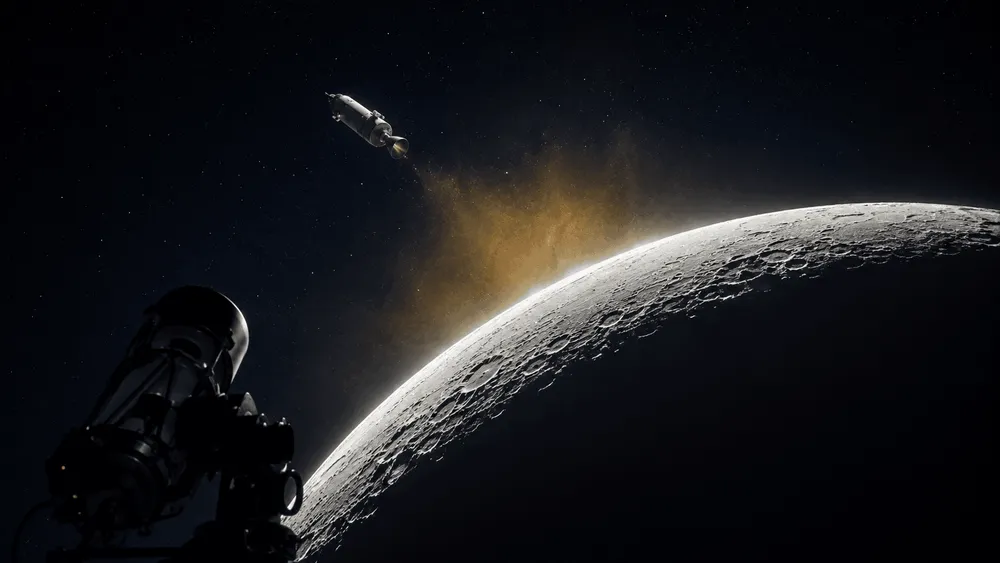
The second stage of a SpaceX Falcon 9 that launched two lunar landers in January 2025 appears to have struck the Moon roughly a year and a half later, on August 5, 2026. What has not yet been directly observed from the ground is the crater itself. Observers conducting repeated tracking and spectroscopy reported a gaseous plume containing sodium and lithium.
Neither an impact flash nor crater imagery has been confirmed, but orbital tracking up to just before impact, combined with ejecta observations reported after the predicted time, strongly supports the conclusion that the object cataloged as "2025-010D" reached the lunar surface. The task of confirming what change was left on the Moon now passes to imagery from lunar orbiters.
What Fell on the Moon: The Falcon 9 Upper Stage That Carried the Landers
2025-010D is the official catalog designation assigned to the second stage of a SpaceX Falcon 9 Block 5. On the "Ghost Riders in the Sky" launch of January 15, 2025, it sent Firefly Aerospace's lunar lander Blue Ghost Mission 1 and ispace's RESILIENCE toward the Moon. The upper stage that remained afterward became the object of this tracking effort.
NASA's launch records list the launch time of Blue Ghost Mission 1 as 1:11 a.m. Eastern Time on that same day. Blue Ghost separated from the Falcon 9 at 2:17 a.m. NASA's CLPS program is a framework that uses commercial lunar landers to deliver science and technology payloads to the Moon, supporting crewed exploration in the Artemis era. 2025-010D was the artificial object left behind after completing that delivery.
A study addressing its physical characteristics tracked 2025-010D using visible and near-infrared spectroscopy and light curves, reporting a rotation period of approximately 7 minutes. During observations, the period reportedly varied by more than 8 seconds. While the data cannot pin down the material composition, it did serve as an observational record that identified the target and kept it under continuous tracking as an object heading toward the Moon.
The Upper Stage Headed Toward 06:35 UTC — Direct Observation Proved Difficult
A paper on observation planning predicted the impact would occur around 06:35 UTC on August 5, 2026, near the bright-side limb of the Moon in the vicinity of the Einstein crater. A separate study estimated the location as being between Bell and Einstein. Both are predictions based on prior orbital and physical-characteristic data, not measurements taken after the fact.
The same paper assumed a dry mass of about 4,000 kg, a velocity of about 2.43 km/s, and kinetic energy of about 11.8 GJ. The physical-characteristics study estimated the velocity at about 2.4 km/s and the crater diameter at about 40 m, while another prediction put it at the 27-m class. The crater diameter figures are derived from models, not from direct measurement. The absence of a directly observed impact flash also does not mean no impact occurred — detection conditions from the ground are severe near the bright-side limb.
SpaceX's Julianna Scheiman has explained that this impact was not intentional, and that a combination of solar activity and gravity put the upper stage on a trajectory toward the Moon. She stated that, following procedure, a separate maneuver was carried out to safely dispose of the second stage. However, this explanation alone cannot fully reconstruct the entire process by which 2025-010D's orbit changed.
Part of the difficulty in tracking stems from the object's distance as it heads toward the Moon. According to Project Pluto, 2025-010D remains in Earth orbit while receding to a distance close to the Moon, meaning that asteroid surveys and telescope observations are more useful than radar, which excels at tracking near-Earth-orbit objects. Solar radiation pressure, which varies with the upper stage's attitude and how it reflects light, compounds the uncertainty in the time and location at which it would reach the Moon.
Clues Left by Tens of Kilometers of Ejecta
Carl Schmidt told Inside Outer Space that, based on a preliminary analysis of long-slit spectroscopy conducted with the 4.3-meter Lowell Discovery Telescope, a gaseous plume containing sodium and lithium was detected spanning a scale of tens of kilometers and lasting 5 to 10 minutes. This observation suggests the possibility that the object which reached the lunar surface ejected material into its surroundings. As this is a preliminary analysis, no formal observational dataset or third-party verification has yet been confirmed. Even without an image capturing the moment of impact, tracking the composition and extent of material that appeared over a short period offers another angle for narrowing down what occurred on the lunar surface.
Cross-referencing with pre-impact models is also beginning. A separate study had predicted that the ejecta curtain would reach 15–20 km, the central ejecta plume would reach 75–100 km, and lateral spread would reach 183 km. Determining which part of this model the observed "tens-of-kilometers-scale" plume corresponds to will only be possible once imagery and spectroscopic data are brought together.
However, this plume is not a direct image of the crater. Its position, shape, and diameter cannot be determined from it. Because the impact itself could not be visually confirmed from the ground, the tracking data and the ejecta observations serve as complementary evidence — but they must be treated separately from the evidence needed to determine what actually remains on the lunar surface.
Three distinct levels of confidence need to be separated here. That 2025-010D reached the lunar surface is strongly supported by tracking data and observational reports. The plume containing sodium and lithium has been reported as an observer's account. However, the impact flash and direct crater imagery have not yet been confirmed.
LRO Imagery Will Turn the Impact Into a Record on the Lunar Surface
NASA's Lunar Reconnaissance Orbiter (LRO) has observed the Moon since 2009 and has captured high-resolution images of past artificial impact sites, including that of the Apollo program's S-IVB upper stages. If post-impact imagery of this impact site can be obtained, it will be possible to verify whether a crater exists, along with its location and diameter. Only then can it be confirmed whether the predicted figures — in the 27- to 40-meter class — match the actual measurements on the lunar surface. The value of this observation lies in its ability to connect an object with a known history, estimated mass, and predicted velocity to an actual change on the lunar surface. Whether and when such imagery can be captured depends on the orbiter's trajectory and the lighting conditions at the target site.
LRO's role is not to retroactively capture footage of the impact. Rather, it is to connect an artificial object — with a known history, estimated mass, and predicted velocity — to the lunar surface after impact. If before-and-after images can be compared, it will be possible to leave a lasting record of a lunar surface change that light and ejecta observations alone cannot determine.
The research team that designed the observation plan views this impact as an opportunity to verify simultaneously the light, ejecta, and crater of an artificial impact. While the flash lasts only an instant, the ejecta can be tracked over several minutes, and the crater remains recorded in the orbiter's before-and-after imagery. The ability to link data across such different timescales to a single impact is what distinguishes this from observing a natural meteor impact. The resulting record could serve as material for future methods of pinpointing locations in lunar seismic observations, for understanding ejecta dynamics, and for assessing the risks that artificial debris poses to future lunar surface activity.
As more transport missions head toward the Moon, how to dispose of upper stages can no longer be treated as a mere afterthought following launch. If the history, estimated mass, and predicted velocity of 2025-010D can be cross-referenced with LRO imagery, this impact could become a benchmark for assessing future lunar surface activity.