


Harnessing renewable energy such as wind and solar is essential to the green transition. But renewable energy is intermittent and hard to predict. We cannot control when the wind blows or when the sun shines.
Today, we don't have to rely on the weather to boil a kettle. We largely have fossil fuels to thank for that. To break our dependence on this finite and polluting energy source, we need to store large amounts of renewable energy cheaply and safely. Unfortunately, no existing technology meets all of those requirements.
Lithium-ion batteries are used in our smartphones, laptops and electric vehicles. But lithium-ion technology depends on materials such as lithium and cobalt, which are expensive and geographically concentrated.
Cobalt mining can be a dangerous and polluting process. The organic electrolytes that contain lithium ions (the liquid chemicals between a battery's positive and negative electrodes) are flammable. Because of the fire risk, deploying these batteries at a scale that could power homes, cities and industry is risky.
There is, however, an alternative: flow batteries.
In a flow battery, energy is stored in liquid electrolytes held in large external tanks. To charge or discharge, the electrolytes are pumped through a cell stack, where electrochemical reactions generate or consume electrons. This design offers several advantages.
In most batteries, two properties, energy and power, are inherently linked. Energy refers to the amount of electricity actually stored in the battery, which determines how long it can keep supplying power at a given rate. Power is the rate at which that energy is delivered, indicating how much electricity can be supplied in a given time.
Normally, you cannot change one without the other. Adding more cells to store more energy also increases power you may not need (and adds costs you don't want).
With flow batteries, that is not the case. If you want to store more energy, you simply use more liquid in a bigger tank. If you need more power, you simply use a bigger cell stack. Because power and energy can be controlled independently, this technology becomes cheaper at larger scales. In addition, unlike lithium-ion batteries, flow batteries cannot catch fire (they are mostly water) and are extremely durable. Some flow batteries have been operating for more than 20 years.
Several large-scale flow battery systems have already been deployed. In China, the largest grid-connected systems have reached gigawatt-hour scale (enough to power 100,000 homes for a full day). In Switzerland, a facility is under construction that is set to be the world's largest flow battery at 2.1 gigawatt-hours (enough to power more than 200,000 homes for a full day) to supply AI data centres. Even so, flow batteries are still a developing technology, and many challenges remain to be solved.
Test cells
Around the world, researchers like us are developing new electrolyte chemistries and materials to reduce the cost of flow battery systems and encourage wider adoption. But getting started in flow battery research is far from easy. Test cells often cost thousands of pounds, and testing a new cell requires a lot of ancillary equipment.
Through our research, we developed a low-cost 3D-printed test cell. This has made flow battery research much easier, allowing our group to test dozens of these cells. However, our team struggled to obtain reproducible test results. In our own lab at Queen's University Belfast, we also found it difficult to reproduce the results of earlier flow battery studies by other groups. The problem forced us to scrutinise every aspect of our testing protocol, and we spent months in a frustrating period of trial and error.
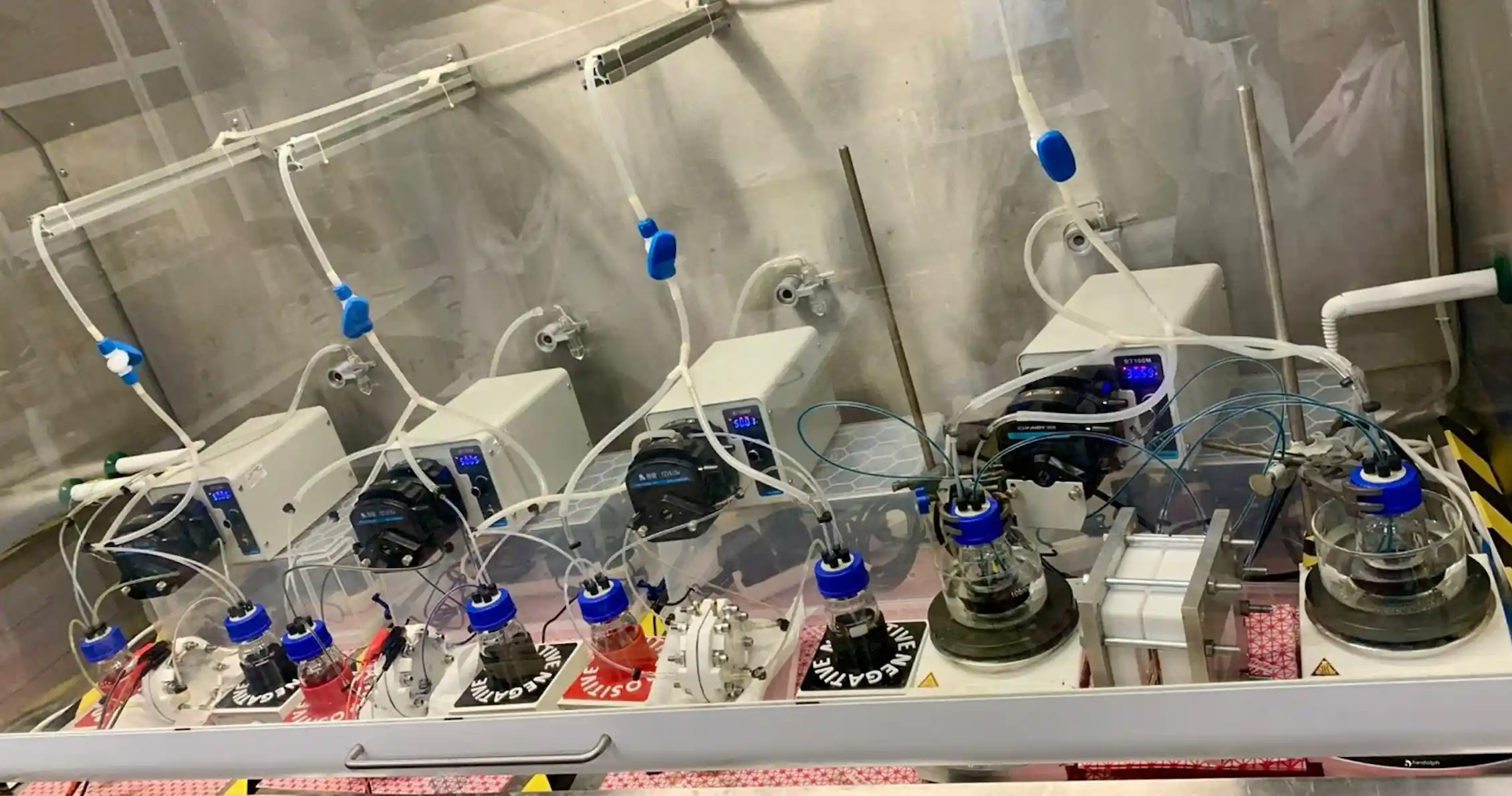
In fact, our group was not the only one struggling. At a conference in early 2024, we heard a talk by Fikile Brushett, a professor of chemical engineering at the Massachusetts Institute of Technology (US), who described the lack of protocols in this field. Since then, we have jointly led a series of studies investigating and tackling the challenge of how to reliably reproduce the data in reported scientific work.
In a study published in April 2026, we sent our low-cost 3D-printed test cells to several leading research groups around the world. We were surprised by how much performance varied between groups, even though they were testing identical cells under nominally the same conditions. Since then, we have identified some potential causes of this variability and proposed improvements to testing protocols.
In our latest work, more than 30 research groups are taking part in evaluating our test cells. Our test data is now publicly available online. We are using it to try to pin down why performance varies between groups. The results will help the community develop testing protocols that all researchers can use.
Eventually, this work should make it easier for newcomers to take up flow battery research. It should also give established research groups a reliable basis for comparing results and speeding up their work. All of this will help chemical engineers innovate more quickly in storing renewable energy cheaply, safely and at scale.