

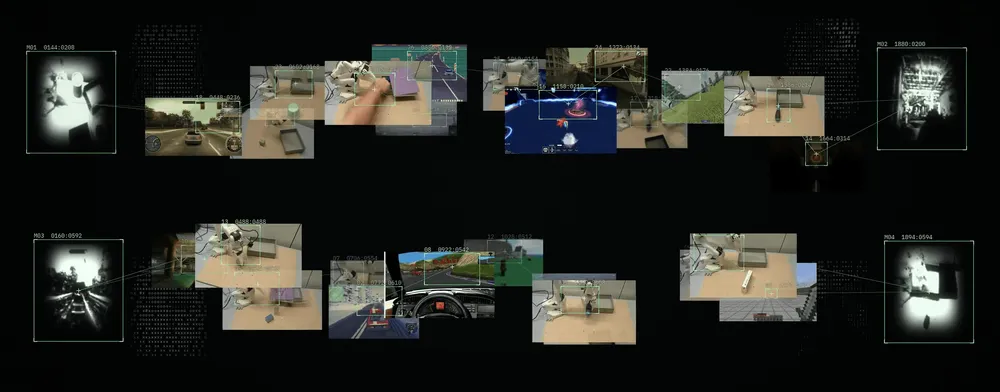
Black Forest Labs (BFL), the company behind the FLUX image generation model, has released an open world action model for robotics called FLUX 3 Action (F3A). Despite keeping the parameter count to just 7 billion, the model is designed to handle both future video prediction and robot action prediction within a single unified model.
According to BFL, F3A outperformed previously top-ranked models on NVIDIA's RoboLab-120 benchmark. While large reasoning models are increasingly being applied to robot control, inference latency and computational cost remain major constraints on real hardware. The central question for F3A is how far a relatively small 7B model can go in balancing performance with speed.
From Video Prediction to "World Action Models"
Research on predicting a robot's future state from camera footage and then determining the next action based on that prediction has been ongoing for some time.
Early approaches such as UniPi used a large text-conditioned video generation model to render footage showing how a task would unfold. This was followed by a two-stage pipeline in which an inverse dynamics model (IDM) estimated the actual actions the robot should take based on changes between frames.
This approach has the advantage of making it easier to transfer knowledge gained from vast amounts of general internet video into robot control. However, because video generation and action estimation are handled as separate processes, this increases computational load and allows errors from the first stage to propagate into the second.
In recent years, a growing number of approaches have instead predicted future video and robot actions simultaneously within a single generative model. GR-1, GR-2, WorldVLA, and Cosmos Policy all follow this trend. Models that jointly handle how the environment will change and how the robot should move are called "World Action Models" (WAMs).
BFL had previously experimented with a VAM (Video-Action Model) configuration called "FLUX-mimic." In that approach, latent representations produced by the video model were used to drive a separate action decoder.
F3A goes a step further, adopting a WAM configuration that jointly predicts future video and the robot's action sequence within a single generative process.
At the core of the model is a backbone that uses BFL's multimodal Self-Flow pretraining. After acquiring representations of the visual world through pretraining, the model takes as input multiple camera feeds capturing the workspace, proprioceptive information indicating the robot's own joint states, and text-based instructions.
The output is an action sequence spanning 32 steps at a 15Hz control frequency, corresponding to roughly 2.13 seconds into the future.
In other words, rather than predicting only the next instant, the model is designed to jointly predict "how the surroundings will change if this action is taken" and "how the robot should move within that changing environment."
Outperforming Larger Models on RoboLab-120
F3A achieved strong results on RoboLab-120, a benchmark built on a simulation environment.
RoboLab-120 consists of 120 different robot manipulation tasks. The 7-billion-parameter version of F3A, with guidance distillation applied, recorded an average success rate of 42.2%.
For comparison, Cosmos 3 Nano, which has 16 billion parameters, recorded a success rate of 36.8%.
Across evaluations using multiple random seeds, the guidance-distilled F3A recorded average success rates in the range of roughly 42.19% to 42.24%, reaching as high as 42.92% in individual trials.
This means F3A outperformed Cosmos 3 Nano while using less than half the parameter count. BFL also reports that F3A outperformed other open models such as π0.5 and DreamZero.
However, in robot control, success rate alone isn't the only thing that matters—inference time is equally important.
Action generation using diffusion models typically requires multiple rounds of sampling and classifier-free guidance (CFG), which tends to introduce latency that becomes problematic for real-time control.
BFL applied both guidance distillation and step distillation to F3A, producing a variant capable of generating actions in a single step.
This single-step version maintains a 38.3% success rate while processing a single forward pass in FP8 precision in 32.29 milliseconds, according to BFL.
BFL reports that FP8 inference speed was 1.52 to 3.95 times faster than Cosmos 3 Nano. The company also states that, in terms of the inference time needed to generate one second's worth of robot motion, F3A was 1.34 to 2.28 times faster than π0.5.
While the success rate drops compared to the full configuration, this speed advantage becomes critical for real-world control scenarios that demand low latency.
28 Out of 30 Successes on a Real Franka Arm
Strong performance in simulation doesn't necessarily translate to the same results on real hardware.
BFL commissioned an independent comparative test through third-party lab Positronic Robotics.
At Positronic Robotics' facility, a Franka robotic arm was used to set up 10 tasks based on DROID.
Four models were compared: F3A, Cosmos 3 Nano, DreamZero, and π0.5. Each task was performed three times, giving each model 30 trials in total.
With conditions such as time limits standardized, the evaluation was conducted blind—staff operating the equipment were not told which model was controlling the robot.
The results showed F3A succeeding in 28 out of 30 trials, for a success rate of 93.3%.
Cosmos 3 Nano recorded 90.0%, DreamZero recorded 66.7%, and π0.5 recorded 43.3%.
At least under these test conditions, F3A demonstrated high success rates not only in simulation but also in real physical manipulation tasks involving actual object contact.
BFL further validated the model using SO-101, a relatively inexpensive open-hardware robotic arm.
Using a small dataset collected via teleoperation, the team fine-tuned F3A within the LeRobot environment. They then examined whether the model could handle environmental changes that were absent during training.
The model was reportedly able to complete grasping and placement tasks even when the target object was swapped out, when the shape of the container it was placed into was changed, or when the camera position was altered.
This suggests the model is not limited to operating solely in environments identical to its training data, but can adapt to some degree of environmental variation.
Pairing with GPT-6 Astra: Delegating Only High-Level Decisions
While F3A alone can handle many manipulation tasks, it has limits when it comes to tasks requiring long-horizon, multi-step planning or scenarios involving complex clutter.
On high-difficulty tasks within RoboLab-120, such as "Pumpkins in clutter," standard action policies including F3A were left unable to solve some cases.
On the other hand, the frontier reasoning model GPT-6 Astra can solve such complex challenges when using high reasoning effort.
However, invoking Astra for every low-level robot control decision is inefficient.
Astra's inference takes an average of 16 seconds per call, and calling it every time the robot needs to decide on an action introduces substantial latency. In BFL's evaluation, a configuration using Astra alone took an average of 16 minutes and cost $13.47 per successful task completion.
BFL therefore tested a hierarchical configuration in which Astra serves as a high-level decision-maker while fine-grained, continuous motion is delegated to F3A.
F3A generates a robot action sequence based on the current observation and presents it to Astra. Astra then judges whether to proceed with execution as-is, and if necessary, modifies the action, swaps in a different maneuver, or halts the operation.
With this combination of GPT-6 Astra and F3A, the cost per successful task dropped to $8.77, with a required time of 8 minutes.
Compared to the $13.47 and 16 minutes required when using Astra alone, this represents roughly a 29% reduction in cost and a 40% reduction in time. The overall episode success rate was 90%.
According to BFL, using F3A as the underlying action model reduced the frequency of Astra's interventions compared to a combination of π0.5 and Astra tested in prior research.
These results suggest that a configuration in which a fast action model handles routine manipulation, while a large reasoning model is called upon only for difficult judgment calls, could offer a way to control computational costs.
Using Different Guidance Strengths for Video and Action
One factor supporting F3A's performance and inference efficiency lies in fine-grained adjustments to its training and inference methods.
Among the most distinctive is "Split Guidance," which applies different classifier-free guidance (CFG) strengths to future video prediction and action prediction.
Through parameter experimentation, BFL found that a higher guidance strength (Video CFG=4.0) worked well for video generation, while a lower value (Action CFG=1.0) was more suitable for robot action generation.
On the video side, stronger adherence to conditioning helps produce more accurate depictions of the future environment. On the action side, however, excessively strong guidance destabilizes the trajectory.
By configuring the two independently, BFL was able to optimize future environment prediction and robot motion generation separately.
Exponential moving average (EMA) is also used for managing model weights.
In addition to standard EMA (decay rate β=0.9990), the team also maintained a Power EMA based on research by Karras et al. in parallel, allowing appropriate weights to be reconstructed after training concludes.
During fine-tuning on the DROID dataset, to prevent large gradients early in training from disrupting pretrained weights, certain weights were frozen during the initial phase, followed by a gradual warmup that progressively increased the learning rate.
When loss spiked sharply mid-training, rather than continuing training as-is, the team would roll back to the most recent stable checkpoint and resume from there.
The training infrastructure used NVIDIA GB200 systems, with custom kernels written in CuTe DSL to improve computational efficiency.
Speed Gains Don't Solve Long-Horizon Reasoning Challenges
F3A demonstrates that techniques developed for video generation models can be effectively applied to robot control. That said, not every challenge required for practical deployment has been resolved.
On its own, F3A may still make errors in scenarios involving unexpected obstacles or tasks requiring long-term memory of past states.
Additionally, the fast single-step distilled model shows a success rate of 37.92% under FP8 precision, somewhat lower than the standard multi-step version.
When deploying to real hardware, developers will need to weigh how much failure can be tolerated against how much response speed is required, selecting the appropriate model configuration based on the intended application.
BFL has published weights for base, droid, and so101 configurations on Hugging Face, and further adaptation to different robots and work environments is expected going forward.
Also noteworthy is the hierarchical approach of combining a high-performance reasoning model like GPT-6 Astra with a fast action model like F3A.
Rather than having a large reasoning model deliberate over every single action, routine operations are handled quickly by a lightweight model, with the higher-level model consulted only in situations requiring difficult judgment.
These results suggest that such a division of labor could offer a path toward balancing the performance and computational cost needed for autonomous robot control.