


The green glow of a night vision view is familiar from movie scenes and recorded military operations. For more than half a century, it has been humanity's standard window into the dark. The sensor behind the lens captures the heat an object emits, or the faint infrared light it reflects, and converts it into shades of a single color. The approach let people operate in darkness, but it draws out only half of what the human eye is truly capable of. A research team at the Beijing Institute of Technology has overturned this long-held convention, unveiling a new optical device that translates the wavelengths of invisible light into "color."
A History of Night Vision Bound to Shades of Green
The Limits of the Human Eye at Night, and the Compromise
In bright environments, the human eye uses the cone cells densely packed in the center of the retina to perceive the world in vivid full color. Once we enter the dark, the situation changes completely: rod cells, which cannot distinguish color but respond to even a few photons, take over vision. This biological switch is why colors drain from a nighttime landscape and everything appears to sink into monochrome. Engineers have long turned their attention to infrared light, which the human eye cannot see, and developed devices for seeing in the dark. Every object radiates infrared according to its temperature, and also reflects the faint infrared contained in starlight. Night vision devices, which came into practical use in the 1960s, adopted a mechanism in which this infrared strikes a photocathode to knock out electrons, which are then amplified into visible light on a phosphor screen.
Missing Wavelength Information
The output color chosen was a specific wavelength of green. In the dark, the human eye is most sensitive to wavelengths near green. Because it makes the image on the screen easier to see even with very little light, choosing green was highly rational, and it remains a foundational design principle of infrared imaging to this day. Conventional systems absorb the broad range of infrared wavelengths emitted by a target with a single detector, then show the total amount of energy on screen as differences in green brightness, or luminance.
In this conversion process, crucial information is discarded. Infrared light, like red and blue in visible light, differs by wavelength. Materials found in nature emit or reflect infrared at subtly different wavelengths depending on their chemical composition and surface temperature. In conventional systems, even if several infrared beams of different wavelengths arrive, the final output is flattened into the strength of a single green. If the trees of a forest in the background and an artificial camouflage net return infrared of the same intensity, telling the boundary between them by monochrome brightness alone is extremely difficult.
The human visual system is far better at discerning changes in color than changes in brightness. The compromise of painting the world in a single tone has placed a strict ceiling on the amount of information night vision devices can provide. What was needed was a way to remove this constraint and convert differences in the wavelengths of invisible light into color differences that people can understand intuitively.
Quantum Dots and Organic EL Translate Light into Color
Mercury Telluride Captures Invisible Light
The research team broke through this historical limit with an approach rooted in materials science. The detection layer of the device they developed is laid with colloidal quantum dots of mercury telluride (), uniform in size at a few nanometers. Quantum dots, tiny semiconductor crystals, have a property known as the quantum size effect, which allows the wavelength of light they absorb to be tuned freely by changing the particle size.
When infrared light reaches this detection layer, electrons inside the material absorb the energy and are excited, generating positively charged holes. The core of the physical phenomenon here is that the number of holes generated changes dynamically with the wavelength and intensity of the incoming infrared. Long-wavelength, low-energy infrared produces only a small number of holes. Conversely, when short-wavelength, higher-energy infrared enters, more complex electronic transitions are induced inside the material, and a large number of holes are produced.
An Energy Barrier Sorts Holes Between Emissive Layers
The generated holes flow into two layers of organic EL (OLED) stacked directly above. This is where the physical differences in infrared are translated into differences in color. The lower layer contains a red-emitting dopant material, and the upper layer a cyan-emitting dopant material. The research team deliberately designed a hole injection barrier between the two layers. The barrier height is set at .
This figure represents the height of the energy wall that holes must overcome to move from the lower layer to the upper layer.
When weak infrared or long-wavelength infrared enters, few holes are generated. These holes lack the momentum to cross the barrier and are captured in the red layer in front. As a result, the whole device emits a dim red. When the situation changes and stronger or shorter-wavelength infrared arrives, a large number of holes are generated. Because there is an upper limit to the number of holes the red layer can accept, the excess holes that reach saturation cross this energy barrier and flow into the cyan layer beyond.
As a result, both the red and cyan emissive layers are driven at the same time, and the device emits vividly mixed light combining the two, while its overall brightness also increases. There is no preset software program that colors the image artificially. The design ties the physics of the incoming light directly to color changes in the hardware itself.
| Feature | Conventional monochrome night vision device | Full-color night vision prototype |
|---|---|---|
| Input signal processing | Sums a broad wavelength band into a single signal | Separates differences in wavelength and intensity into individual signals |
| Output format | Brightness variations in a single color (mainly green) | Continuous color mixing from red to cyan, plus changes in brightness |
| Signal discrimination sensitivity | Baseline | Distinguishes signal differences 100 times finer than conventional |
| Information delivery to vision | Relies on the retina's sensitivity to changes in brightness | Exploits the retina's high sensitivity to color contrast |
The Future of Artificial Vision and Three Hurdles Ahead
A 23-Gram Translucent Prototype
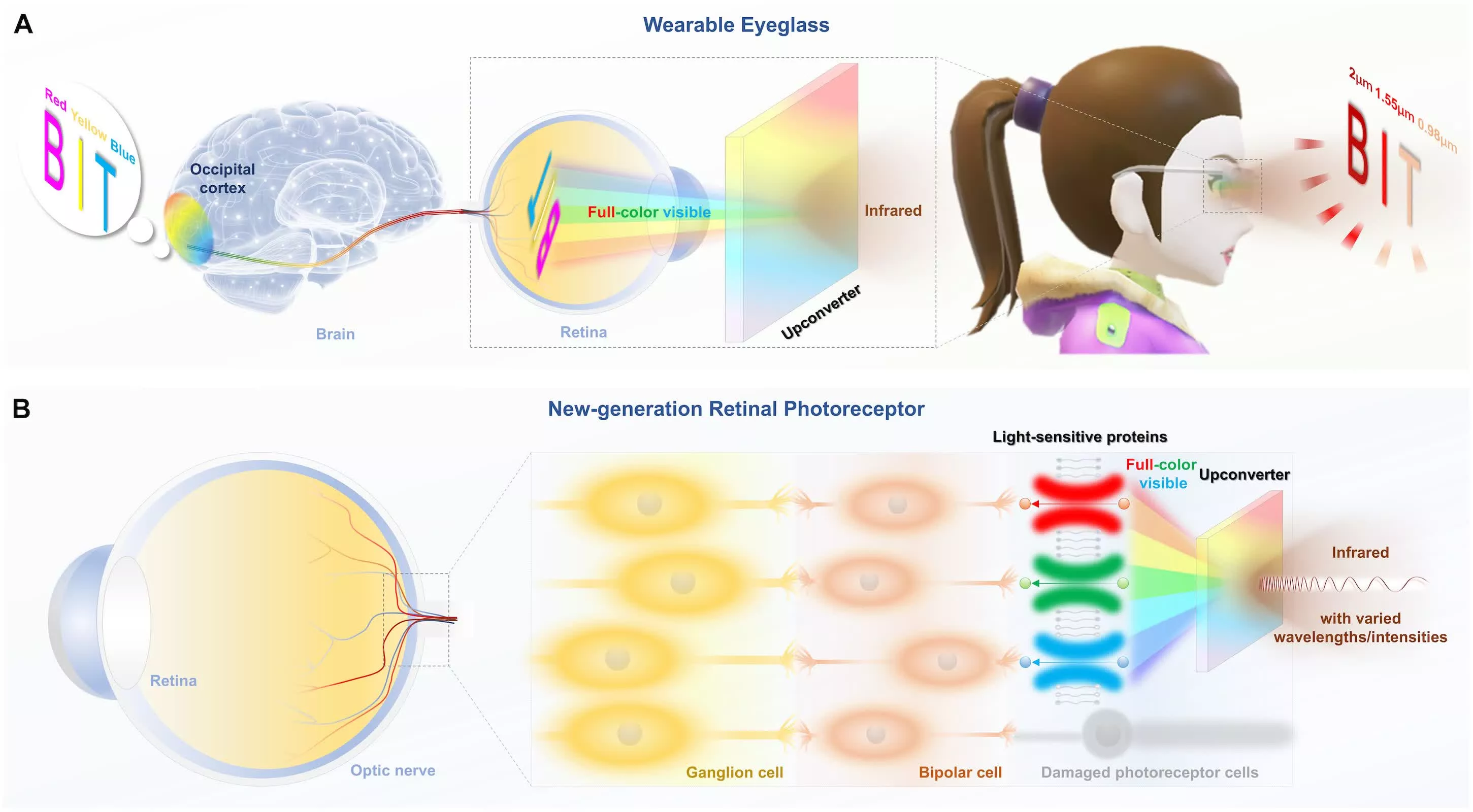
To demonstrate the practicality of the new hardware, the research team built a glasses-type prototype that can be worn on the face. Conventional binocular night vision goggles, such as those used by the military, weigh from several hundred grams to more than one kilogram in heavier models, and prolonged use strains the neck. By contrast, the developed prototype weighs just 23 grams, comparable to ordinary plastic sunglasses.
The lens is designed to be translucent, so the wearer sees a full-color view converted from infrared overlaid on the visible-light world seen with the naked eye. It also includes a function to switch, depending on ambient light conditions, to an immersive mode that blocks visible light and shows only the infrared information. In laboratory tests, moving objects and multiple geometric patterns illuminated with short-wavelength infrared were displayed in real time with clear color differences. The data show that, because color information was obtained in addition to brightness, the device could distinguish differences in infrared signals two orders of magnitude, or 100 times, finer than conventional monochrome systems.
Light That Drives Biological Systems
The research reaches beyond the framework of a display viewed from outside, extending to acting directly on the biological retina. Experiments were conducted to explore whether the converted light signals could directly stimulate the visual nervous system. The team irradiated a culture of artificial cells, engineered to respond to visible light, with infrared passed through the device. The cells, which should not respond to infrared itself, showed a clear physiological response to the light after it passed through the device.
In addition, in experiments using living animals, changes in brain activity were measured in mice, and responses to the signal were likewise confirmed in the retinas of human volunteers. Because no response occurs at all when infrared is applied directly, the results show that this full-color conversion device works as a translator that drives the biological visual system. This suggests it may operate as a component of next-generation artificial vision prosthetics to bring light to patients who have lost their sight.
Challenges for Real-World Deployment
The foundation of a technology that sees through the night in rich color is complete, but several challenges await its application in the real world. First, the mercury telluride used in the light-detection layer is a heavy metal compound. This study does not address toxicity or biocompatibility in the case of long-term skin contact or future implantation in the body as an artificial retina. For medical uses or everyday wearable devices, replacement with safer materials will be needed.
Second is the dependence on an external power source to drive the OLED. As the device is made lighter, the battery becomes a constraint. In its current form, it is closer to a power-consuming display than to a self-contained, passive optical filter.
Third, the tests so far remain confined to laboratory environments using controlled lighting and simple, high-contrast objects. Whether the intended color separation will work in the real world, where complex heat sources intermingle and unpredictable environmental noise arises from infrared absorption by water vapor and reflected sunlight, remains untested. To make the colors of the dark part of everyday scenery, these barriers in materials engineering and environmental adaptability will have to be overcome one by one.