


In Gaggenau, in southwestern Germany, plans have been approved for a large-scale energy storage facility that will stack zinc-bromine batteries on the site of a former liquefied gas facility. The project is being developed by the municipal utility Stadtwerke Gaggenau and JP Holding. The planned investment is €15.2 million, with an output of 7.5 MW and a storage capacity of 30 MWh. Construction is due to begin in 2027, with operations targeted for 2028.
The project will use "Indensity," an energy storage system from the U.S. company Eos Energy Enterprises. Battery units are mounted into a steel support structure, stacked vertically and side by side, so the site is used in three dimensions. The system is expected to supply power for about four hours at rated output, and CAPAC is responsible for design, construction, and commissioning. The city of Gaggenau announced on November 13 that the city council had approved the plan.
How Batteries Are Stacked on a Former Gas Site
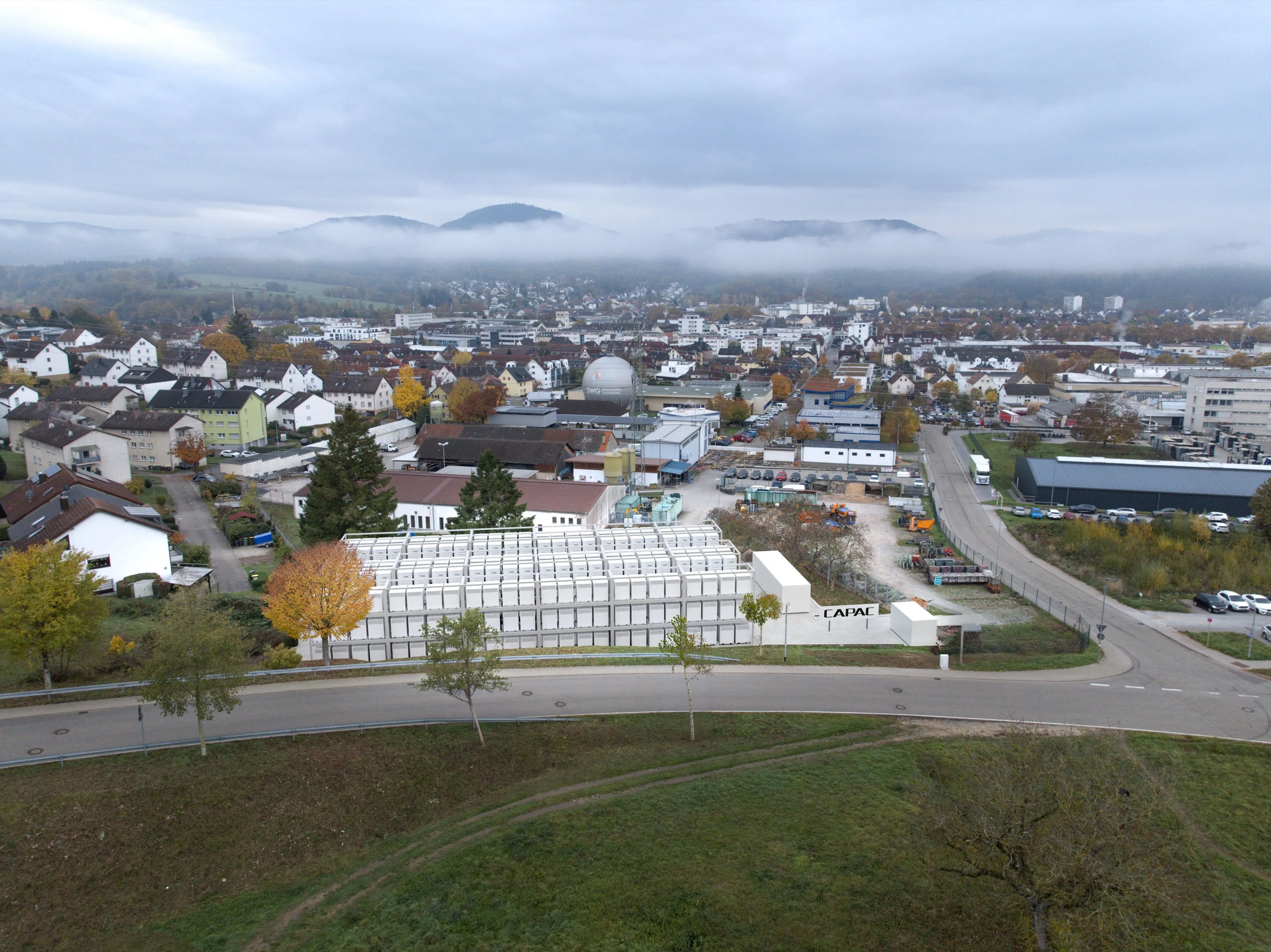
Indensity uses zinc-bromine batteries. According to the companies involved, the water-based electrolyte is non-flammable, which allows battery units to be packed at high density. In Gaggenau, that property will be used not only to lay batteries out across the former liquefied gas site but also to stack them upward.
Stacking is made possible by more than a change in layout. According to Eos, earlier designs had six battery strings sharing a single enclosure and control system, arranged in a single layer on the ground. In the new design, each string is separated into an independent unit called a "Core," with its own control, cooling, and communication functions. This allows each string to be managed individually and reduces the scope of replacement when a fault occurs.
Cores slide into a steel support frame from the front. The frame has built-in power wiring and control and communication signal paths, with cabling consolidated on one of the short sides. This structure allows batteries to be arranged vertically and horizontally while still being serviced from the front.
Eos envisions a maintenance approach in which a faulty Core is swapped for a spare and the removed unit is repaired elsewhere. Even when units are placed back to back, space for ventilation and work access must be maintained, but smaller replacement units and a support structure with consolidated wiring make it easier to use the space above the site.
7.5 MW / 30 MWh Delivers Roughly Four Hours of Power
In this project, 7.5 MW represents the amount of power the facility can deliver at a given moment, while 30 MWh is the amount of energy it can store. Dividing the nominal capacity of 30 MWh by the nominal output of 7.5 MW gives a discharge time of four hours. However, this is a duration calculated from nominal figures and has not been confirmed by discharge tests on the actual installation.
The U.S. outlet Interesting Engineering highlights a storage capability of up to 16 hours in the headline of its article on the battery, but its body text describes the Gaggenau facility as a four-hour storage system. Discharge duration varies with system configuration and output conditions. Eos's product datasheet also lists output ratings for 4-, 6-, 8-, and 10-hour conditions, and the configuration adopted at Gaggenau corresponds to four hours.
A four-hour discharge duration depends not only on storage capacity but also on when the power is delivered. The facility plans to store electricity during periods of high wind and solar output and supply it when demand rises.
Cooling and a Design Built for 25 Years of Operation
To operate stacked batteries, the heat generated by each unit must be properly dissipated. CAPAC says active cooling is not required, but Eos's comparable products use forced-air cooling with outside air and have internal fans. The Indensity Core datasheet describes its temperature management method, and technical explanations describe a structure in which fans in each Core move air through the unit. However, this is general product design information and does not show the auxiliary equipment configuration of the facility to be installed in Gaggenau.
According to the companies, the batteries' operating temperature range is from -20°C to 50°C, and capacity loss over 25 years is limited to a maximum of 3.6%. Eos's datasheet also gives an expected lifespan of 25 years, but the standard manufacturer warranty is 10 years, with extensions available. The expected operating life and the warranty period need to be distinguished.
| Item | Published information | Meaning |
|---|---|---|
| Cooling | Forced-air cooling with outside air, fans inside each Core | A design that manages temperature by moving outside air through the units |
| Lifespan | Expected 25 years; the companies state a maximum 3.6% capacity loss over 25 years | A design projection assuming long-term operation |
| Warranty | Standard manufacturer warranty of 10 years, extendable | The period the manufacturer guarantees |
To operate this design on site, space must be secured for fan ventilation and for the work needed to replace units from the front. The 25-year lifespan and the capacity loss rate are also long-term projections presented by the companies, not figures based on actual operating records.
Energy losses during charging and discharging also affect a storage facility's profitability. Eos gives a maximum round-trip efficiency of 81% under four-hour operating conditions. However, this figure applies to cycles on the DC side of the unit in which the state of charge is raised from 20% to 80% and returned to 20%. It also comes with conditions, such as optimal temperature, output, and depth of discharge, and a capacity design with margin relative to the application and warranted capacity. The actual AC-side efficiency of the whole facility will vary with local operating conditions.
How Will the Facility Earn Revenue?
The companies plan to store electricity when wind and solar output is high and supply it according to demand. The planned revenue sources are the day-ahead market, where power is traded the day before use, the intraday market, where it is traded on the same day, and services that support the stable operation of the power grid. The stacked battery design is being adopted to secure the storage capacity needed for such operations on a limited site.
Dividing the planned investment of €15.2 million by the nominal capacity of 30 MWh (30,000 kWh) gives an investment of about €507 per kWh of capacity. This is a simple calculation that divides the facility's total investment by its nominal capacity, and it does not represent battery manufacturing cost, electricity sale prices, or the cost of storage over the entire operating period.
Actual profitability will depend on the gap between electricity purchase and sale prices, as well as charge-discharge losses and operation and maintenance costs. At present, the actual charge-discharge efficiency of the Gaggenau facility, the breakdown of maintenance costs, and specific figures for expected revenue have not been disclosed.
Construction is planned to begin in 2027, with operations starting in 2028. Whether a storage facility that makes three-dimensional use of a former gas site can succeed commercially will be judged by its post-launch efficiency, maintenance costs, and revenue from electricity markets and other sources.