

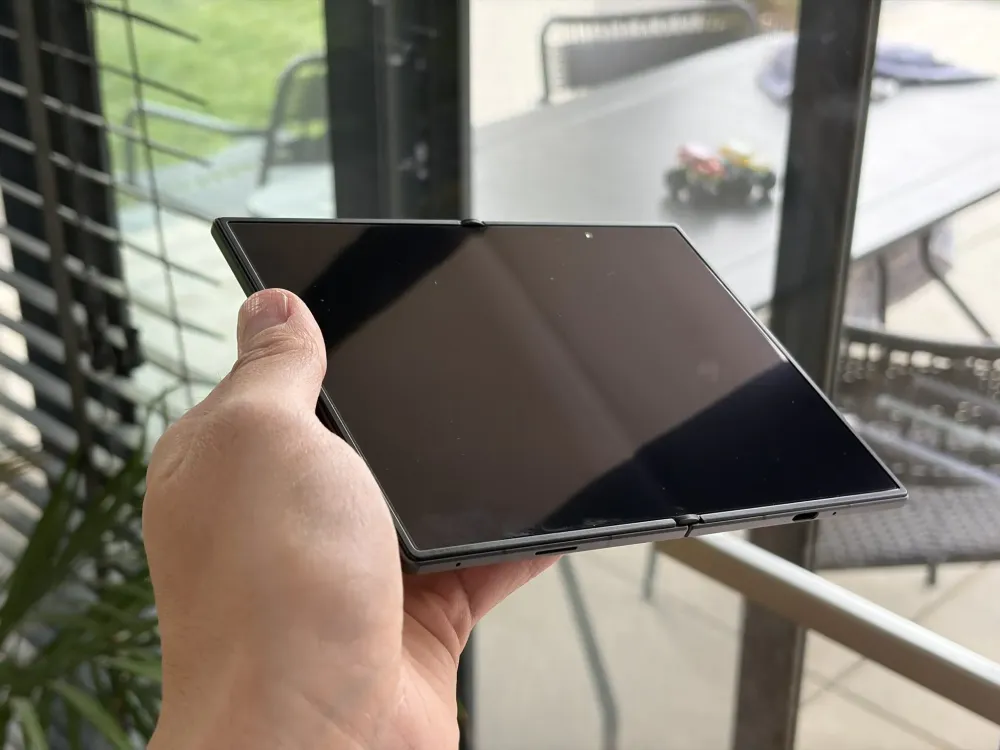
What Samsung's "Flex Titanium," introduced with the Galaxy Z Fold8 generation, aims for is not the elimination of the crease, but a reduction in its visibility. When Android Authority compared the Galaxy Z Fold8 and Z Fold8 Ultra when new versus after one week of use, both devices reportedly became easier to spot the crease on depending on the angle of light. However, the feel when running a finger across the screen remained as flat as on day one, and with the display turned on, the crease was less noticeable than in photos. This early assessment shows that the visibility of the crease and its tactile feel do not change in the same way.
After One Week, the Crease Is More Visible, But Fingertip Flatness Is Maintained
On July 30, Android Authority published photos of the Galaxy Z Fold8 and Z Fold8 Ultra taken right out of the box and after one week of use. For both devices, once used, the central crease became easier to catch when viewed from the right angle. The outlet confirmed a similar change across the two units it owns.
![FireShot Capture 071 - What to expect from the Galaxy Z Fold 8's crease after a week\_ - [www.androidauthority.com].webp](https://media.xenospectrum.com/Fire_Shot_Capture_071_What_to_expect_from_the_Galaxy_Z_Fold_8_s_crease_after_a_week_www_androidauthority_com_1a2807c1a2.webp)
On the other hand, there was reportedly no discernible change over the week in the feel of running a finger across the center of the screen. With the display lit up, the impression of the crease is weaker than in photos that pick up reflections from an angle. The outlet itself emphasized that it's "not as bad as it looks in photos," distinguishing the change in appearance from any deterioration in tactile feel.
There are limits to these observations. The comparison involved only two units, and neither the number of fold cycles nor the usage temperature was disclosed. This wasn't a measurement taken under fixed lighting and shooting angles, nor were there any numerical results quantifying surface unevenness. Therefore, what can be confirmed from the photos is limited to "the crease became easier to spot at certain angles"—it cannot be concluded that the groove itself became physically deeper.
A Support Film 20 Times Stronger and Micro-Patterned Holes
Flex Titanium consists of a titanium alloy film placed beneath the OLED panel and a titanium plate beneath that which supports the display module. According to Samsung, the former offers 20 times the mechanical strength of conventional polymer film, while its thickness is kept to about one-third that of an average human hair. The company explains that this thinness enabled a slimmer display panel.
On the titanium plate side, advanced hole processing ensures no air remains between the module and the adhesive, achieving tight adhesion. Precise micro-patterned holes are placed at the folding section, giving the otherwise rigid titanium a structure that can withstand repeated bending. It's a design that maintains stable support when the screen is open while retaining the flexibility needed for folding.
Even Samsung's official claims don't promise the complete disappearance of the crease. At the product announcement on July 22, the company explained that Flex Titanium strengthens screen support, absorbs pressure and impact, and makes the crease less noticeable over time. This week-long comparison doesn't serve as a long-term test that disproves that claim. However, it did quickly demonstrate that the appearance on day one won't necessarily persist unchanged.
The Fold7 Already Had a Titanium Plate
To understand what changed with the Fold8, one needs to separate the adoption of titanium itself from the new two-layer structure. The Galaxy Z Fold7 had already incorporated a titanium plate layer beneath the main screen. Its Ultra-Thin Glass (UTG) was 50% thicker than the Fold6's, and the company explained that the teardrop-shaped Armor FlexHinge and multi-rail structure evenly distributed stress to make the crease less visible.
The main difference added with the Fold8 is that the support film directly beneath the OLED was switched from polymer to titanium alloy, and the plate's hole processing and adhesion structure were also revised. In other words, it's not simply a case of adding one more rigid plate—both the layer supporting the screen and the layer that folds were redesigned. Crease countermeasures are moving toward handling stress across multiple layers, from the hinge's trajectory to the UTG, the support film, and the plate's adhesion.
| Comparison Point | Galaxy Z Fold7 | Galaxy Z Fold8 |
|---|---|---|
| Plate | Adopted a titanium plate layer | Adopted advanced hole processing and micro-patterned holes |
| Support material beneath OLED | Structure not detailed in product announcement | Adopted titanium alloy film |
| Folding section | Stress distributed via teardrop-shaped hinge and multi-rail | Balance of hinge, screen tension, and magnetic force also adjusted |
| Official description of effect | Makes the crease less visible | Makes the crease less noticeable over time |
With the Fold8, even the support material inside the panel has been converted to titanium, and the plate's adhesion method has also been revised. That said, Samsung has not provided numerical figures for crease depth or reflectivity, nor has it disclosed the number of fold cycles used to determine whether it remains "less noticeable over time." The degree of improvement between generations cannot be measured from the official structural explanation alone.
This distinction also matters for how to read the early photos. Just because a line became visible after a week doesn't mean the new structure isn't working. What should be compared is whether it's less noticeable than the Fold7 under the same lighting and number of uses, whether the unevenness felt under the fingertip increases more slowly, and whether the change plateaus with long-term use.
Comparisons That Align Time and Conditions Matter More Than "Zero Crease"
Samsung's support page describes the crease visible at the center of the main screen on its foldable Galaxy devices as a natural characteristic of the device. The Flex Titanium announcement itself uses the phrase "less noticeable," not a claim that the crease doesn't exist. If one takes the term "creaseless" as a product promise, then the week-later photos look like a failure. But returning to the official standard, what should be evaluated isn't whether the crease is zero, but how much the visual and tactile impact has been reduced compared to before.
There are also two things to check before purchasing. Viewing a powered-off screen from an angle makes it easier to catch the line via reflection, while viewing it powered on reveals the visibility during actual use. Additionally, running a finger across the center lets you check for unevenness that photos can't capture. Android Authority's report shows that these three checks don't necessarily yield the same answer.
What will determine the true evaluation of Flex Titanium is a long-term comparison that tracks mass-produced units under the same lighting and shooting angles, recording the number of fold cycles alongside changes in tactile feel. If the initial flat feel persists for months and the crease remains less noticeable than in the previous generation, then the new structure can be judged to have worked as intended. The week-old photos are the first piece of evidence suggesting that such verification is necessary.