


On September 1, 2026, Google introduced "agentic video understanding" for Gemini 3.7 Flash, 3.6 Flash, and 3.5 Flash-Lite. Instead of reading a video from start to finish at fixed intervals, the model now uses the question as a cue to move through the timeline, selecting and examining the video frames, audio, and transcripts it actually needs. Google claims this cuts token usage by up to 88%, reduces analysis costs by up to 66%, and improves quality by up to 7%. However, these three maximum figures were not all produced by a single test.
The new feature applies to video files and YouTube videos, and is available through the Gemini API in Google AI Studio and the Gemini Enterprise Agent Platform. For applications that handle long videos, this is a different kind of improvement from simply extending the context limit. Rather than determining how many hours of footage a model can read, the model itself now decides how many seconds it needs to read in order to answer a question.
From a fixed 1FPS scan to a loop that hunts for the right moment
The conventional static approach extracts one frame per second from a video and feeds it into a single input alongside the audio. According to Gemini API documentation, at low media resolution, frames use 66 tokens per second and audio uses 32 tokens per second, bringing the rough total to about 100 tokens per second including metadata. At high resolution, frames alone use 258 tokens per second, pushing the total to roughly 300 tokens per second. As a video gets longer, sections unrelated to the question still occupy input space in near-direct proportion to length.
Agentic video understanding changes this entry point. The model first considers the question, then chooses whether to search the transcript, look at frames from a specific range, or listen to the audio. If the information it gathers isn't enough, it goes back for more, adjusting the time range, frame rate, or resolution. For example, if the model suspects a fast-motion anomaly in a particular segment, it can re-examine just that segment at a rate finer than 1FPS—reducing the overall input while still catching sub-second changes that static processing would miss.
In the Interactions API, this is configured by setting the video input's processing to agentic. If processing_call and processing_result appear in the response's steps, that's evidence the model dynamically navigated within the video. This is not a function call that developers implement themselves—it's Gemini's internal video retrieval process. Applications can use it to display progress, but they don't need to return a value to the call.
The conceptual predecessor to this is the agentic visual processing for images that Google introduced to Gemini 3 Flash in January 2026. For images, the model used Python to repeatedly zoom, crop, annotate, and calculate. The video version extends the same "think, act, observe result" loop across a timeline and three types of information sources.
The 88% figure comes from the maximum across two long-video evaluations
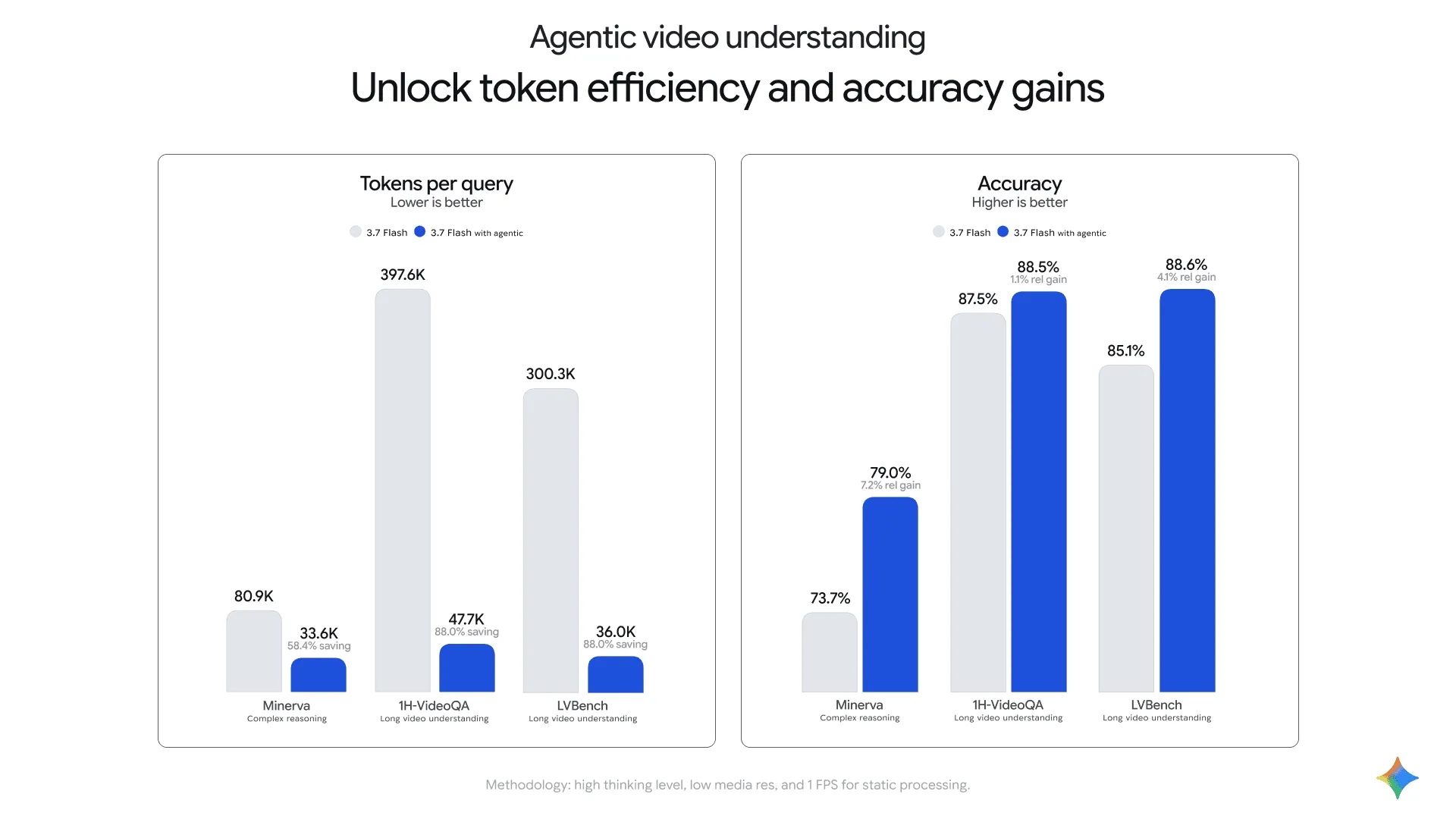
The comparison Google published ran Gemini 3.7 Flash with high reasoning settings and low media resolution, while static processing was fixed at 1FPS. Converting the figures from the announcement's chart into consistent units yields the following results:
| Evaluation | Static Processing Tokens | Agentic Tokens | Reduction | Accuracy Change |
|---|---|---|---|---|
| Minerva | 80,900 | 33,600 | 58.4% | 73.7% → 79.0% |
| 1H-VideoQA | 397,600 | 47,700 | 88.0% | 87.5% → 88.5% |
| LVBench | 300,300 | 36,000 | 88.0% | 85.1% → 88.6% |
According to Google's chart, switching Gemini 3.7 Flash from static to agentic processing reduced Minerva's token count from 80,900 to 33,600—a 58.4% drop—while accuracy rose from 73.7% to 79.0%, a 5.3-point gain. For 1H-VideoQA, tokens dropped from 397,600 to 47,700 (an 88.0% reduction), with accuracy rising 1.0 point from 87.5% to 88.5%. For LVBench, tokens dropped from 300,300 to 36,000 (also an 88.0% reduction), with accuracy rising 3.5 points from 85.1% to 88.6%. In other words, the maximum 88% token reduction and the maximum 7.2% relative accuracy improvement came from different benchmarks.
The evaluation targets themselves also differ. The publicly available 1H-VideoQA consists of 101 five-choice questions across 21 videos ranging from 40 to 90 minutes, testing the ability to locate short events within a long timeline. Minerva covers videos from 2 minutes to over 90 minutes and includes roughly 1,500 questions requiring various forms of reasoning—numerical, temporal, and spatial. LVBench likewise measures comprehension and information extraction from long-form video. The fact that selecting question-relevant segments from long footage led to major reductions specifically on 1H-VideoQA and LVBench reflects a good fit between the mechanism and the evaluation tasks.
The numbers are promising, but they remain Google's own internal evaluation. The published chart doesn't include the number of trials, error margins, or the evaluation prompts alongside the question counts. Even where public datasets were used for testing, that doesn't mean a third party could reproduce these exact execution conditions. The 88% figure is neither an average across all videos nor a guaranteed minimum.
Why the token reduction rate and cost reduction rate don't match
A maximum 88% reduction in token usage cannot simply be read as an 88% reduction in billing. Google's stated cost reduction for analysis tops out at 66%, and the announcement text doesn't provide actual cost figures broken down by benchmark. Standard pricing for Gemini 3.7 Flash, through December 31, 2026, is $0.75 per million input tokens and $3.75 per million output tokens (including reasoning tokens). There's no additional charge for agentic processing itself, but what's mainly reduced is video input.
Agentic processing adds reasoning to decide where to look, plus processing to retrieve portions of the video. API usage is broken down into total_input_tokens for the initial input, total_thought_tokens for the reasoning behind navigation, total_tool_use_tokens for on-demand retrieval of transcripts, frames, and audio, and total_output_tokens for the final answer. Even with a major cut to input, there's no guarantee reasoning and output shrink at the same rate. Since 88% and 66% are each maximum values, you can't back-calculate the cost of additional processing from the gap between them. Estimating video analysis costs requires accounting for usage beyond just input.
Moreover, usage isn't fixed. Google's pricing documentation explicitly states that usage varies with question complexity and the amount of dynamic sampling, and that segments requiring detailed examination may exceed 1FPS. For the same one-hour video, "list the three main points of the lecture" and "list every timestamp where the display in the bottom-right corner changed" will lead the model to search different amounts of footage. Cost estimates made before implementation need to account for the type of question, not just the video's length.
Effective for long-video search, but different for short videos and full-video review
Google's developer documentation doesn't treat agentic processing as a universal replacement. While it recommends agentic processing for long videos and questions that search for specific moments, it recommends static processing for videos under 5 minutes where prioritizing time-to-first-response matters, and for cases requiring frame-by-frame examination of an entire video. Because agentic processing involves back-and-forth between reasoning and video retrieval before answering, the time before the first response begins can be somewhat longer for short videos.
| Use Case | Recommended Processing | Reason |
|---|---|---|
| Finding a specific explanation within a 90-minute lecture | Agentic | Only the relevant segment needs to be loaded |
| Detecting fast motion or momentary state changes | Agentic | Frame rate can be increased only for the suspect segment |
| Quickly answering questions about videos under 5 minutes | Static | Avoids the overhead of internal search back-and-forth |
| Inspecting an entire video at uniform frame density | Static | Avoids coverage bias from selective search |
With a selective-viewing mechanism, the judgment of which segment to examine becomes part of accuracy itself. Even if recognition is correct once the target is found, if the initial search misses the candidate segment, the answer never arrives. Therefore, for tasks like full-audit surveillance review or legal evidence verification, a rise in average accuracy alone isn't grounds for dropping static processing—search omissions need to be measured against proprietary videos with known correct answers. Since the Gemini API allows different processing modes to be set per video within the same request, it's possible to design comparisons where, for instance, a long lecture uses agentic processing while a short experimental clip uses static processing.
Availability and general release are separate matters
The September 1 announcement covered 3.7 Flash, 3.6 Flash, and 3.5 Flash-Lite. The following day, 3.8 Flash was announced, and as of September 3, the Gemini API documentation lists 3.8 Flash among the supported models as well. Meanwhile, the Gemini Enterprise Agent Platform documentation explicitly labels agentic video understanding as "Preview," and on Google Cloud's GenerateContent API, it's only available under v1beta1. Being callable via the API is not the same as being a fully released, stable specification.
Multi-turn conversations also come with implementation requirements. On Google Cloud's GenerateContent API, failing to pass the opaque step_list included in a response into the next request causes the video context to be lost, requiring reprocessing for follow-up questions. Using a feature designed to reduce tokens while discarding this state risks re-reading the same video and increasing both cost and latency.
Google plans to roll this out to Flash and Flash-Lite in the Gemini app soon, and to bring it to "Ask YouTube" on YouTube playback pages within the coming months. The question that matters going forward isn't whether the maximum reduction rate will appear again. It's whether, for each video type and question, total tokens, time-to-first-response, and search omissions against known correct answers can be measured under the same test conditions—and whether the scope in which static processing should remain can be properly determined.