

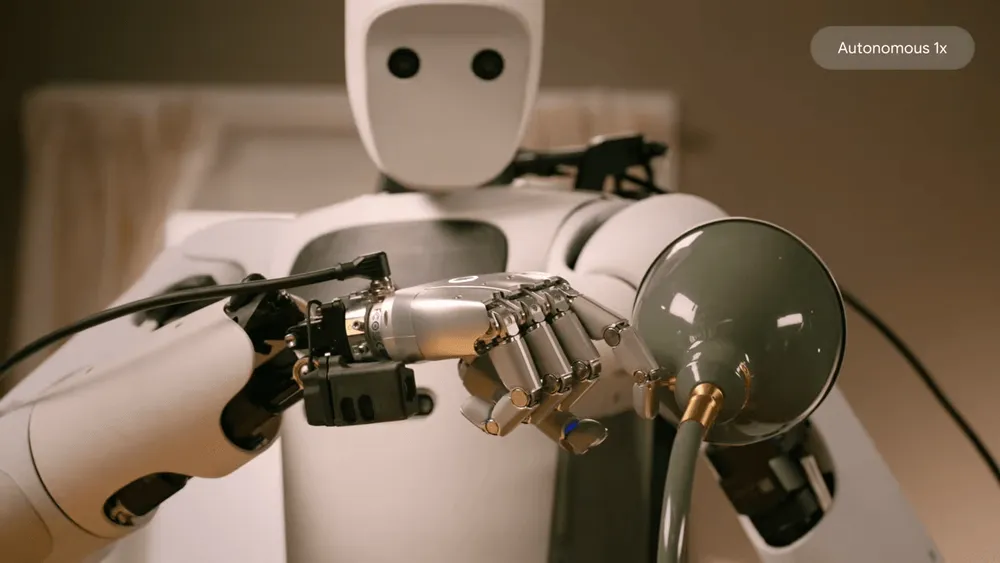
Google DeepMind has announced "Gemini Robotics 2," a model that handles humanoids from toe to fingertip. Whereas the previous generation mainly performed tabletop tasks with the upper body, the new model controls a whole sequence of movements—walking toward an object, crouching, and reaching while balancing. That said, what developers can use right away is Gemini Robotics ER 2, which handles planning and monitoring; the VLA that directly drives the physical robot is in private preview. The significance of this announcement lies not in completing an "all-purpose robot brain," but in dividing labor between reasoning and motion, layering low-level control and functional safety on top of that, and taking a step toward whole-body work.
The Reasoning Model and Two VLAs, Each with Its Own Role
The Gemini Robotics 2 series consists of three products with distinct roles. In the cloud-based configuration, ER 2, which handles high-level planning, reads video and audio and passes instructions to the VLA that generates motion. On-Device 2 is not a third layer in this stack; rather, it is a local VLA that takes over motion generation on-site when connectivity is unavailable.
| Model | Role | Availability |
|---|---|---|
| Gemini Robotics 2 | A VLA that converts images and instructions into motor commands. Controls everything from dual-arm machines to whole-body humanoids | Private preview, early access by application |
| Gemini Robotics ER 2 | Plans based on video, audio, and instructions, and calls VLAs or navigation APIs | Public preview via Gemini API and Google AI Studio |
| Gemini Robotics On-Device 2 | Processes images, instructions, and joint states, outputting motion on-device | Trusted Tester only |
This division of labor also existed in generation 1.5, where ER decides "what to do" and the VLA handles "how to move." What's changed in generation 2 is that ER now tracks task progress from continuous video, and the VLA's scope has expanded from tabletop dual-arm manipulation to the whole body. Motion transfer—repurposing motion data from different robot bodies—has also been carried forward.
However, this does not mean whole-body control has been fully achieved even up through On-Device 2. Google's model card states that the primary evaluation target is standing dual-arm manipulation, and notes limitations in tasks outside the training distribution and in controlling high-degree-of-freedom robots. The claim that a new dual-arm machine can be adapted to within a few hours, typically with fewer than 200 examples, is also a result from the Trusted Tester stage.
From Toe to Fingertip: What 32–92% Success Rates Tell Us About the Current State
Apptronik's Apollo 2 was used to demonstrate whole-body control. When instructed to "put the watering can in the green box on the bottom shelf," the robot walked to a table, picked up the object, moved to a shelf, and placed it while crouching. What Gemini Robotics 1.5 had shown as tabletop manipulation using Apollo's upper body now includes locomotion and posture control.
Hand movements have also grown more complex. Using the 5-finger, 22-degree-of-freedom SharpaWave hand attached to Apollo 2, the system tried actions such as turning a light bulb, tying a bag closed, and zipping a ziplock bag shut. With Franka Duo, using a standard 2-finger gripper as-is, it performed tasks like assembling a tool kit and precision insertion. The aim is for a single model lineage to handle differing numbers of joints and gripping mechanisms across different robot bodies.
The published per-task performance figures offer a sober way to measure achievement. Apollo 2's whole-body manipulation achieved 68.4% for picking up from a table, 45.7% for picking up from the floor, and 76.3% for picking up from a shelf. The five tasks using the SharpaWave hand ranged from 32% to 92%—removing a light bulb scored 92%, while handling a dustpan scored only 32%. Meanwhile, Franka Duo's 2-finger gripper scored 74.2–89.6% across tasks ranging from moving objects to precision insertion.
Google describes this on its product page as "human-level dexterity." However, these are accuracy figures measured for specific robot bodies and specific tasks—not success rates across the full range of household or factory work. What's new is that both whole-body movement and multi-fingered hands now fall within the scope of a single VLA; it has not been confirmed that the system can work as stably as a human across the board.
Supervising Long Tasks with 57.4% Progress Recognition
Built on Gemini 3.5 Flash, ER 2 judges "what to do next" rather than motion itself. It divides each frame of continuous video into five stages, from 0–20% to 80–100%, tracking how far a task has progressed. The accuracy of this progress classification is 57.4%, up 14.7 points from ER 1.6's 42.7%. If it detects a failure, it redoes the same step, and upon catching the moment of completion, it can move on to the next instruction.
In an evaluation of finding key moments within video, it scored 91.3%, with a mean absolute distance from the correct timestamp of 0.96 seconds. Furthermore, in an evaluation where ER 2 directs a physical-robot VLA, the success rate reached 60.0%, exceeding ER 1.6's 48.6%. Google describes the long tasks it targets as lasting several minutes and involving hundreds of decisions. This supervisory role prepares the next step while the VLA is in motion.
ER 2 also coordinates collaboration between multiple robots. In a public demo, Apollo 2 and a Franka F3 Duo split roles between each other, taking over a single task that would be difficult to complete alone. However, what has been shown so far is a combination of just two specific robot models—not proven interoperability across a general heterogeneous fleet.
Developers can choose between the standard gemini-robotics-er-2-preview and gemini-robotics-er-2-streaming-preview for the Gemini Live API. The latter streams video and audio bidirectionally, with low-latency function calling. ER 1.6 is scheduled for shutdown at the end of August 2026, requiring a model name migration. Paid tier pricing for both the standard and streaming versions is $2 per million input tokens and $10 per million output tokens.
High-Level Stop Decisions and Functional Safety Are Different Things
Safety evaluation figures have improved significantly. In a test judging whether a person is within 1 meter based on a static stereo image, ER 2 achieved 93.0% accuracy with a mean absolute distance error of 0.36 meters. ER 1.6 scored 51.1% and 1.40 meters, respectively. In an experiment inside a garage using Apollo 2, person detection reached 99% and transition to a safe posture reached 96%.
Even so, a generative model cannot itself serve as a safety device. According to DeepMind's safety report, under conditions where the false-stop rate was kept below 5%, the rate of missing a nearby person exceeded 40%. When the miss rate was lowered to roughly 10–15%, unnecessary stops increased to 15–25%. Among the models evaluated, none managed to suppress both misses and false stops to near zero simultaneously.
What the safety report measured was a semantic judgment—whether the high-level model understands danger and can call a stop tool. Functional safety, which includes certified hardware, redundancy, and real-time guarantees, was outside the scope of evaluation. ER 2's model card also asks that it not be used in domains like medicine or transportation where failure could lead to death, injury, or property damage. It states that careful judgment is also needed before deployment in general commercial or public environments.
Because the system continuously ingests video and audio, field deployment also requires privacy design. The Gemini API developer documentation asks that, when identifiable people are nearby, developers notify them in advance and obtain consent, since video and voice may be provided to Google. Data minimization measures such as blurring faces or narrowing the capture range are also the developer's responsibility. The more a robot works in shared spaces with people, the more deployment conditions arise beyond mere recognition performance.
What Gemini Robotics 2 demonstrates is a shift from an era where robot AI competed purely on arm dexterity to one where it begins supervising whole-body movement over extended periods. The next benchmark won't be about flashy demos, but about how consistently per-task success rates hold up among early access partners, and whether task speed can be maintained even when deterministic low-level control is combined with certified safety mechanisms.