


On October 7, 2026, Google launched Playground, an experimental platform that lets users create games with nothing more than text instructions, then play and share them in a browser. It is available to users in the US aged 18 and over.
Google also announced a partnership with Unity and said it plans to combine Playground with Unity Spark, a more full-fledged game-creation environment.
Tools for prototyping games with AI already existed, but Playground brings creation, playtesting, publishing, and connecting with other players together in a single service.
With Unity on board, the key question is how far the ease of making a working game from text can be carried over into more serious production that polishes every detail.
Build through conversation, and refine by actually playing
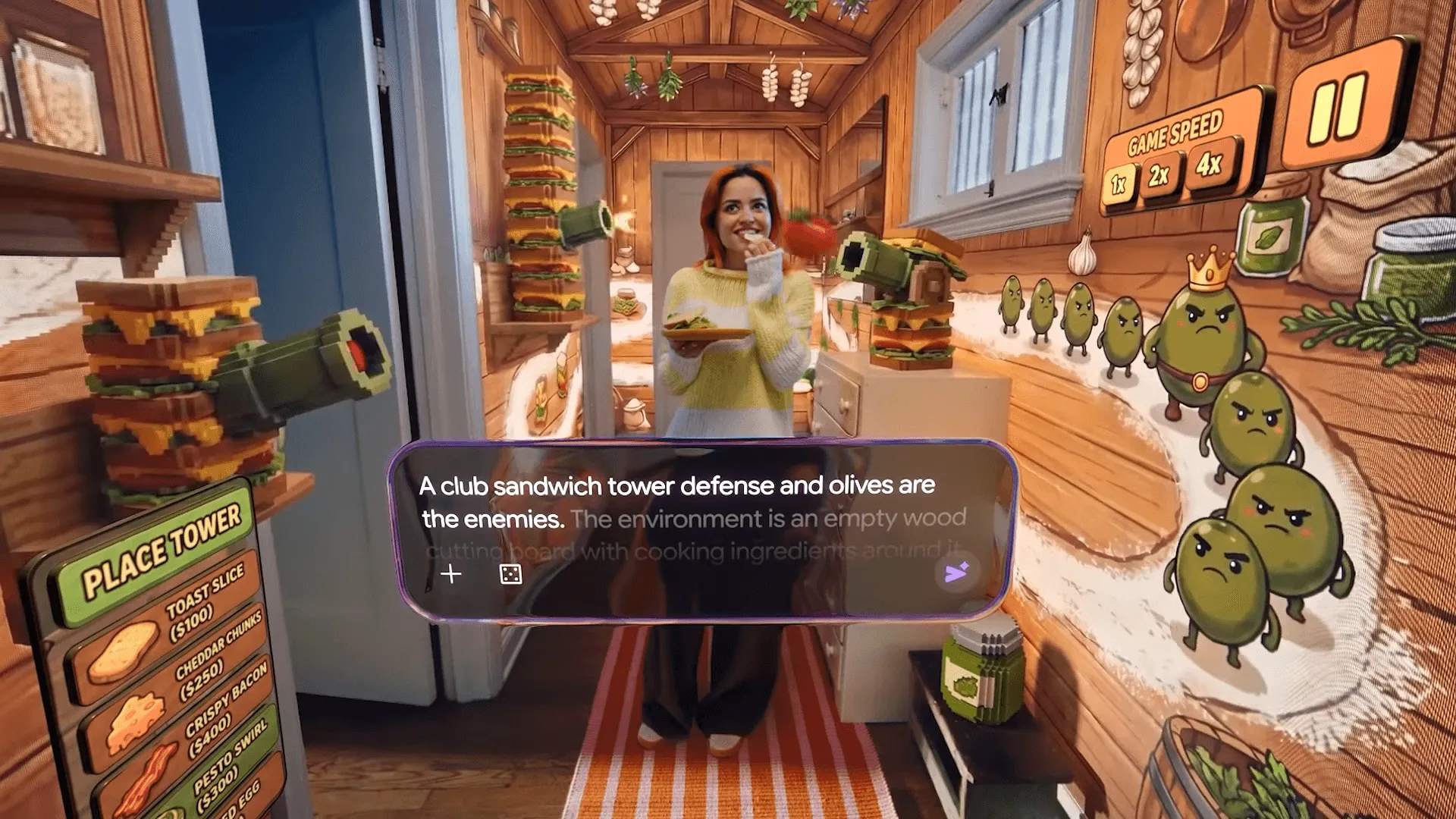
In Playground, users can start from a blank slate by typing a game idea in text, modify a ready-made prompt template, or follow a guide to turn a concept into a game.
According to Google, users can change physics and game rules through conversation, and can also redo characters and backgrounds.
Because a modified game can be tried immediately, the intended workflow is not to instruct the AI and wait for a finished product, but to keep revising while actually playing.
For example, you play the game yourself to judge whether a character moves as intended, or how the difficulty changes after a rule change.
Based on that, you give the next instruction and gradually bring the game to completion.
Even if the burden of learning to code is reduced, the role of deciding what kind of play you want to create and what to change to make it fun remains with the creator.
Finished works can be saved privately or shared with friends and family via a share link.
Creators who want a wider audience can list their games in the "Playground Explore" gallery. Games run in the browser, and Google says they can be played on both smartphones and laptops.
With a Google Play Games profile, users can also "like" games they enjoy and follow their creators.
However, in-game leaderboards and multiplayer are supported only for certain genres, so not every generated game will offer competitive or cooperative play.
Access to the game-creation features will also be rolled out in stages depending on the user's Google AI subscription. It is therefore too early to assume this is a service where anyone can iterate without limits.
Unity Spark is an environment for refining generated games further
Unity Spark is positioned as an environment for extending the creation features of the newly launched Playground into more serious game development.
Google and Unity plan to use Unity's runtime to make the mechanisms used in professional games and high-quality 3D visuals available.
A runtime is the underlying software that actually runs rendering, physics simulation, and the many other processes inside a game.
The idea is to pair an easy entry point, starting a game from text, with the full-scale capabilities of a game engine.
Spark, however, is still at the pilot stage.
Google says a private beta will begin soon, and Unity plans to make it available within the year.
The product page includes a waitlist and demo games, but the announcement does not say that every current Playground user can use Spark's creation features.
Descriptions such as "high-quality 3D visuals" and "professional-grade game creation" should also be read as capabilities the companies aim for after integration.
Unity President and CEO Matt Bromberg cited several kinds of people as the reason he conceived Spark: those who have played a particular genre of game for years, graphic artists who cannot write code, and people who have long modded games.
The aim is to give creation tools to people who have a clear idea of how a game should play or look but have been unable to turn it into a working game.
The handling of assets follows the same thinking.
Spark is designed to connect directly to the Unity Asset Store, giving access to thousands of assets made by artists in the community.
Rather than generating every asset automatically with AI, it leaves room to choose human-made assets and combine them into a finished game.
That does not mean all Asset Store assets can be used for free, and the announcement did not clarify the terms of use for individual assets.
What Bromberg emphasizes is not producing a game that resembles an existing one with a single AI prompt, but creating games worth continuing to refine by hand afterward.
He also cites, as hopes, that it could serve as an entry point for aspiring game developers and let working developers test new ideas quickly.
Those benefits, however, have not yet been demonstrated.
From AI prototyping to a service covering creation, publishing, and sharing
On March 6, 2026, Google described how it used Gemini to build a game announcing the I/O event.
The team prototyped many ideas in Google AI Studio, moved to Google Antigravity as the game grew more complex, and ultimately refined it into a publishable work.
The workflow of treating AI output not as a finished product but as a starting point, then having people play and revise repeatedly to raise quality, was already evident at that point.
The case also reveals two different roles for AI in game creation.
In the side-scrolling game, Gemini was used to explore ideas and build prototypes.
In the puzzle game Nonogram, by contrast, AI was used to dynamically generate later boards during play.
Generating code and content while making a game is a different use from generating new content while the finished game is being played.
Playground can be seen as a more accessible packaging of this prototype-and-revise workflow, as an environment where ordinary users can create and publish games.
However, there is no explanation that it uses the same internal systems as the game creation described in March.
Nor should one assume that, just because a game is "made with AI," everything on screen and in its behavior is generated by AI in real time during play.
The clear change for users is that creating, playtesting, revising, and sharing games can now all be done within one service.
The AI game-making race is shifting to how finished works reach players
Meta also announced, on September 24, Horizon Create and Horizon Studio, which let users make games with natural language.
The former is a creation environment for smartphones, the latter for browsers.
Meta explains that in Studio, in addition to natural-language instructions, users can place objects directly in a scene, swap assets, and adjust script parameters.
The design lets users make broad changes with words and finish the details through visual editing.
What Google and Meta share is an effort to combine natural-language game creation with an editing environment and a destination for distributing finished works.
However, Google's Unity Spark is still in testing, and Meta's new tools are also being offered through staged early access.
| Item compared | Google Playground and Unity Spark | Meta Horizon Create / Studio |
|---|---|---|
| Entry point | Create through conversation or templates in Playground and playtest on the spot | Create with natural language: Create on smartphones, Studio in the browser |
| Editing and assets | Changes made by conversation in Playground. Spark plans to combine Unity's runtime with Asset Store assets | Studio adds scene placement, asset swapping, and parameter adjustment to conversation |
| Publishing and discovery | Share links and the Explore gallery. Google also plans to showcase standout works through its service network | Published works can be distributed on Facebook, Instagram, and Horizon |
| Availability stage | Playground is open to US users aged 18+. Spark is in testing, due within the year | Staged early-access rollout |
The table organizes the announced details as of October 8, 2026, under the same headings: creation, editing, distribution, and availability stage.
On the Google side, the currently available Playground and the upcoming Unity Spark are listed separately.
It is not a comparison of work quality or production speed, and it does not mean that publishing on either service guarantees many people will play a game.
What this comparison shows is that both companies are building, at the same time, a mechanism to increase the number of game creators and a mechanism to deliver finished works to players.
Meta points to a route that leads people from existing social feeds to games, while Google sets out a policy of using the Playground gallery and its own services.
Even if AI makes games easy to create, it is hard to stay motivated to keep creating if no one discovers the finished work.
The competition over AI game creation is becoming one that includes not only whether games can be generated, but also the systems for publishing works and having players discover them.
As more games can be made, finding the good ones matters more
The Playground gallery features works based on player ratings and actual play activity.
Google says it conducts safety reviews of all published games in line with community guidelines, and also accepts reports from users.
Beyond providing an easy way to make games, how to maintain an environment where players can choose what to play from a large number of works is part of the service design.
The publishing rules permit using common mechanics found in existing games and widely shared genres such as kart racing.
At the same time, creators are required to make clear that a work is independent and to avoid labeling that could mislead people into thinking it has official permission or sponsorship.
Titles or appearances that could be confused with existing works, low-value auto-generated content, and repeated posting of similar works are also prohibited.
Even when creation itself becomes easy, rules remain on how works are presented and how they behave after publication.
However, passing a safety review, being fun as a game, and having no rights issues with the assets used are separate matters.
How much recommendations based on player ratings and play activity will help people find works that creators spent time refining will only become clear from how the service is run.
If the barrier to making games drops sharply and large numbers of similar works are published, the mechanism that decides what is shown to players could shape the user experience as much as the creation tools themselves.
The current announcements do not specify details such as revenue sharing for creators, exporting games outside the platform, or how to move creations into the standard Unity Editor.
No timing has been given for availability in Japan.
Through the Unity Spark beta, it should become clear how finely generated games can be edited. If the systems for delivering works to players after publication, and the conditions that let creators keep making games, are also put in place, the platform could grow into a place where people who used to only play games continually create and nurture their own works.