

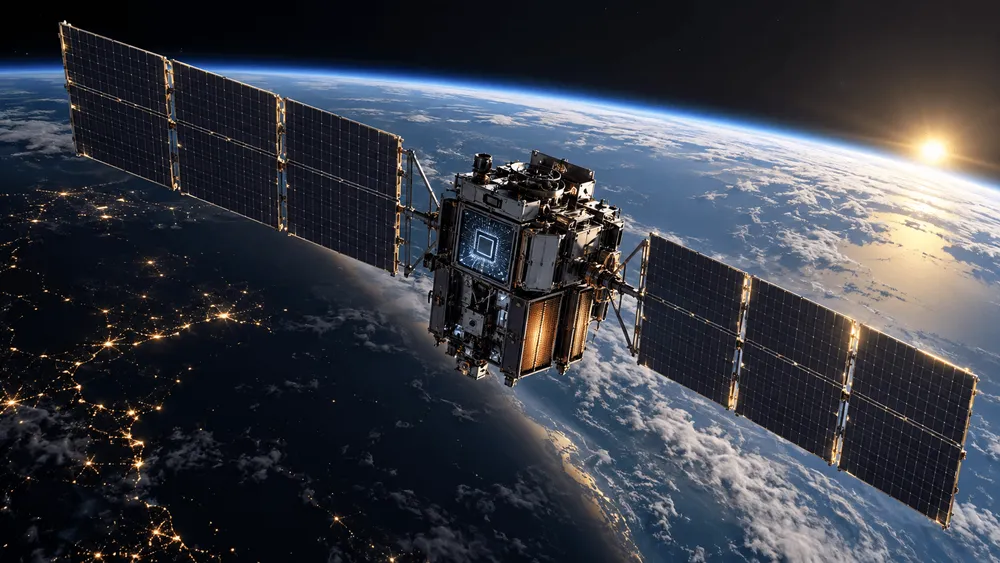
Google is launching its first in-orbit demonstration satellite for Project Suncatcher, a research initiative exploring space-based data centers as a long-term solution to the growing power and cooling demands driven by the spread of AI.
Travis Beals, Senior Director leading Paradigms of Intelligence at Google Research, revealed the plan in an official blog post on September 24, 2026. A prototype satellite co-developed with Planet Labs (Planet), a company with extensive experience operating satellite constellations, will be placed into orbit next week aboard SpaceX's "Transporter-18" rideshare mission.
The goal of this mission is to verify whether Google's proprietary AI accelerator, the TPU (Tensor Processing Unit), can operate normally in the space environment. The space data center concept, which has so far relied primarily on theoretical calculations, ground-based accelerator testing, and thermal vacuum testing, is now moving into a phase of validating hardware in actual orbit.
A Dawn-Dusk Orbit for More Solar Energy Than on Earth
As generative AI models grow larger, the computational demands of training and inference are rapidly increasing. The ground-based data centers supporting this growth are increasingly constrained by power grid capacity, land availability, cooling infrastructure, and water consumption.
On the ground, Google is also pursuing new power sources, including geothermal energy with Fervo Energy and small modular reactors with Kairos Power. Solar power, meanwhile, faces terrestrial-specific constraints such as nighttime, weather, and atmospheric attenuation.
Project Suncatcher focuses on the solar energy available outside the atmosphere.
The concept envisions using a "dawn-dusk" sun-synchronous orbit (SSO) at an altitude of roughly 650km. In this type of orbit, the satellite's orbital plane tracks near the boundary between Earth's day and night sides, allowing it to receive continuous sunlight for extended periods.
According to Google's calculations, a dawn-dusk sun-synchronous orbit at approximately 650km altitude experiences minimal atmospheric attenuation and is largely unaffected by the day-night cycle on the ground, potentially enabling access to up to eight times more solar energy per unit area compared to ground-based solar power installations.
With extended sunlight exposure, dependence on the large-scale battery storage systems that ground-based solar installations need to cover nighttime hours could be reduced. Smaller onboard batteries could also help keep launch mass and costs down.
Can TPUs Survive Launch Vibration and Space Radiation?
Space, however, is a harsh environment for semiconductors.
The first hurdle is the acceleration and vibration experienced during rocket launch. As a satellite ascends to low Earth orbit, the spacecraft experiences significant acceleration, and onboard electronic components are subjected to intense shock and vibration over short periods.
Google's engineering team conducted ground tests that replicated expected launch vibrations, shaking the satellite along three axes. The purpose was to confirm whether hardware, including the TPUs, could withstand the mechanical loads of launch.
Space radiation poses another major challenge.
When high-energy particles originating from solar activity or galactic cosmic rays strike semiconductors, they can cause Single Event Upsets (SEUs), where memory values flip, or Total Ionizing Dose (TID) effects, where device characteristics degrade after prolonged radiation exposure.
Google used a proton accelerator at the Crocker Nuclear Laboratory at UC Davis to run AI workloads on its sixth-generation TPU, Trillium (Cloud TPU v6e), while exposing it to a 67MeV proton beam.
The results showed that even systems including High Bandwidth Memory (HBM), which is particularly sensitive to radiation, continued computing without errors or malfunctions up to a cumulative dose of 2 krad(Si).
For the low Earth orbit satellites Google envisions, appropriate shielding is estimated to limit cumulative radiation exposure over a five-year mission to approximately 750 rad(Si). This means the ground test demonstrated normal operation even under radiation exceeding that projected exposure.
Furthermore, no unrecoverable permanent failures were observed even after continued irradiation up to a cumulative dose of 15 krad(Si).
However, these are results from ground-based accelerator testing. In actual orbit, multiple factors will combine, including the type and angle of incident radiation and long-term temperature fluctuations. This satellite mission will verify whether TPUs can operate stably under those real-world conditions.
How Do You Dissipate Heat From TPUs in Space?
Even if TPUs can survive without damage in space, another major challenge remains: heat dissipation.
Ground-based data centers use fan-driven air cooling and liquid cooling systems to move heat generated by servers away from the equipment.
In the vacuum of space, however, there is almost no air to carry heat away, making the convection-based cooling used on the ground impossible.
Inside the satellite, heat must be transferred away from the TPUs using thermal conduction and heat pipes, ultimately radiating it into space as infrared radiation from radiators.
Google is exploring a design that uses highly thermally conductive heat pipes to carry heat generated by the TPUs to the satellite's outer structure, then dissipate it into space via radiators positioned to avoid direct solar heat input.
Up to now, Google has tested cooling performance using ground-based thermal vacuum (TVAC) chambers that simulate space-like conditions.
In this orbital demonstration, a key verification point will be whether this thermal design functions as expected in the actual space environment.
Why Satellites Need to Fly 100-200 Meters Apart
To eventually use large numbers of TPUs in space as a single unified computing platform, inter-satellite communication also poses a major challenge.
Today's large-scale AI models rely on connecting numerous processors through low-latency, high-bandwidth networks, exchanging data frequently during training and inference.
As a means of achieving similar connectivity in space, Google is researching a free-space optical (FSO) communication approach combined with dense wavelength division multiplexing (DWDM) and spatial multiplexing.
In ground-based experiments, a single pair of optical transceivers achieved bidirectional transmission of 1.6Tbps, and unidirectional transmission of 800Gbps.
However, optical communication faces a fundamental challenge: as distance increases, the amount of light received decreases, making it harder to sustain terabit-class high-speed communication.
For this reason, Project Suncatcher is exploring a future concept of gathering 81 satellites within a radius of roughly 1km, maintaining distances of approximately 100 to 200 meters between neighboring satellites.
This is an extremely close distance compared to typical satellite constellations.
Maintaining spacing of roughly 100 to 200 meters between multiple satellites while orbiting at high speed at an altitude of approximately 650km requires highly precise orbital control.
Earth's gravitational field is not perfectly spherically symmetric, and even at 650km altitude there is slight atmospheric drag. Such perturbations gradually alter the relative positions of satellites, causing formations to drift apart if left unmanaged.
Google's research team built a differentiable physics model in JAX, starting from the Hill-Clohessy-Wiltshire (HCW) equations that describe relative motion between satellites.
By combining numerical integration of ordinary differential equations (ODEs) with automatic differentiation, the model optimizes the necessary thruster firings while accounting for various perturbations.
The research team's numerical calculations suggest that such close formations could potentially be maintained using minimal propellant.
However, operating 81 satellites at 100-200 meter spacing over an extended period has not yet been demonstrated in actual orbit. This remains one of the key technical challenges Project Suncatcher must still verify.
Would It Work If Launch Costs Fell to $200 per Kilogram?
Even if AI computation in space becomes technically feasible, whether it can ultimately be commercialized depends on economics.
Launch costs have long been a major constraint on space infrastructure. Because transporting even 1kg of equipment into orbit requires substantial expense, there has traditionally been little economic incentive to place ground-buildable facilities in space instead.
A technical paper (arXiv:2511.19468) co-authored by Blaise Agüera y Arcas, Travis Beals, and James Manyika analyzes the declining cost of the launch industry based on Wright's Law.
The paper estimates that if reusable heavy-lift rockets are mass-produced and launch frequency continues to rise, the cost of launching to low Earth orbit (LEO) could fall below $200 per kilogram by the mid-2030s.
According to Google's analysis, if launch costs fall to around $200/kg, the capital costs required for satellite manufacturing, launch, and replacement could approach a level comparable, on a per-unit-of-compute-power basis, to the long-term costs of power and cooling infrastructure required by ground-based data centers.
However, this estimate assumes future declines in launch costs and does not guarantee that $200/kg will actually be achieved in the 2030s.
Moreover, realizing large-scale space data centers will require solving many problems beyond launch costs.
Operating large numbers of satellites in close proximity requires managing collision risks with other satellites and space debris. Systems must also be in place to reliably deorbit satellites and ensure atmospheric reentry after their operational life ends.
Communication links for transmitting computed data from orbit to the ground present another challenge. Handling large volumes of computational results requires securing sufficient downlink bandwidth to Earth.
When using optical communication, weather conditions such as cloud cover become a factor, necessitating countermeasures such as deploying ground stations across multiple regions.
One Satellite First, Then Inter-Satellite Communication
The prototype launching next week aboard Transporter-18 will not immediately create a massive space data center.
What this mission will confirm is whether the TPU onboard a single satellite can operate stably under conditions including launch vibration, space radiation, vacuum exposure, and temperature fluctuations.
Google and Planet plan to incorporate the measured data from this satellite into their next design phase, with plans to launch two satellites in early 2027 to test high-speed laser communication in orbit.
Beyond that lies the broader vision: linking satellites carrying numerous AI accelerators over short distances to operate as a single large-scale computing platform.
The idea of building data centers in space remains far from practical realization. But with this launch, Project Suncatcher moves beyond desk-based design and ground testing into a phase of verifying feasibility in the actual space environment.