

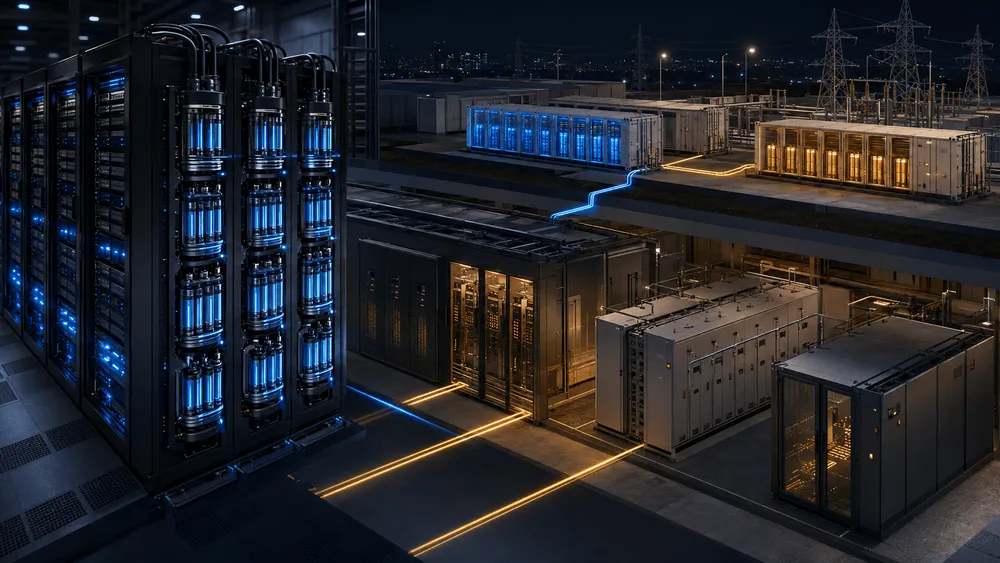
Chinese battery maker Highstar (Jiangsu Highstar Battery Manufacturing) announced a lineup of battery cells for AI data centers (AIDCs) on July 27, 2026. The lineup covers three layers: in-rack BBUs within server racks, facility-side UPS/high-voltage direct current (HVDC) systems, and energy storage equipment at grid connection points. Across all three layers, the company differentiates between lithium-ion and sodium-ion chemistries, as well as cylindrical and prismatic form factors, to address power fluctuations of varying speed and duration. The "full-chain" terminology here does not refer to a completed integrated power system, but rather to a product matrix that places cells throughout the entire power delivery pathway.
Assigning Cells to Three Power Layers
Highstar's structure divides the data center into what it calls the "white zone," "gray zone," and "grid side." The white zone is the IT space housing servers and networking equipment, where in-rack BBUs respond from the position closest to power interruptions and sudden changes. The gray zone contains power equipment such as UPS and HVDC systems, supporting multiple racks. Grid-side energy storage equipment acts as a buffer to prevent large facility-wide load fluctuations from propagating directly upstream.
| Power Layer | Key Equipment | Cells Assigned by Highstar | Intended Role |
|---|---|---|---|
| White Zone | In-rack BBU | 18650/21700 full-tab cylindrical cells, LFP or high-nickel NMC | Instantaneous high current, low internal resistance, suppressing temperature rise |
| Gray Zone | UPS/HVDC | 85Ah LFP, 50Ah sodium-ion | High-rate pulses, short-duration power supply during outages, wide temperature range |
| Grid Side | Large-scale energy storage | 314Ah lithium-ion, 160Ah sodium-ion | Smoothing fluctuations lasting seconds to minutes, long-life storage |
Even under the common label of "backup battery," the jobs are not identical. Right next to the rack, response speed and heat generation matter more than capacity. On the facility side, high output must be sustained until switching to a generator or alternate power line occurs, while on the grid side, greater energy quantity and charge-discharge lifespan become more important. Rather than asking a single chemistry to shoulder every role, Highstar swaps cells layer by layer.
At the same time, what the announcement presents is a group of cells, which Highstar positions as a common foundation for joint validation and application-specific development. No integration specifications with UPS units or power conversion equipment were disclosed, and no explanation of BMS control methods was given. This is not an announcement of a system that integrates cooling equipment and energy management software and has been operated in an AIDC. Deployment customers and order volumes were not disclosed, and pricing and operational sites remain unknown.
10C 85Ah LFP and Full-Tab 21700
The flagship product for the gray zone is the prismatic IFP50160118-85Ah LFP cell. According to specifications Highstar presented in May 2026, it supports continuous 10C discharge with instantaneous peaks up to 12C, and is designed for over 60,000 high-frequency pulse charge-discharge cycles. The operating temperature range spans -20°C to 60°C, with millisecond-level switching and six minutes of power supply after an outage cited as key figures. The design targets applications that draw large currents over short periods and hand off power to generators or upstream power sources.
However, the figures of 10C and 60,000 cycles are based on Highstar's exhibition materials. No third-party test report has been published covering cell temperature, depth of discharge, lifespan determination criteria, or the conditions of the paired UPS. A cell's rate performance alone does not guarantee six minutes of system-level availability.
For the 50Ah sodium-ion cell, Highstar claims an operating range from -40°C to 80°C. According to the 2025 annual report of parent company PRET, the 50160118-50Ah cell entered mass production during 2025 and began shipping to customers. The same annual report also notes large-volume shipments of 160Ah sodium-ion cells. However, the disclosed overseas orders exceeding 1GWh for residential, commercial/industrial, and telecom applications, as well as the 30MWh contract with China Southern Power Grid Technology, are not AIDC projects. Mass-production track record and adoption in AI data centers need to be read as separate matters.
For in-rack BBUs, Highstar places full-tab cylindrical cells in the 18650 and 21700 formats. While conventional cylindrical cells position current-collecting tabs at only part of the electrode, the full-tab structure gathers current across the entire electrode end face, shortening the current path. This suppresses internal resistance and Joule heating while making it easier to draw large currents, making it well-suited for BBUs that require instantaneous output within tight rack spaces.
The 21700-50PS, which uses high-nickel NMC, has a capacity of 5.0Ah, with Highstar citing maximum output of 250A and 3C charging. Lifespan is rated at 1,000 cycles, with an operating temperature range of -40°C to 80°C. The company's 2.5GWh cylindrical cell facility in Malaysia came online in March 2026, and Highstar has announced the start of mass production and shipment for full-tab cells. However, it has not disclosed whether current shipments are destined for AIDC-bound BBUs.
Fluctuations of Tens of MW Don't Disappear with Batteries Alone
The power challenges facing AI training infrastructure extend well beyond outage preparedness. In large-scale training, numerous GPUs repeatedly synchronize computation and communication. NVIDIA has explained that rack power consumption can swing from roughly 30% idle load to 100% active load within milliseconds. Joint research by Microsoft, OpenAI, and NVIDIA has reported that fluctuations from synchronized training jobs can reach tens of MW across an entire data center, and potentially hundreds of MW depending on scale.
How power fluctuations are handled depends on the timescale. Under NVIDIA's 800V DC architecture concept, millisecond-to-second fluctuations are absorbed by capacitors and supercapacitors near the rack, while fluctuations spanning seconds to minutes are smoothed by facility-side energy storage systems. The joint research identifies rack-level storage as a promising configuration, while calling for co-design that combines GPU-side power smoothing with mutual communication of battery state-of-charge.
This is where Highstar's three-layer structure overlaps. Full-tab cylindrical cells handle high output near the rack, 85Ah LFP cells support short-duration power for UPS/HVDC, and 314Ah/160Ah cells manage upstream storage. However, Highstar has not announced telemetry for synchronized control across the three layers, nor any protocol linking GPU load with BMS. A broad cell lineup fills necessary component gaps, but suppressing power fluctuations will require joint validation with power equipment manufacturers, system integrators, and data center operators.
The Distance Between Mass-Produced Cells and AIDC Adoption
Highstar does have a mass-production foundation. PRET's annual report states that annual production capacity at the end of 2025 reached 2.83GWh for cylindrical cells and 12.49GWh for prismatic cells, totaling 15.32GWh. Three sodium-ion products, including the 50Ah and 160Ah variants, advanced to mass production and customer supply during 2025. With the Malaysia facility now operational, full-tab cylindrical cells have also moved from the lab to the production stage.
Even so, the July 27 announcement does not demonstrate commercial operation within AIDCs. No model number was given for the 314Ah lithium cell, and it cannot be confirmed whether it is identical to the 314Ah semi-solid-state cell the company separately mass-produces. There is also no test result yet that combines the individual strengths—10C performance of the 85Ah LFP, the wide temperature range of the sodium-ion cells, and the low resistance of the full-tab cells—into a single availability metric spanning from rack to grid.
Highstar's advance lies in breaking down AIDC battery demand not as one massive energy storage block, but into a group of cells tailored to response time and installation location. The value of this as an AIDC product will only be confirmed once the company discloses which customers it has tested each layer with, and how it has synchronized the cell lineup with UPS, BMS, and GPU-side power control.