


The Hong Kong University of Science and Technology (HKUST) announced on November 25, 2026, a new method that uses a polymer to bond the light-absorbing layer and the electron transport layer of perovskite solar cells. The prototype cells reached a peak power conversion efficiency of 27.04%, and a third-party certification recorded 26.67%. In a separate cell configuration used for lifetime testing, 46 of 50 treated cells took more than 1,400 hours of operation for their conversion efficiency to fall to 80% of the initial value. The approach tackles durability, one of the obstacles to commercializing perovskite solar cells, by improving the structure of the interface that governs power generation.
The peer-reviewed paper by Pengfei Guo, Wenjian Yu, Mingwei Hao and colleagues was published online in Nature Photonics on September 29 of the same year (DOI: 10.1038/s41566-026-02007-w). The corresponding author is Yuanyuan Zhou of HKUST.
27.04% efficiency, with a different cell configuration used for lifetime testing
The cells that recorded 27.04% efficiency and the cells used to examine lifetime distributions differ in the composition of the light-absorbing layer and in the hole transport layer material. When perovskite absorbs light, it generates electrons and holes (the vacancies left behind by electrons, which behave as positive charges). Electrons are extracted through the electron transport layer and holes through the hole transport layer. According to Figure 3 of the paper, tin oxide (SnO₂) is used as the electron transport layer in both configurations. The authors call their method, which bonds the light-absorbing layer and the electron transport layer across the interface, TIE (Trans-Interface Engineering).
| Item | Efficiency evaluation (Fig. 3a, b) | Lifetime evaluation (Fig. 3c–f) |
|---|---|---|
| Light-absorbing layer | (FA₀.₉₅Cs₀.₀₅PbI₃)₀.₉₇₅(MAPbBr₃)₀.₀₂₅ | FA₀.₉Cs₀.₁PbI₃ |
| Hole transport layer | spiro-OMeTAD | PTAA |
| Measurement method | Current measured while varying voltage (reverse scan, Fig. 3a) | Continuous operation while adjusting the operating point to maximize output (maximum power point tracking, Fig. 3c, d) |
Comparing the best-performing cells shown in Fig. 3a, the conversion efficiency measured with a reverse voltage scan was 25.95% for the control cell and 27.04% for the TIE cell, an improvement of 1.09 percentage points. The open-circuit voltage (the voltage when the circuit is open under illumination) rose from 1.209 V to 1.220 V, and the short-circuit current density (current per unit area when the circuit is shorted) rose from 25.89 mA/cm² to 26.35 mA/cm².
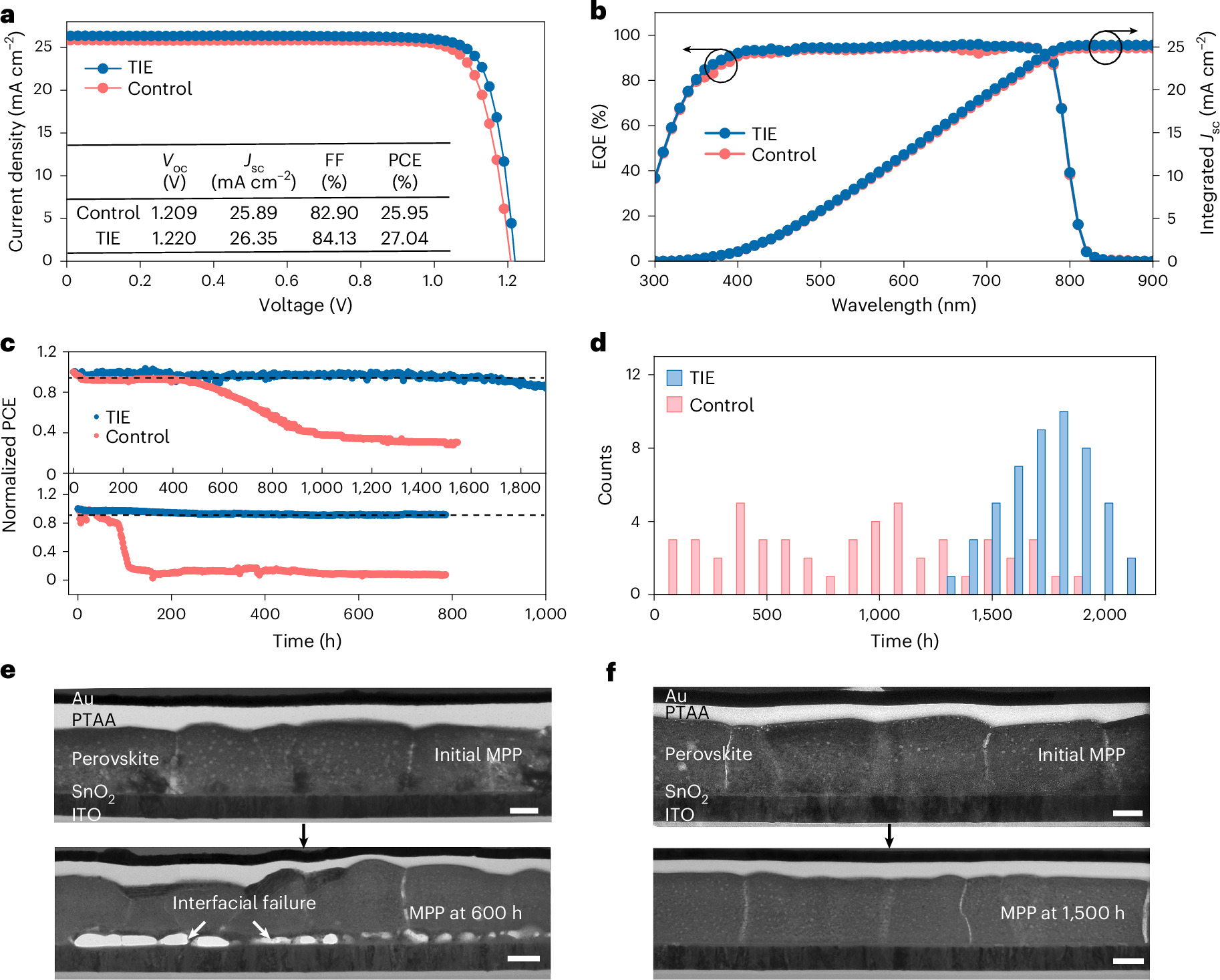
The certified efficiency of 26.67% was measured on a single TIE cell by China's Tianjin Institute of Metrological Supervision and Testing (TIMST). The testing body's report is included in Supplementary Fig. 34 of the paper.
"Stitching" different layers with a polymer raises interfacial fracture toughness about 2.26-fold
The interface between the light-absorbing layer and the electron transport layer is the region electrons pass through on their way to the electrode. According to HKUST's explanation, cracks or delamination at this interface during long operation or temperature changes can accelerate cell degradation. It is important to keep the layers firmly bonded without impeding charge transport.
Conventional approaches have tried to suppress defects and reinforce bonding by inserting a planar interlayer at the interface. In contrast, the research team extended a polymer from the perovskite grain boundaries down to the tin oxide layer, forming a nanoscale bonding structure that penetrates not only the interface but also the interior of the film.
The authors pre-added organic molecules that bond with each other through polymerization to the perovskite side and the tin oxide side. TMTA, added to the perovskite side, has three reactive sites involved in polymerization; AM, added to the tin oxide side, has one. When heating causes azobisisobutyronitrile (AIBN) to generate highly reactive radicals, polymerization begins, forming a covalently bonded polymer network spanning both layers. Zhou describes the method as "like stitching the layers together."
As evidence that the polymer extends from the perovskite grain boundaries to the tin oxide layer, the authors present cross-sectional electron microscope images and elemental maps in Supplementary Figs. 7 and 8. In Supplementary Fig. 10, they analyzed the material remaining after solvent washing using infrared spectroscopy and report confirming components derived from both organic molecules. Supplementary Fig. 2 shows computed electrostatic potential distributions for each molecule.
To evaluate bonding strength between the layers, the authors measured interfacial fracture toughness, an index of the energy required to extend an interfacial crack by a unit area. Calculating the mean and sample standard deviation for each group of 10 samples from the source data for Fig. 2e gives 0.76 ± 0.23 J/m² for the control group, 1.72 ± 0.30 J/m² for the TIE group, and 0.67 ± 0.23 J/m² for a comparison group whose interface was bonded by another method. According to Supplementary Fig. 9, the polymer PTMTA was also added to the perovskite side of the control samples. Comparing mean values, extending a crack by the same area at the TIE interface requires about 2.26 times the energy needed for the control group.
50 cells per group tested for lifetime; 92% of TIE cells ran 1,400 hours or more
In the lifetime tests, cells were operated under continuous illumination at one-sun intensity in a nitrogen atmosphere while tracking the maximum power point. Lifetime was evaluated using T80, the time for conversion efficiency during operation to fall to 80% of its initial value. This allows lifetimes to be compared on the basis of relative performance loss even when the initial efficiencies of individual cells differ. For example, in the individual operating runs shown in Fig. 3c, the initial conversion efficiency was 22.82% for the control cell and 23.73% for the TIE cell.
Fig. 3d aggregates the lifetimes of 50 cells each in the TIE and control groups. Based on the 92% figure given in the paper's abstract, 46 of 50 TIE cells reached a T80 of 1,400 hours or more. Supplementary Figs. 45 and 46 show how each cell's conversion efficiency changed during operation, and the source data for Fig. 3d lists the number of cells in each time bin.
In the control group, some cells reached T80 relatively soon after the start of operation. The time-bin labels in which cells fall ranged from 100–1,900 hours for the control group and 1,300–2,100 hours for the TIE group. In the TIE-treated group, fewer cells degraded early, and the spread in lifetime between cells was also narrower. However, the source data give cell counts per time bin, so determining exactly how many control cells had a T80 of 1,400 hours or more would require the bin boundaries and each cell's individual T80.
Cross-sectional electron microscope images capture mechanical degradation
In the cross-section of a control cell operated for 600 hours at room temperature, damage was observed at the interface between the light-absorbing layer and the electron transport layer. In the TIE cell, by contrast, the bond between the two layers was maintained even after 1,500 hours of operation. These cross-sectional images, shown in Fig. 3e and 3f, were taken after different operating times. The authors also examined whether sample preparation for cross-section observation might have caused the delamination, and confirmed delamination even in regions less affected by processing (Supplementary Fig. 49).
From the interfacial fracture toughness measurements and the electron microscope cross-sections, the authors consider that suppression of mechanical damage by polymer bonding between the layers was the main factor behind the longer operating life. In the lifetime tests, cells with the same configuration were operated under identical conditions to evaluate the difference with and without TIE treatment. However, because TIE treatment may also affect charge transport properties and the state of the materials, there remains room to separately assess how much of the lifetime improvement stems from suppressed mechanical damage versus other factors.
Durability in high-temperature, high-humidity environments and challenges for commercialization
The authors also ran an operating test under continuous one-sun illumination at 85°C, with results for four cells per group shown in Supplementary Fig. 47. Separately, they conducted a damp-heat test at 85°C and 85% relative humidity, comparing untreated, control and TIE groups. They also performed a thermal cycling test between −40°C and 85°C. The error bars in the thermal cycling and damp-heat tests shown in Supplementary Figs. 50 and 51 each represent the standard deviation of five cells.
The operating tests using 50 cells per group are significant not only for demonstrating improved lifetime but also for evaluating cell-to-cell variability among cells fabricated in the same laboratory environment. Meanwhile, the third-party certification covers the conversion efficiency of a single cell, and independent replication by outside research institutions of the lifetime distribution or interfacial bonding strength has not been confirmed in publicly available materials.
For commercialization, a key question is whether 27%-class efficiency and long operating life can be achieved together in the same cell configuration. Beyond long-term operation outdoors, where temperature and humidity vary with the seasons and weather, whether a uniform polymer network can be formed in large-area modules while preserving the interfacial reinforcement effect will be a measure of the technology's practicality.