


The new "Apple Intelligence" announced by Apple at WWDC 2024 skillfully combines models that run locally on Apple devices with models that run on AI servers powered by Apple's own Apple Silicon. This strategic move can be seen as an ambitious attempt by Apple to strengthen its competitiveness in the AI field and fundamentally transform the user experience. So how exactly do these two approaches work together?
AI Built with Apple Products in Mind
Apple describes its foundation models as follows:
"Our models have been created with the purpose of helping users do everyday activities across their Apple products, and are built to ensure the utmost usefulness, and provide a foundation that respects user privacy. We look forward to sharing more information soon on our broader family of generative models, including language, diffusion, and coding models."
At the core of this new AI system called Apple Intelligence are the "Foundation Language Models." These large language models (LLMs) are designed to leverage up to 3 billion parameters to provide general-purpose generative AI capabilities. Specifically, these models—collectively known as the Apple Intelligence Foundation Models—consist of two main models: AFM-on-device and AFM-on-server. AFM-on-device runs directly on the user's device, achieving both immediacy and excellent privacy protection, while AFM-on-server runs on Apple's servers to handle more complex, computationally intensive tasks.
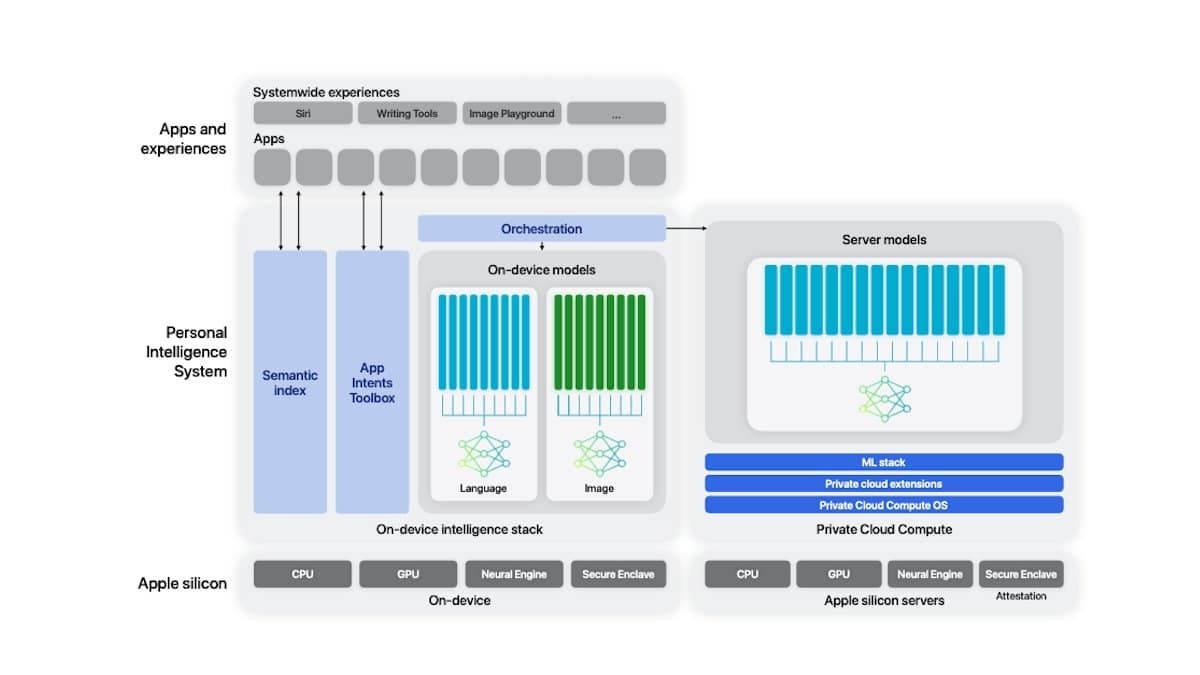
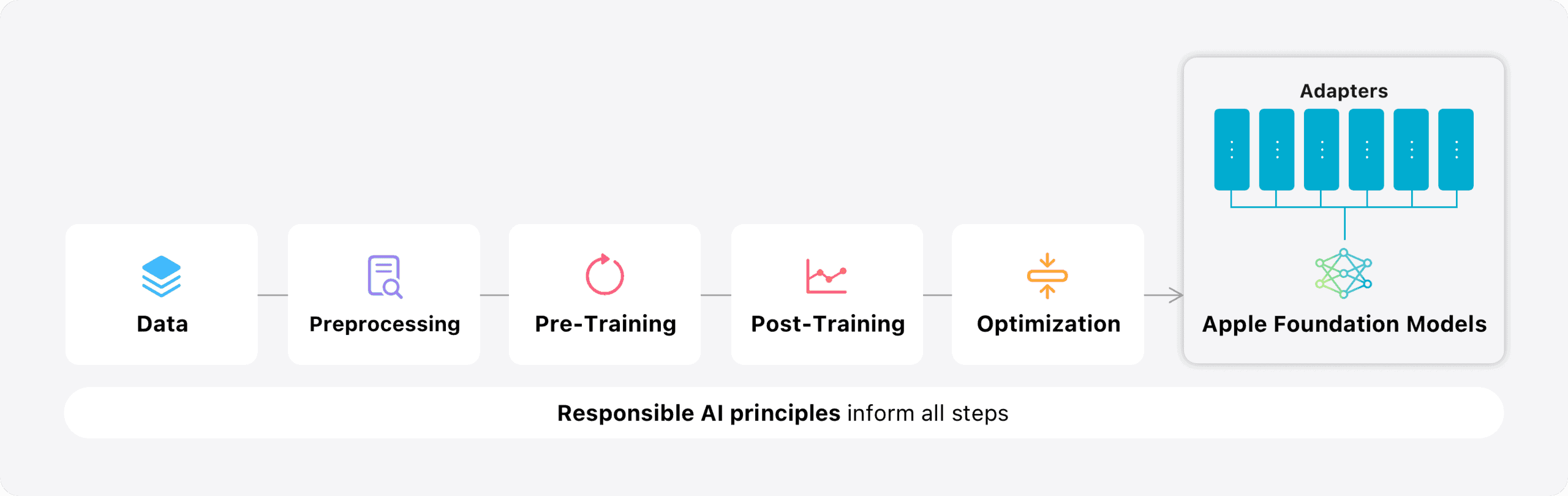
The technical foundation of these models reflects the latest advances in AI research. They employ a Transformer architecture and integrate advanced techniques such as shared input/output embedding matrices, pre-normalization, query-key normalization, grouped-query attention, SwiGLU activation, and RoPE positional embeddings. Furthermore, these models have been fine-tuned with human alignment and feedback, designed to produce more natural and contextually appropriate outputs.
Apple's strategy doesn't stop at on-device models. With the introduction of a remote AI service called Private Cloud Compute (PCC), Apple also provides advanced cloud-based processing capabilities. In addition to the foundation models, PCC can also access additional models for extended intelligence. The primary goals of this service are to improve speed, accuracy, privacy, and site reliability. Notably, PCC uses the same Secure Enclave and Secure Boot technologies found in Apple's consumer devices. This helps prevent tampering with the operating system and data, ensuring a high level of security.
One of the most notable aspects of Apple's AI strategy is its commitment to responsible AI development. Apple has stated a clear purpose in developing its AI models: to help users with their everyday activities. The company adopts responsible practices at every stage of development, designing its AI in accordance with Apple's core values. Apple also places strong emphasis on AI alignment, focusing on designing and implementing AI systems that align with human goals, values, and desired outcomes.
Apple's comprehensive approach could have a major impact on the future of AI. By combining local processing with cloud-based processing, Apple aims to provide users with advanced AI capabilities while balancing performance and privacy. Furthermore, Apple uses an automated web crawler called AppleBot to gather information from the web, and also trains its coding AI using open-source software hosted on GitHub. Through these efforts, Apple's language models are able to acquire a broader knowledge base and handle a diverse range of tasks.
Apple has stated that these foundation models will lead to the development of models across a variety of domains, including language, diffusion, and coding. Going forward, it will be worth watching how these models evolve and what impact they have on Apple's broader ecosystem. As AI technology advances rapidly, along with the ethical and social challenges that come with it, the industry as a whole is watching closely to see how Apple will balance continued innovation with these considerations.
Sources